Showing posts with label memory. Show all posts

Sunday, 22 February 2015

The Miraculous Dog


A boat on the Brahmaputra River.

An old well, Ghoraghat.
It was after evening when we sat in the living room ready for adda, a chat that could foreseeably last half the night. Zaharul Islam, 50, had just arrived in the city from his home in Dinajpur’s Ghoraghat. He found his way to my place from Gabtoli Bus Stand.

It’s ironic we spoke of it then – it was hardly the first topic – because well-after-evening is probably the time of day when people most readily consider those Islamic spirits called jinns. And yet, from Zaharul Bhai I was about to hear that a jinn can also arrive of an afternoon.

Before we go further… Of course I cannot attest to the veracity of what he described. It occurred when he was twelve years old. What I can say is that he was entirely serious in the telling.

It happened on a day in Falgun or Choitro month – the season of spring. The sun was hot enough for his uncle, with whom the young Zaharul was to travel to his maternal grandmother’s house, to carry an umbrella.

And the late Hafez Abdur Rahman was no ordinary uncle. Blind from birth, he was renowned for being spiritually gifted – he was considered a pir or a dervish. “In Ghoraghat we use the word aulia,” says Zaharul Bhai.

Early morning, Ghoraghat.


From childhood Zaharul’s uncle had been educated by a Maulavi from Noakhali. The parents hoped their blind son could memorise the holy Quran to become a Hafez, which village wisdom says assures one a place in heaven. Zaharul’s uncle studied for seventeen years. He was a good student.

“He didn’t only know the Quran,” says Zaharul, “He knew all the hadiths. Not only did he know the hadiths but he understood their meaning.”

“Planes, volcanoes, science…” says Zaharul, “How big is the world? Without the hadiths, who could understand?”

There are many stories about his uncle. “He could read palms,” says Zaharul, “telling people about a serious disease they’d suffered ten years before. He’d tell their futures, including when they’d die.”

Once, Zaharul’s uncle is said to have arrived home with his wife and after going inside, he told her they’d been robbed. The blind man described what was missing and where it had been placed; and he identified the thieves.

Another day, Zaharul remembers, the large stand of bamboo outside the house was behaving strangely. It was as though a large wind was passing, except there was no wind. Yet the large stalks were bending profusely until with a tap-tap-tap they hit and hit again the tin roof of the house. “The bamboo will be ruined!” said Zaharul’s father.

Ghoraghat, Dinajpur.
His uncle then called out, “Lalu… Kalu… Stop!” Suddenly the bamboo stood straight. There was no more tapping. The air was still. “He often called those names,” says Zaharul, “Nobody knew what they meant. But he said he could control jinns. On that day it seemed his jinns were making mischief.”

“My uncle had many followers. There was a retired major from Dhaka Cantonment – when my uncle died ten years ago the major offered a water buffalo for his chollisha,” says Zaharul, referring to the tradition of a deceased’s family providing food to the poor forty days after their relative’s demise. “The major gave many goats too.”

In the morning of the day when he was twelve, Zaharul set off, leading the blind man towards the house of Zaharul’s maternal grandparents – a house that sat on a shoal across a wide stretch of the Brahmaputra River, some 30 kilometres away in Gaibandha District.

They had reason to go. Zaharul had another uncle there, and that uncle’s wife was having trouble conceiving. She’d had three to four unsuccessful pregnancies and despite previous efforts by the late Hafez Abdur Rahman to help her, nothing worked.

“My aunt was very beautiful,” says Zaharul. “After we arrived, my blind uncle did some treatment.” He performed an exorcism. “Suddenly I heard my aunt shouting, ‘I will go! I will not stay here any longer! I will never come again!’” The jinn inside her, was pleading for mercy.

Zaharul’s uncle was serious. “No! You stayed here for long. You will not go.”

“When the jinn emerged, my uncle caught it and put it into a bottle,” says Zaharul. “I saw that! He buried the bottle. After that my aunt had a son followed by three daughters. One of them lives in Italy.”

Boat on a channel of the Brahmaputra.
By early afternoon it was time to leave, so uncle and nephew made their way back to the riverbank. In the morning it had been no problem but by afternoon the riverbank was deserted. There was not a single boatman waiting to ferry them across. “We could go to Phuphu’s house?” suggested the young Zaharul, knowing his paternal aunt’s house was nearby.

“No,” said his uncle. “We’ll cross the river, you’ll see!”

“After some time,” says Zaharul, “I heard a snorting sound. I saw a large dog come out of the bushes. The dog went to the water’s edge.”

“Did Kaloo come?” asked his uncle. “Don’t you see him?” The dog was in the river. He was very broad in the back and jet black. Only its head and back were above water.

His uncle told Zaharul to climb onto the dog’s back. “You must only look forward,” he told his nephew, “Don’t look around. Focus on the river’s far bank.” After Zaharul climbed aboard his uncle did the same.

“My uncle was speaking without sound,” says Zaharul. “It looked like he was reciting something.”

What happened next was remarkable. “At most,” Zaharul says, “within forty seconds we were on the other side. I hardly knew what happened. I was in ankle-deep water – it was clear, you could see everything – just beside the far bank.” The dog had vanished.

The twelve-year-old was terrified. He ran as fast as he could up the bank.

“Where are you, nephew?” his uncle was calling. “Come here! Come here!” After running some distance Zaharul stopped, and returned to his uncle. How else would the blind man find his way home? “Now, don’t tell your grandparents,” the late Hafez Abdur Rahman said.


This article published in Star Magazine, here: The Miraculous Dog


At the bank of a sand shoal in the Brahmaputra River.

Friday, 4 April 2014

A River to Get Lost In


Sunset on the Chitra.

The ceiling is sagging. In thatch, painted silver, it’s a ceiling of ripples and waves. There are holes in it, possibly gnawed into the design by an artisan mouse, possibly the one I disturbed earlier as it ran up the electric cord beside the bed. I’m on haunches, typing, trying to understand how to write a river. I wonder how to find myself in it – contemplating the Chitra.


Water hyacinth in the Chitra.

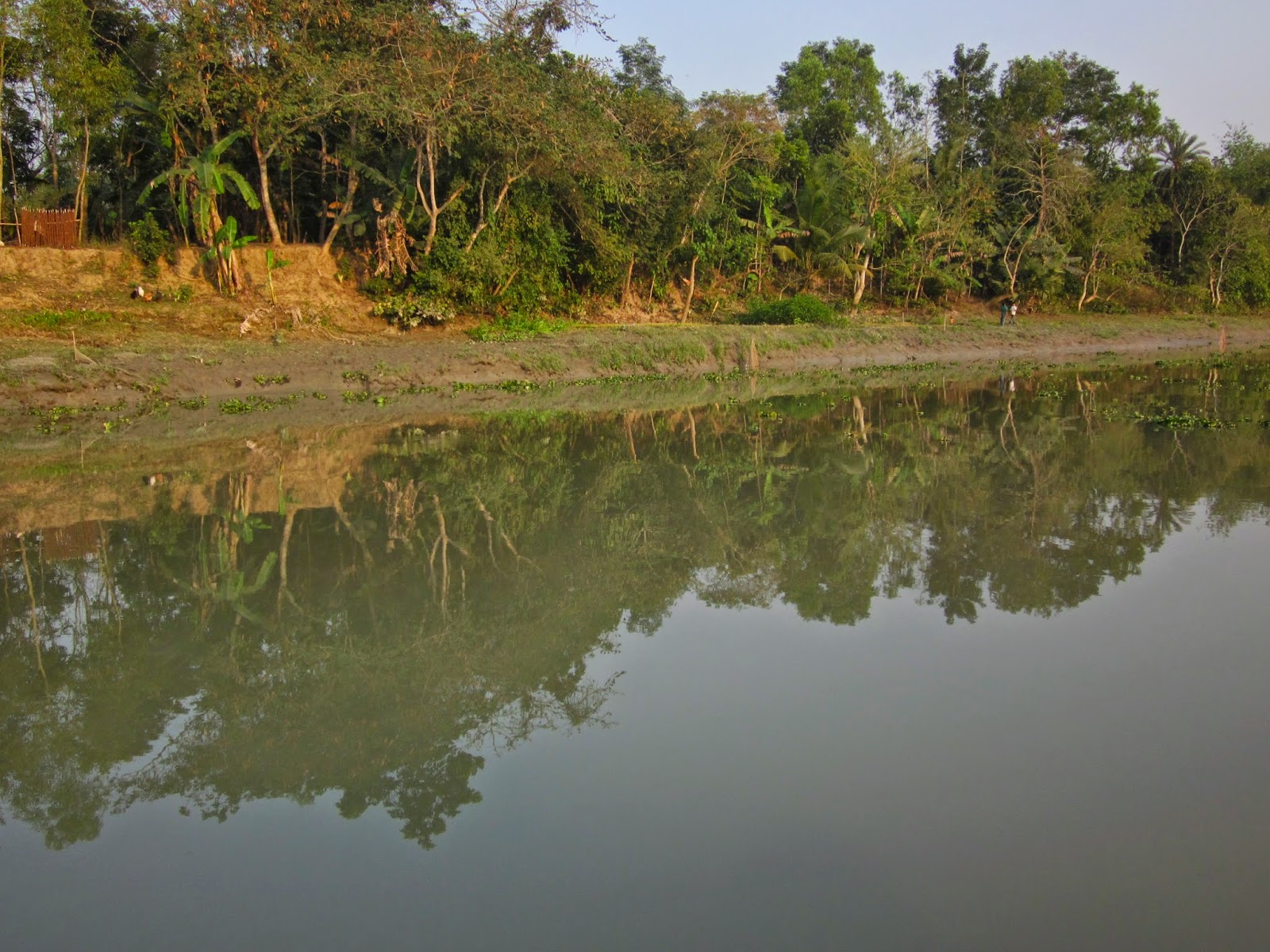
On the afternoon I spent with her, she’d painted trees in the water in grey silhouette. There were long and longer canopies of various species, and the high and higher palm crowns among them had their randomness replicated in the reflection, frond by frond. Despite the undeniable beauty of the water forest it looked an awkward arrangement. It was as a poorly planned team photograph with tall and short players posing wherever they wished.

The Chitra River, Narail.


Was the Chitra drawn to the lack of symmetry to be found in reflected trees and, equally, in human lives? Patterns of neat squares and lines – they are not more than a foolhardy attempt to order ourselves as we might like to think we are. In the Chitra was the randomness in the template of humanity in actuality.

As once I moved about the nouka boat taking photographs of every aspect of that river I now move about the room driven by thoughts and words: sitting spread out on the polished concrete floor and typing, then standing, then pausing to consider where that mouse went. It was brown and looked clean. But it’s not without cause that I’m thinking to find myself in the Chitra. It’s what the people of Narail have done.


The Chitra: river of culture and identity.

It’s a river that’s been written about, admired and longed for. The Chitra is culture. The Chitra is identity. Merely to speak Chitra’s name is to invoke nostalgia in Narail, to see arise in the local listener that warm, quiet feeling of belonging. Among the myriad influences that make the human, for Narailis the Chitra is one. It doesn’t take long for them to mention her.
 
Chitra scenery.
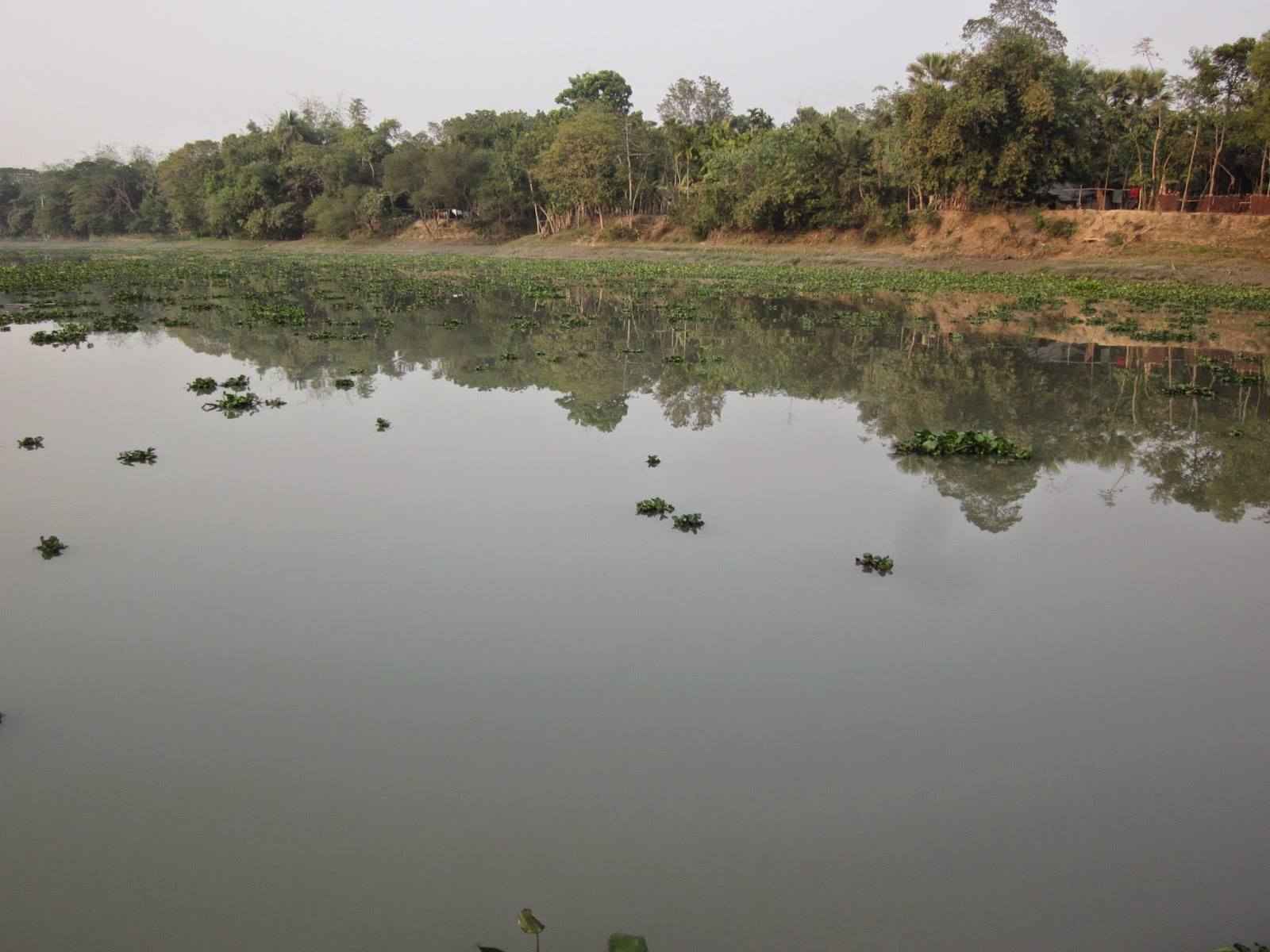
Chitra reflections.
East bank of the Chitra


“The Chitra is polluted now,” said the advocate, “but ten years back it was a pristine river. The water was colourful and pure. I love Narail – it is in my heart and I can’t imagine living anywhere else. The Chitra is important.”

“Chitra water is clean and tasty,” it is written in S.M. Royis Uddin Ahmed’s 2009 book, Laraku Narail. “It was famous across the country.... The Chitra’s banks were like paintings and people’s houses looked like features in a great work of art.” True: on that afternoon the east bank was glowing. The sun was bold, boasting in painting it that way. It was a Baul song, spiritual and uplifting.

Meanwhile a monitor lizard on Chitra’s bank up and scuffled away into the bushes, not wishing to be observed. The bright and the hidden: parts of the river and the human. It can’t be hard for Narailis to find themselves when contradiction is there.

Monitor lizard on the bank of the Chitra.

Md. Litu Sheikh.
Yet for Md. Litu Sheikh the Chitra is a practical affair: he’s spent ten of his twenty-eight years ferrying passengers the short distance into Roopganj Bazar and home again. They arrive at the eastern bank with empty artificial-hessian sacks and carry bags. They return from the western bank burdened with groceries: rice grain, vegetables, clothes, eggs, books. They stand as a floating crowd, with one or two finding a sitting place; some hold umbrellas to protect from the sun – all are as mannequins on a street parade float. The stationary crowd moves smoothly eastwards at the pace of Sheikh’s oar.

From the Chitra’s waters comes the ferryman’s modest income that supports his son and daughter but despite the day to day nature of his river-relation he will admit to the river’s beauty. The Chitra is the human is Narail – at many levels.

The water of the Chitra was once renowned for its purity.
But on that afternoon Sheikh’s nouka wandered up and down instead – with a group of local journalists I journeyed there. They had taken the opportunity to retire from the usual chatting and strategising spot under the bokul tree. They were joking and discussing matters of journalist interest. Video and still cameras were busy for no real purpose, other than to keep their stock images ready in case a Chitra-related story came along – illegal dredging or land-filling or pollution.

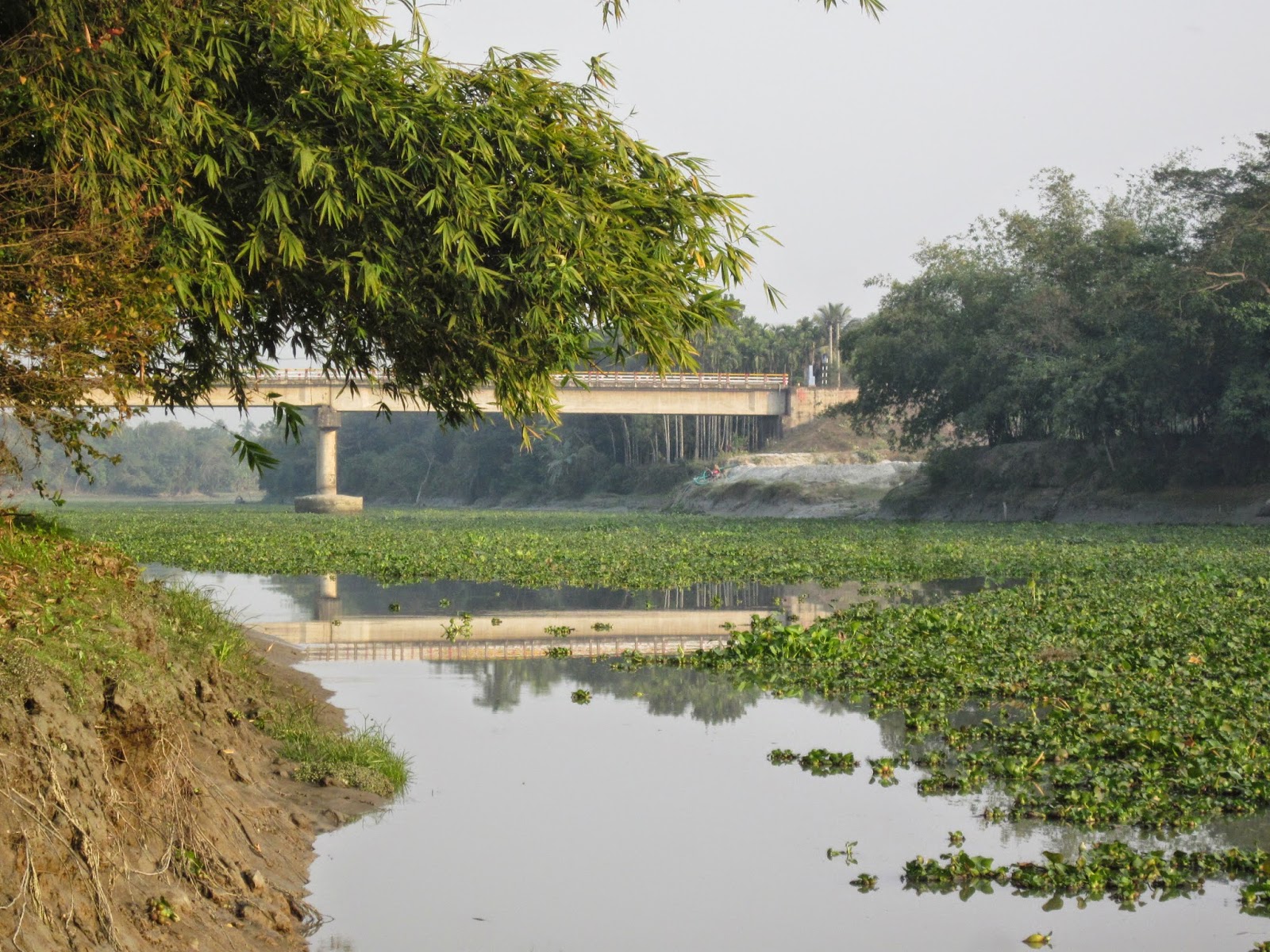
We saw people gathered at the stately ghat which the zamindar landlords built many years ago, some socialising, others pondering and casting thoughts into the water like skimming stones. We saw the bridge in the south that not everyone chooses to use: it’s as easy to take Sheikh’s ferry and join a bus service originating on the eastern side. Many Narailis must seek to keep a little more Chitra in their lives.

Boat on the Chitra.
In the kochuripana, the water hyacinth, the path of the mainstream was clear. As a great Serengeti herd it moved in unison. There’s the human in that too I suppose. And for the few who choose to do things differently, they can as easily detect the current to move against.

Taro plants meanwhile grew in rows along the shoreline in places, planted by some innovative thinker. They were orderly and out of place of course. They might represent mankind’s interference with the natural world, a kind of deterioration brought about by the need for sustenance.

But it being Narail, taro rows might better be described as symbols of the strength from the earth, the gift of God in providing nourishment. That’s how the town’s premiere artist S.M. Sultan would have described it. He held affection for farmers.

Bridge to the south of Roopganj Bazar.

And it was along Chitra’s banks that the man, affectionately known as Lal Miah, often walked. On the west bank before the bridge is his boat in yellow and sky blue, displayed for the Chitra’s viewing, under an awning, outside the museum.

And on the Chitra children still get about by arranged boat on special days, in mimicry of one of Sultan’s endeavours. He wanted them to experience the intersection between nature, art and the human. He wanted they should be inspired and find their better selves.

Let's take a nouka out on the Chitra.

Given the indivisibility of Chitra and Narail it’s initially surprising to notice that the huddle of buildings that is Roopganj Bazar follow the curious Bangladeshi tradition of facing away from the river. Yet in Chitra’s case perhaps there’s an element of shame in it. The buildings must recognise their preference for bustle more than beauty. Facing the past renown of the clear water Chitra – it’s understandable if they don’t feel up to it.

Ferry passengers on the Chitra.
As the sunset painted a finale, a bright orange streak across the water; and the nouka turned at last for the Roopganj ghat, the Chitra contemplation was almost done.

And yet, for a river of a town-and-district identity, a river in which one may seek to find oneself, the Chitra’s realm is as easy to get lost in. Anyway, perhaps it’s rather simpler to find the human in the moving about in a room with a mouse somewhere and a sagging ceiling overhead, typing into a laptop.


Md. Litu Sheikh has been a boatman for ten years.

Sheikh's nouka and the bridge.

The Chitra is Narail.


Water hyacinth and Roopganj Bazar.


This article is published in Star Magazine, here: A River to Get Lost In