Showing posts with label Chitra. Show all posts

Friday, 4 April 2014

A River to Get Lost In


Sunset on the Chitra.

The ceiling is sagging. In thatch, painted silver, it’s a ceiling of ripples and waves. There are holes in it, possibly gnawed into the design by an artisan mouse, possibly the one I disturbed earlier as it ran up the electric cord beside the bed. I’m on haunches, typing, trying to understand how to write a river. I wonder how to find myself in it – contemplating the Chitra.


Water hyacinth in the Chitra.

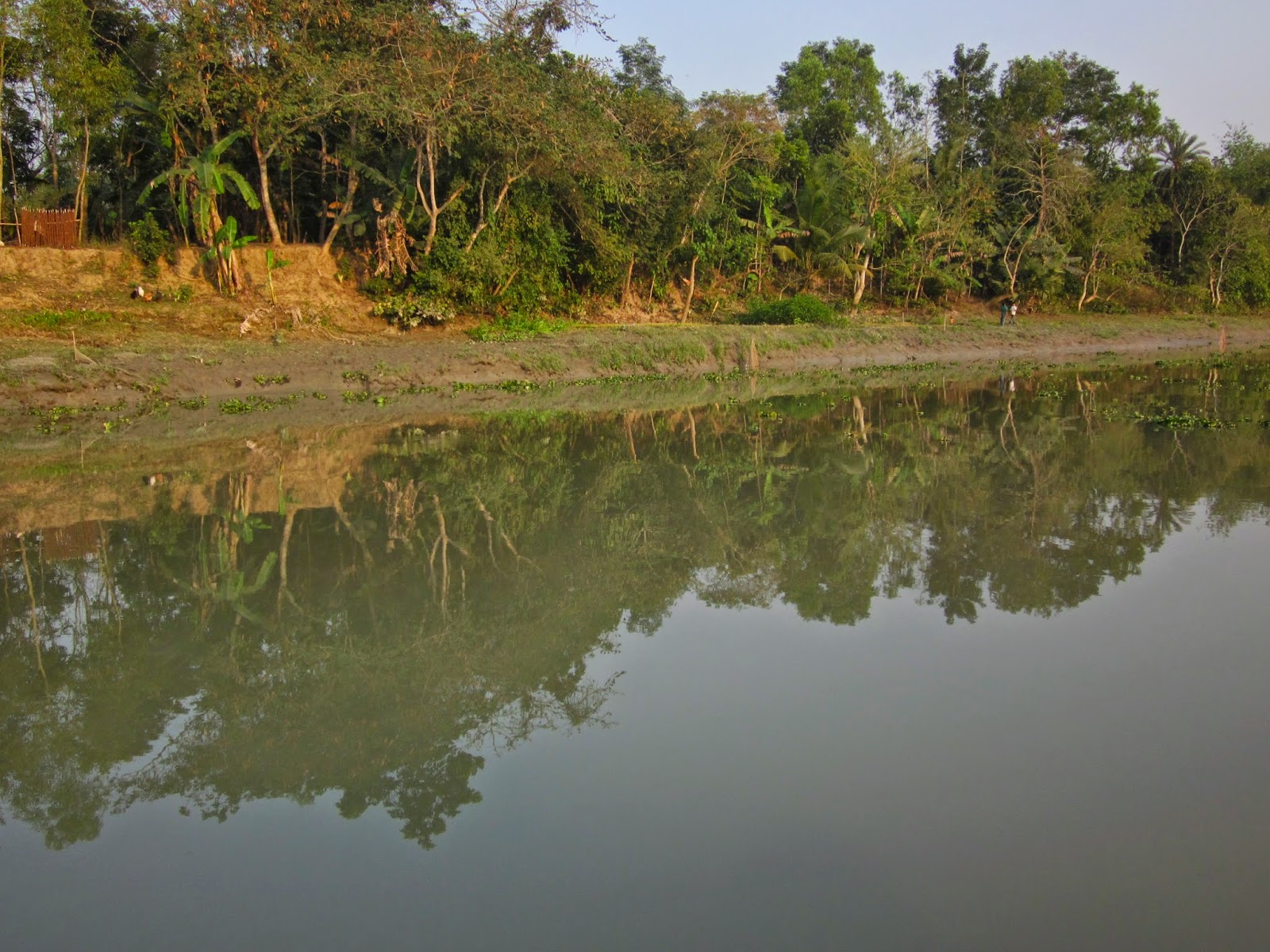
On the afternoon I spent with her, she’d painted trees in the water in grey silhouette. There were long and longer canopies of various species, and the high and higher palm crowns among them had their randomness replicated in the reflection, frond by frond. Despite the undeniable beauty of the water forest it looked an awkward arrangement. It was as a poorly planned team photograph with tall and short players posing wherever they wished.
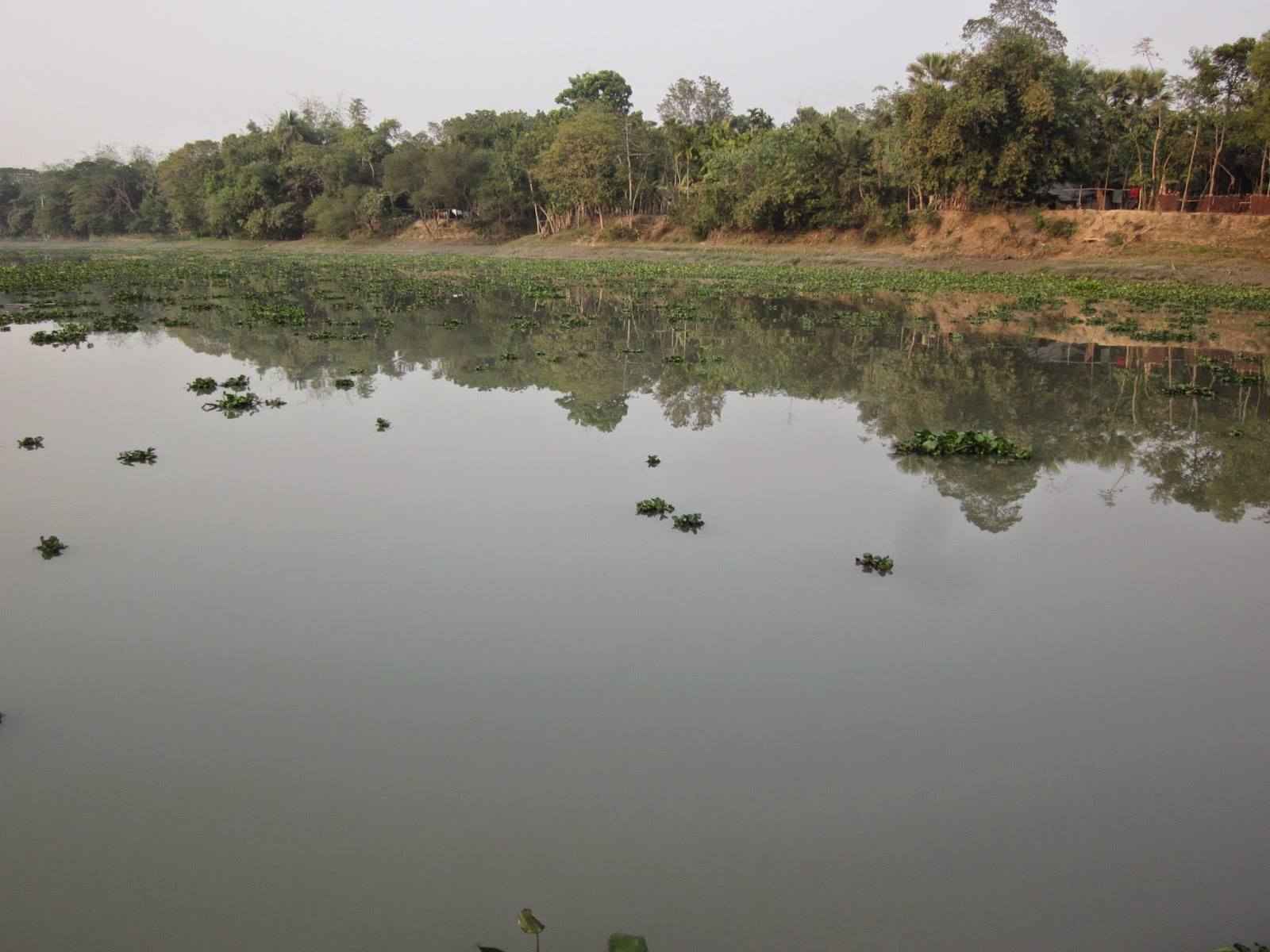
The Chitra River, Narail.


Was the Chitra drawn to the lack of symmetry to be found in reflected trees and, equally, in human lives? Patterns of neat squares and lines – they are not more than a foolhardy attempt to order ourselves as we might like to think we are. In the Chitra was the randomness in the template of humanity in actuality.

As once I moved about the nouka boat taking photographs of every aspect of that river I now move about the room driven by thoughts and words: sitting spread out on the polished concrete floor and typing, then standing, then pausing to consider where that mouse went. It was brown and looked clean. But it’s not without cause that I’m thinking to find myself in the Chitra. It’s what the people of Narail have done.


The Chitra: river of culture and identity.

It’s a river that’s been written about, admired and longed for. The Chitra is culture. The Chitra is identity. Merely to speak Chitra’s name is to invoke nostalgia in Narail, to see arise in the local listener that warm, quiet feeling of belonging. Among the myriad influences that make the human, for Narailis the Chitra is one. It doesn’t take long for them to mention her.
 
Chitra scenery.
Chitra reflections.
East bank of the Chitra


“The Chitra is polluted now,” said the advocate, “but ten years back it was a pristine river. The water was colourful and pure. I love Narail – it is in my heart and I can’t imagine living anywhere else. The Chitra is important.”

“Chitra water is clean and tasty,” it is written in S.M. Royis Uddin Ahmed’s 2009 book, Laraku Narail. “It was famous across the country.... The Chitra’s banks were like paintings and people’s houses looked like features in a great work of art.” True: on that afternoon the east bank was glowing. The sun was bold, boasting in painting it that way. It was a Baul song, spiritual and uplifting.

Meanwhile a monitor lizard on Chitra’s bank up and scuffled away into the bushes, not wishing to be observed. The bright and the hidden: parts of the river and the human. It can’t be hard for Narailis to find themselves when contradiction is there.

Monitor lizard on the bank of the Chitra.

Md. Litu Sheikh.
Yet for Md. Litu Sheikh the Chitra is a practical affair: he’s spent ten of his twenty-eight years ferrying passengers the short distance into Roopganj Bazar and home again. They arrive at the eastern bank with empty artificial-hessian sacks and carry bags. They return from the western bank burdened with groceries: rice grain, vegetables, clothes, eggs, books. They stand as a floating crowd, with one or two finding a sitting place; some hold umbrellas to protect from the sun – all are as mannequins on a street parade float. The stationary crowd moves smoothly eastwards at the pace of Sheikh’s oar.

From the Chitra’s waters comes the ferryman’s modest income that supports his son and daughter but despite the day to day nature of his river-relation he will admit to the river’s beauty. The Chitra is the human is Narail – at many levels.

The water of the Chitra was once renowned for its purity.
But on that afternoon Sheikh’s nouka wandered up and down instead – with a group of local journalists I journeyed there. They had taken the opportunity to retire from the usual chatting and strategising spot under the bokul tree. They were joking and discussing matters of journalist interest. Video and still cameras were busy for no real purpose, other than to keep their stock images ready in case a Chitra-related story came along – illegal dredging or land-filling or pollution.

We saw people gathered at the stately ghat which the zamindar landlords built many years ago, some socialising, others pondering and casting thoughts into the water like skimming stones. We saw the bridge in the south that not everyone chooses to use: it’s as easy to take Sheikh’s ferry and join a bus service originating on the eastern side. Many Narailis must seek to keep a little more Chitra in their lives.

Boat on the Chitra.
In the kochuripana, the water hyacinth, the path of the mainstream was clear. As a great Serengeti herd it moved in unison. There’s the human in that too I suppose. And for the few who choose to do things differently, they can as easily detect the current to move against.

Taro plants meanwhile grew in rows along the shoreline in places, planted by some innovative thinker. They were orderly and out of place of course. They might represent mankind’s interference with the natural world, a kind of deterioration brought about by the need for sustenance.

But it being Narail, taro rows might better be described as symbols of the strength from the earth, the gift of God in providing nourishment. That’s how the town’s premiere artist S.M. Sultan would have described it. He held affection for farmers.
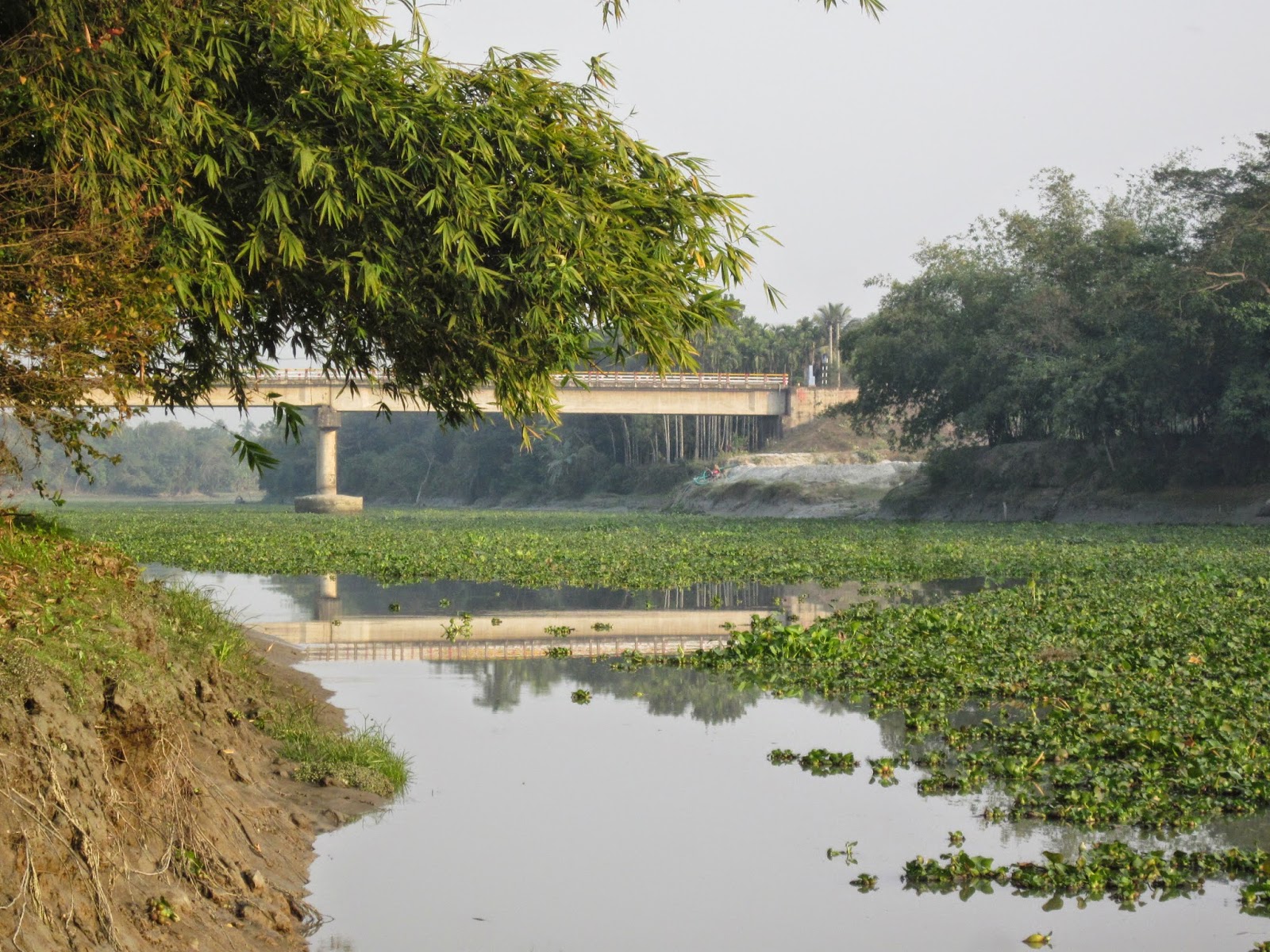
Bridge to the south of Roopganj Bazar.

And it was along Chitra’s banks that the man, affectionately known as Lal Miah, often walked. On the west bank before the bridge is his boat in yellow and sky blue, displayed for the Chitra’s viewing, under an awning, outside the museum.

And on the Chitra children still get about by arranged boat on special days, in mimicry of one of Sultan’s endeavours. He wanted them to experience the intersection between nature, art and the human. He wanted they should be inspired and find their better selves.

Let's take a nouka out on the Chitra.

Given the indivisibility of Chitra and Narail it’s initially surprising to notice that the huddle of buildings that is Roopganj Bazar follow the curious Bangladeshi tradition of facing away from the river. Yet in Chitra’s case perhaps there’s an element of shame in it. The buildings must recognise their preference for bustle more than beauty. Facing the past renown of the clear water Chitra – it’s understandable if they don’t feel up to it.

Ferry passengers on the Chitra.
As the sunset painted a finale, a bright orange streak across the water; and the nouka turned at last for the Roopganj ghat, the Chitra contemplation was almost done.

And yet, for a river of a town-and-district identity, a river in which one may seek to find oneself, the Chitra’s realm is as easy to get lost in. Anyway, perhaps it’s rather simpler to find the human in the moving about in a room with a mouse somewhere and a sagging ceiling overhead, typing into a laptop.


Md. Litu Sheikh has been a boatman for ten years.

Sheikh's nouka and the bridge.

The Chitra is Narail.


Water hyacinth and Roopganj Bazar.


This article is published in Star Magazine, here: A River to Get Lost In

Friday, 21 March 2014

Fishing with Otters

Fishing with otters is an age old tradition.

An otter fishing boat beside Goalbari village.


By lunchtime it’s unmistakable: the sunshine is bringing new warmth to winter’s end. Water hyacinth lazily rides the currents on the offshoot of the Chitra River in Goalbari village of Narail. Along the riverbank wives have hung clothes to dry and below, where a muddy track leads to water’s edge several canoe-like boats are moored. It could be a pleasant scene from any fishing village except that as well as the boats Goalbari harbours a unique fishing tradition.

Lunchtime finds Bhoben Biswas, 35, aboard his narrow boat in front of his modest house. Sitting on haunches he’s sorting small fish. He’s not examining his catch but arranging a raw fish lunch for his Indian smooth-coated otters – called either udhbiral or bhodor in Bangla, and known as dhere in Narail.


Bhoben Biswas, 35, making a raw fish lunch for his otters.


Fishing with domesticated otters was a practice once found in several countries but is nowadays most probably restricted worldwide to southwest Bangladesh – more specifically to Mongla and Narail. As is still true for eight other Goalbari families – in a village of two hundred households – Biswas inherited this livelihood from his father who learnt from his father before him. Otter fishing has potentially been part of the small community for many centuries, but is in decline.

Biswas’s son has manoeuvred the boat onto the water at our request while his father spreads the fish onto a large metal feeding tray. At one end of the boat is a covered area where the customary crew of four somehow find sleeping place during extended fishing expeditions, while at the other is the long box of bamboo slats where the otters live.

The otters are also aware of tradition. They similarly learnt the art of fishing with humans from their parents and grandparents; and they know when it’s lunchtime. There’s a lot of shuffling inside the box. Tips of noses, claws and eager eyes are finding gaps between the slats; a shrill rat-like squealing challenges the Chitra’s tranquillity. The otters are ready.


The otters know when it's lunchtime.

Biswas's son helps his father.


Biswas signals his son. With the lid’s opening there’s a scramble of seven thick-coated furry bodies – an otter can weigh up to 11 kilograms – leaping up and out, with each body momentarily rainbow-arch-manoeuvred in a beeline to the fish feast on deck. Squealing stops as gorging begins.

His otters eat about five kilograms of fish per day which costs up to 400 taka. Presumably this is more burdensome on the budget when the troop is in their home port, because otters will eat crustaceans, insects and even small mammals – while on a fishing expedition keeping their bellies satisfied must be simpler.

“Some people are scared of them,” says Biswas, “but not me.” It mightn’t be easy to be scared of an otter from a distance, as they look storybook cute: but watching them eat with sharp gnawing teeth and mesmerising pink gums, seeing right into their throats as morsels of fish slide down, noting their ravenous manners, beady eyes and what may be a battle scar or two – it doesn’t inspire putting one’s hand between an otter and its lunch. Yet for their part they’re unaffected by the new human barely two feet away.

Biswas says all his otters are the same – he doesn’t have names for them. Perhaps they feel the same about their humans.


The otters waste no time in devouring their lunch.
Table manners are not the otters' strong point.


The team leaders – the adult otters, wear rope harnesses with Biswas’s son holding the other end. The younger otters remain free. It’s the system that’s used as the otters work, as they shepherd fish into the net attached to a long bamboo pole that’s currently rolled up and stored along one side of the boat. “They focus on the bamboo pole,” says Biswas, “and drive fish towards it.”

Like for all Bengalis the otters’ year begins on Pahela Boishakh, 14 April. It’s an important day that marks the embarkation in their motor-less boat for five months of fishing in the Sundarbans wilderness. “It takes two days to get there,” says Biswas, “but if we hang onto a trawler we arrive in one.”


Southwest Bangladesh is likely the only otter fishing place, worldwide.


The crew of four will spend five days at a stretch fishing the jungle river channels before heading to a nearby settlement to sell the catch. The crew cooks on a solar powered stove and drinking water lasting for several days is stored in a large urn. Fishing occurs at low tide, day or night.

“If we get fish we are happy,” says Biswas, “But when fish are few our stomachs aren’t full.” It’s a sentiment most likely shared with his otters.

During the fishing months it’s dacoity, robbery, which is the biggest problem. There’s not a lot of security on a quiet deep-jungle waterway. “Last Aasha month we were held hostage by bandits for twelve days,” Biswas recalls, “We had to pay a 10,000 taka ransom.”


Otter lunchtime.


It’s also difficult if the fish are few. “Once a whole month passed with no fish,” he says, “We had to take a loan to come home again.”

For the otters dangers include illness and crocodiles. According to Biswas an otter can live up to thirty years if there is no misadventure. And of course a problem for the otters is one for the humans and vice versa. It’s a joint venture arrangement that Biswas has pursued for the last fifteen years.

These are the types of concerns that hold sway over Biswas’s face. If he stopped to think he might take pride from pursuing an ancient tradition. He might enjoy the inherent adventure. But his thoughts are family-centred, on his wife Mira, their two sons and daughter, who must manage alone during the fishing months. The pride he seeks is providing for them and it’s when he says “The best thing is if the catch is good. Then we make lots of money and the family runs nicely,” that his face finally surrenders to a broad smile.


Enjoy their lunch, claws and all!


With the five months completed both humans and otters return home to Durga Puja. Afterwards they will leave for a shorter three-month expedition on the nearer rivers of Faridpur. There are few surprises in the otter-and-fisherman life cycle.

After lunch the otters head into their element – the water. “They like to take a drink,” says Biswas. They also play and scamper about the riverbank in search of things of otter-interest. It’s demonstrably apt that the English words ‘otter’ and ‘water’ stem from the same ancient root. A good half an hour later, Biswas calls “Ay! Ay! Ay!” to his otter team and they return to their bamboo home. But Biswas is in no rush to disrupt their play. It’s clear that despite the hardships he holds affection for his animal assistants.


On Pahela Boishakh they leave for the Sundarbans for five months.

Back at the house Mira expresses her hope that her son can run a shop. Biswas too wishes to see an end to the otter fishing for his family. “I hope my sons do not do it,” he says, “But the oldest one doesn’t study properly.” You see, even otter fishermen face that familiar problem – and one cannot but be in two minds upon hearing it. On the one hand, who could wish any student not to do well in their studies? On the other, it is regrettable to concede that before too long otter fishing might finally meet history’s relegation.

After lunch the otters enjoy a drink and a swim.

A brighter future might lie in tourism. The first-rate otter drawcard already lures a trickle of intrepid westerners to stay with local families for several days – perhaps inspired by the BBC documentary. But the sector is unorganised, and even were its potential realised, there is risk that otter fishing would become more entertainment than living tradition, as lucrative tourism taka displaced the drive for Sundarbans bravery.


Otter swimming in Goalbari, Narail.
The smooth coat glistens when in the water.


There's always time for a bit of play and banter.


Otters are in their element in the water.


Otters having river fun.
And onto the riverbank...


Exploring the riverbank.


After lunch play...


Finding otter things to do...


A young otter enjoying lunch.


From a distance, storybook cute.


This article is published in Star Magazine, here: Fishing with Otters


Otters learn fishing with humans from their parents and grandparents.
Too many photos! It's about putting one's foot down.