Showing posts with label landscape. Show all posts

Thursday, 11 June 2015

Money in the Ground


Salt production in Moheshkhali Island accounts for more than half of domestic consumption.


In the fields at Tajiakata of Moheshkhali’s Kutubjom Union they’re lifting water, bucket by bucket. The criss-cross channels are hand dug to entice a little of the sea inland. Seawater is being lifted, litre by litre, to the first of four shallow tanks carved in the ground.

Salt is one of the main industries of Moheshkhali Island.

Even in the morning the sun is fire, but then they’re counting on evaporation. When labourers sweat, sweat is salty.

It’s a semi-lunar landscape, yellow and brown, treeless and arid. It’s a shallow water-trough landscape of salt heaps. Leaving his nearby home at some minutes before 7 a.m., Abdus Salam, 34, will soon be there. For eighteen years he’s been harvesting salt.


“Water collection is the most difficult task,” he says.

For Salam, salt is a livelihood; but salt is also much more.

Salinity in the human, salinity in the sea: for centuries poets and evolutionists have contemplated a distant ancestral link to the earliest life forms that from the primordial soup clambered ashore.


Labourers Mahamadul Karim and Shefatul Islam lift seawater by bucket to begin the salt making process.

More than food seasoning, more than food preserver, sodium chloride is life’s essence: where we came from and where we are. There can be no life without salt. Should we cry, we shed salty tears.

Evaporation ponds. Salt is simple brilliance.


In South Asia there’s independence too in the white sea-spice. On 12 March 1930 Mohandas Karamchand Gandhi began his famous Salt Satyagraha, a march from near Ahmedabad to the Gujarati seaside village of Dandi. At 6:30 a.m. on 6 April Gandhi collected salt by the shore.

Protesting the British salt monopoly brought worldwide attention to the non-violent independence movement and many in India took confidence from Gandhi’s symbolic act. Many followed his example and were arrested. Salt is a harbinger of coming freedom.

The afternoon sun illuminates the salt fields.
Salt taxes also encouraged the French Revolution and paid for Columbus to sail to the New World. At a time when half of China’s revenue came from salt, a Great Wall was made. At the centre of human civilisation you’ll find salt.

Aztec mythology meanwhile includes Huixtocihuatl, goddess of fertility who presided over salt and saltwater. In Hinduism auspicious salt is used in housewarmings and weddings. Prophet Muhammad (pbuh) in a hadith recorded in Sunan Ibn Majah reportedly said, “Salt is the master of your food. God sent down four blessings from the sky: fire, water, iron and salt.”


Religion, civilisation, human life: salt has shaped history.

But Salam’s talk is not of this. He explains that older water will drain through adjoining, ever shallower troughs. He knows evaporation will take to its task. In the final polythene-lined tank after about a week, salt crystals awaiting collection shall sparkle, says he. Salt is brilliance in its simplicity.

The lunar landscape of the salt fields.


He predicts merchants will buy direct from his field. He understands that if he needs to store salt when the monsoon arrives he can bury it, wrapped in polythene, underground. “There’s money in the ground,” say the people of Moheshkhali.


More than half of Moheshkhali's population participates in salt.
When labourers sweat, their sweat is salty.


Salt is also a budget. From 5 kanies of land leased for upwards of 40,000 taka Salam calculates that with two labourers employed he can produce 300 maunds of salt per kanie during the January to April season. He’ll need 100 pounds of polythene for one kanie at 75 taka per pound.

There are contingencies to account for: a falling price caused by transport disruption and late winter fogs that bringing moisture to undo the sun’s work in salt’s disheartening dissolution.

Moheshkhali produces the largest portion of salt to meet domestic demand. Salt farming of about 19,000 acres enlists some degree of participation from most of the island’s 3-lac population.

Abdus Salam, 34, has been working in the salt fields for 18 years.

Yet ironically the Bay of Bengal is best suited for salt. While averaging 3.5% salinity, the world’s seas are not equally saline.

Salt crystals ready for collection.


Of open seas, the Red Sea is considered the saltiest at 4%, due to a lack of rain and river inflow, and because of its narrow connection to the less saline Indian Ocean. Enclosed water bodies can be much saltier still, like the Dead Sea with 34.2% salinity. 


The Yellow, Baltic and Black seas by contrast, like the Bay of Bengal, hold below-average salt content.

Afternoon at Tajiakata salt fields.
Salam can’t consider seawater but he does consider land. Sandy soils are not much good, where absorption is high. Suitable land produces salt more quickly, of higher quality.

As the word ‘salary’ shares its Latin root with salt: either money to buy salt or payment in salt, it’s easy to conclude that Salam has it right… Salt means food on a table and a family fed.


Should we cry, tears are salty.

The alien landscape of Shaplapur in northern Moheshkhali.


This article is published in The Daily Star, here: Moheshkhali's Money in the Ground


Salt. The stuff of life.


Friday, 18 April 2014

To the Tune of SM Sultan, Play On!

A mosaic portrait of SM Sultan by Bimanesh Chandra Biswas.


Even today, Narail doesn’t suffer much from big city problems. There might be small-town electric-engine jams around Roopganj Bazar time to time but they’re not much to contend with. There’s little risk of arriving late for an appointment.

Detail of a portrait of Sultan, SM Sultan Memorial Gallery.
In the mid 1970s the town was quieter still. When carpenter’s son Narayan Chandra Biswas arrived on an empty stomach with time to spare it was a simple matter to set off for a meal. He’d come from Itna village in Lohagara to support his older brother Krishna on the day of Krishna’s BA exam at Victoria College. The exam would start in an hour.

Krishna likewise thought little of Narayan disappearing from the hostel. He gave ten taka for food. What neither brother considered was the risk inherent in a flute song.

Narayan had almost reached the desired shop beside the Chitra when that soulful, melancholy melody first caught his ear. He saw a crowd listening attentively. “The flute pulled me in,” recalls Narayan, “I saw a tall, handsome figure in a long, black kurta and scarf. He had curly black hair falling down his neck in waves.”

When the song abruptly ended Narayan stayed put. “I was hypnotised by that man’s deeply inspiring speech. His words were not of lesser value than his song. Not a single person left.”

Sculptor participating in the Sultan Utsob 2014.
The man spoke of walking along a country road. He described paddy swaying back and forth. As he spoke he smiled a little in the corners of his lips, and he eventually stopped and said, “You know, in the eyes of an artist nothing seen is valueless.”[1]

The eyes of Sheikh Mohammad Sultan had seen much by the mid 1970s. Born the son of a mason in 1923 they’d seen poverty. In Kolkata and later in Karachi they’d seen periods of mingling with the elite, where appreciation of Sultan’s artistic skills had opened doors. In the Second World War years SM Sultan’s eyes had learnt the barrage of visual surprises in store for any wanderer, including one selling cheap portraits to British soldiers through North India. They’d seen exhibition tours to America and Europe; and Kashmir’s beauty.[2]

But the scenery that captivated the most, the place that endured was Narail. Affectionately called Lal Mia in the town, he was known to wander the Chitra’s banks with his flute melodies, to stay out all night and sleep at the Shiva temple. He was a skilled dancer, a Bohemian and a vagrant.

Sultan gave the gift of art to all of Narail.
True to his words SM Sultan found value in all he saw. As a child a piece of charcoal was an invitation to draw upon the walls. Through India and Kashmir dreamy landscapes found their way onto canvas in watercolour and in oil. But it was in Narail he found his most distinctive style – those iconic rural scenes where the figures have exaggerated muscles in place of the thin, bony reality of the peasant farmer.

Sultan had training: at the Kolkata Art College; and he named one Rongolal, a village artist from Kalia Upazila in Narail who’d instructed him from a small age, as his master.

Yet perhaps Sultan’s own paintings are properly understood as temporary outbursts of creativity – an act of painting that was an end in itself. Sultan took little care of his finished works and many are lost. He was unconcerned about using materials that would preserve. Sultan’s song was never about a legacy of artwork, but of ideas.

With the support of friends and sympathetic local officials he founded a Fine Arts Institute in Narail. He taught many, of varying talent, often for free. Sultan didn’t seek to hoard the value in what his artist’s eyes had seen. He wanted to share it. He sought to encourage, challenge and extend: to disseminate the ever present liberation and self-realisation in art.


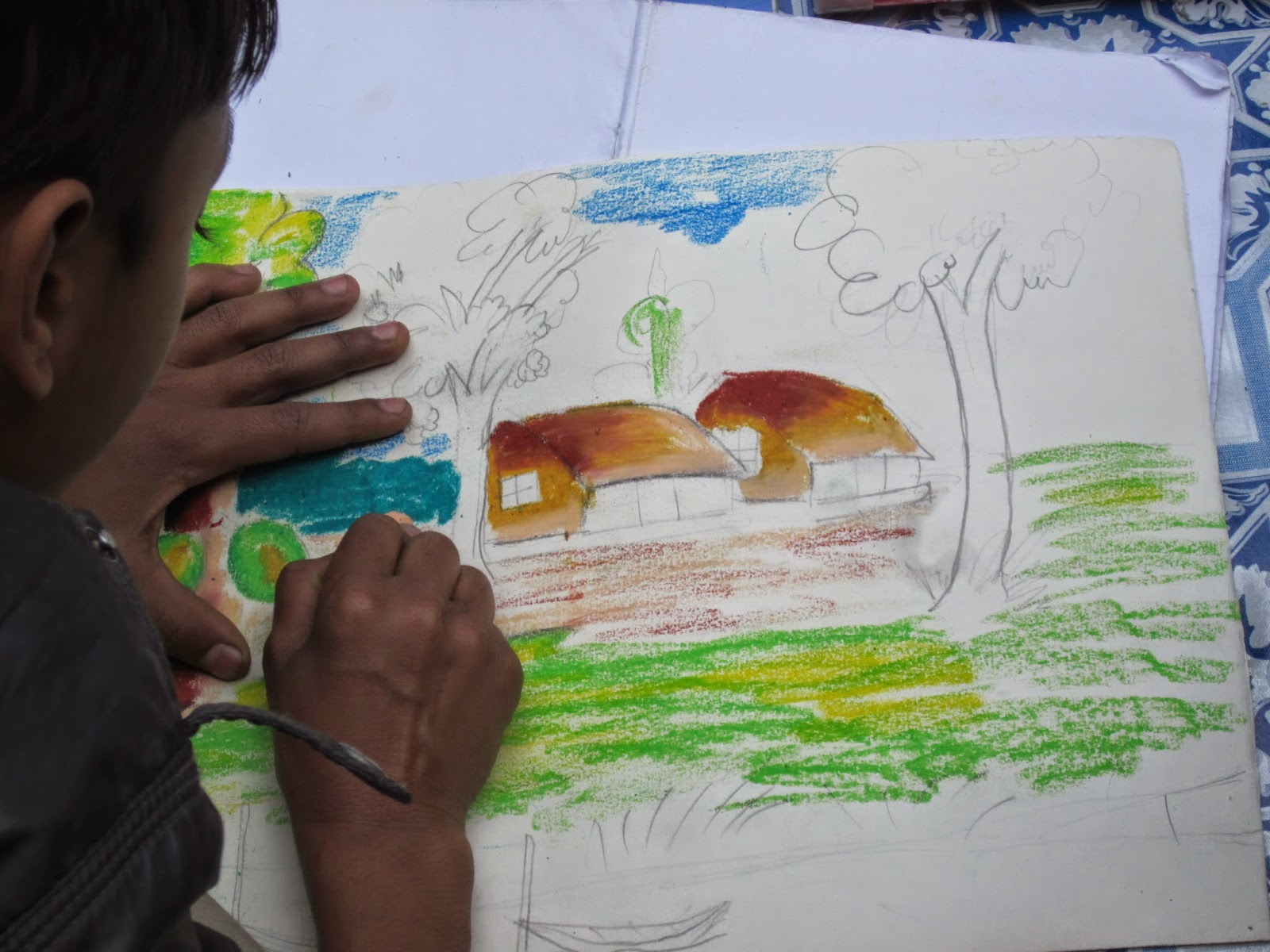
Child participating in a drawing competition for Sultan Utsob 2014 at the SM Sultan Memorial Art Gallery, Narail.

Not many evenings ago I reached a pleasant flat in the alleyways behind Dhaka’s Farm Gate. The location was enviable, featuring an open terrace – rare in the mayhem of the city. I was there to meet 60-year-old artist Bimanesh Chandra Biswas, an ex-chairman of Khulna University Fine Arts Institute and one of SM Sultan’s students.

Artist Bimanesh Chandra Biswas. 
He’s not an easy man to catch, commuting weekly back to his Narail home where he runs art workshops for children. We settle in the small living room that features various ongoing artworks – which seem to be the room’s real owners.

“What people underestimate,” he says, “is the spiritual quality of Sultan’s work. I believe he was the Subcontinent’s only truly spiritual artist. He had a strong faith.”

To illustrate his point, Bimanesh draws my attention to one of Sultan’s most famous paintings, First Plantation from 1975. The painting features a very muscular man planting a small tree. Overhead are two angels, alternatively nominated as images of Cupid.

While this painting has been described by research scholar Dr. Rafiqul Alam as demonstrating man’s power over nature – and he asserts Sultan confessed that he believed in mysticism rather than spiritualism,[3] to Bimanesh the painting depicts the Creator’s blessings bestowed upon humankind. In his view, the muscular image of the man arises from the nutrition and wealth represented in the tree, delivered by angels from God. The man’s strength is not a power over nature but from nature – how a small tree can make a man big.

An unfinished work by SM Sultan on display at the SM Sultan Memorial Gallery, Narail. SM Sultan's vision of introducing every human to the enlightenment of art is also still a work in progress.

Similarly, although it is asserted that the muscular rural figures common to Sultan’s work depict the working man as a hero, perhaps as Sultan wished they were and to the point of being a political statement, and concurrently reducing the natural scene to mere backdrop status,[4] Bimanesh does not agree. To him, Sultan was demonstrating nature-mankind interconnectedness.

Untitled. Bimanesh Chandra Biswas, 2014.
Bimanesh recalls his first meeting with the great artist. His father, Sultan’s former classmate, had taken him to Sultan’s house when he was nine years old. “When I saw Sultan’s hands drawing it was like magic,” he says. Bimanesh became Sultan’s student in the late 1950s.

He was impressed by Sultan’s devotion to Narail and the villages, the life his Guru chose over pursuing more materialistic success as an artist in Dhaka. It wasn’t easy to access paint materials in Narail, and Sultan often made his own paints from local pigments and used jute canvases. For varnish he used gaber gam, the resin of a local type of fruit tree. “You will notice that many of his paintings use only few colours, maybe two or three,” Bimanesh remarks, “and Sultan often did not fully finish a painting before moving on to the next.”

Bimanesh showed artistic promise. In 1975 Sultan took him to Dhaka to admit him into the Fine Arts Institute – the first of Sultan’s students to follow that path. Bimanesh did well and upon graduation was offered a job as a designer with the shoe company Bata, for a then-lucrative salary of 15,000 taka. They promised to send him to Europe to study shoe design. Bimanesh consulted his Guru.

Untitled. Bimanesh Chandra Biswas 2014.
“For the whole of your life you will design only shoes? You will not make your sons?” said Sultan. He encouraged Bimanesh to join the teaching staff at Khulna Fine Arts Institute, which set the course of his career. He wanted Bimanesh to make artists not footwear.

The last major exhibition of Bimanesh’s own work was a watercolour landscape series, “Rural Nature” hosted by Dhaka’s Bengal Gallery in 2011. It is unsurprising that a protégé of Sultan’s would find rural landscapes inspiring. “I thought about the motherland,” says Bimanesh.

But more recently his mind has become occupied with the Creator of that motherland’s beauty. His contemporary works are concerned with spirituality and feature religious symbols – all religions are paths to the one God – with terracotta relief elements and angels. “Artistic styles change as artists mature,” he says. I ask if he can paint a little. He pulls pots of paint from under the sofa.

Children's drawing competition.


SM Sultan Utsob 2014, organised by Shilpakala Academy.


At SM Sultan Memorial Gallery.


When Narayan Chandra Biswas understood it was Lal Mia who stood before him he was astounded. From childhood he had heard – Lal Mia could draw fine pictures, he had no family of his own and kept animals and pet birds. And in those few moments Narayan had learnt that speaking gently with good pronunciation was also a form of art.

Before he realised, the hour was gone. Narayan awoke from his trance at the sound of the Victoria College bell signalling the start of Krishna’s exam. He ran to the hostel but his brother had left.

“Did you get lost?” his brother asked after the exam. Narayan started to explain but before he finished his brother’s roommate interrupted, “Krishna, can it not be that your brother fell in love with Lal Mia’s song?”

Krishna saw the point. “Yes, some of Lal Mia’s disease is also in my brother.”


A self-portrait by artist Narayan Chandra Biswas, symbolising confusion and also his existence within the many aspects of nature - as SM Sultan would have appreciated.

Since childhood Narayan had pursued drawing as a hobby. Being from a poor family he knew not to dream of attending an art college, yet after his chance meeting with Sultan his enthusiasm grew. If only he could learn some techniques... But he was too shy to ask.

A rare piece of commercial style art by Narayan.
It was some years later when Narayan was already a teacher at Itna High School that the chance came for a proper introduction. A junior friend, Ali Azgar Raja, was already taking lessons from Sultan and encouraged Narayan to accompany him.

“If you agree, then sometimes...” Narayan said nervously to Sultan; but before he could finish the sentence Sultan laughed sweetly and said, “It is okay – sometimes you will come.” Noticing Narayan was older Sultan continued, “For learning there is no age limit. Rabindranath Tagore started his painting addiction when he was sixty.”

And when Narayan explained he could not think of attending an art college because his father was just a carpenter, Sultan replied, “My father was a mason. Those who are creating something, they are artists.” For SM Sultan, artistic thought and creative act was where merit lay, more than in the created article.

He also said, “If you want to learn art it is like focusing torch light on the night sky. The light will never find a boundary. If you want to learn such a thing, so start!”

Sketch of Sultan by Narayan Chandra Biswas.
Narayan continued to visit SM Sultan as he could, and Sultan sought to encourage him. Upon receiving an invitation to visit Itna, Sultan said if his Narayan Babu and Raja Saheb held an art exhibition there he was sure to be at the opening. As it happened progressive Itna was due to inaugurate their public library and in order to ensure Sultan’s attendance the local authorities offered funds for Narayan and Raja to organise their exhibition.

On 24 November 1993 SM Sultan took his first steps on Itna’s soil. “You see those birds playing? Do you know what it means?” he asked Narayan, “Those birds are ready to receive the newcomer. They are ready for me.”

It might be that Narayan’s paintings will never hang in a national gallery – but Sultan’s song is a cherished gift. According to Bimanesh, Sultan said that if a man had no money or property to donate as zakat he could donate knowledge. And with Sultan’s tuition, Narayan was brave enough to paint the image of his mother, who died when he was young, of whom there are no photographs. That is of course, no small thing.

In any case, to be a village artist is not to be less than one Rongolal – Sultan’s master.

Poster advertising the Biswas and Raja exhibition, Itna.

A Narayan Chandra Biswas landscape.


Narail graffiti Sultans.

SM Sultan's equipment as displayed at the SM Sultan Memorial Gallery, Narail.

If ever there was a small town more taken with art and creativity than Narail I have not seen it. With numerous celebrations of Sultan throughout the year and weekly art tuition for children it is easy to say that SM Sultan succeeded in his wish that art should flourish.

Niha Bela Saha.
And among the participants at the Sultan fairs and exhibitions, if you look you might just spot 80-year-old Niha Bela Saha. SM Sultan made his family of people close to him and Niha became as a daughter.

Although she was not his student, Sultan did not refrain from challenging her. On one occasion he took her to Narayanganj to a festival, and the organisers, on hearing Sultan’s daughter was in attendance, requested her to give a speech. Having never imagined she would do such a thing – she didn’t know how to handle the microphone or what to say – she was terrified. But due to the crowd’s pressure she stood there, and SM Sultan stood just behind her, quietly whispering the right words into her ear. “It was a really memorable day,” Niha recalls.

“I never met anyone like him,” she says, “He had no pride. Such a good person! Such an artist! There will be none like him.” Bimanesh and Narayan would both agree.

There were those who were quick to say that Lal Mia was a madman. It’s not surprising for one who did not value possessions or conformity to life’s predictable course to be labelled as such. If art can bring the self-assurance of self-knowledge that opens horizons to the broader world, when true caring for humans in general becomes possible: then from the life of SM Sultan we can understand that the true meaning of eccentric is, sometimes, wise.


Art is alive in Narail.


Events to celebrate Sultan inspire all kinds of creativity in Narail.


Performers at Sultan Utsob 2014.


Children's drawing competition.


Painting exhibition in Narail.


Entry to SM Sultan Memorial Gallery.


Traditional pitha cakes baked for Sultan Utsob 2014.


This article is published in Star Magazine, here: To the Tune of SM Sultan, Play On!


To the tune of SM Sultan, play on!


[1] The experiences of Narayan Chandra Biswas in this article researched from interview and his book in Bangla, Chitra o Modhumoti Parer Kotha.
[2] Details of SM Sultan’s life in this article researched from Subir Choudhury (ed), S.M. Sultan, Bangladesh Shilpakala Academy, Dhaka 2003.
[3] Ibid. p. 24
[4] Ibid. p.22