Showing posts with label painting. Show all posts

Sunday, 15 March 2015

Where Santhal Wisdom Shelters


Suddenly in the forest there are faces...
A sal tree in Nawabganj National Park.


Perhaps it’s generally true that shade follows sunshine. Beyond Sitakot in Dinajpur’s Nawabganj the sal trees gather. Though geographically unlikely locals believe Nawabganj National Park might be the last remnants of the forest where Sita of the Hindu epic Ramayana lived in exile.

From field and farmhouse, the cycle van winds along the track into this darker but not-less-beautiful world. Beyond is Ashurer Beel, a picturesque waterhole favoured for picnics and famed for migratory birds.


Into the forest...


And suddenly in the forest are faces… not the middle-class motorcycle-riding ones of picnickers but curious, distinctly non-Bengali faces…

The national park keeps another history. Under its canopy, at its edges, the culture and wisdom of the Santhals finds shelter.


Alekutia village is home to 40 Santhal families.
Peeling jungle potatoes.


In Gabriel Hemrom’s leafy yard a little beyond the park boundary, in Alekuti village along the same track, women sit on the ground preparing date leaves for weaving. Another is busy with jungle potatoes, which are soaked in water for several days and eaten with molasses-like jaggery, known in Bangla as ‘gur’.


A well-constructed mud brick Santhal home.


Alekuti is home to forty Santhal families, Hemrom estimates. “Our ancestors are from a place called Dumka,” says the forty-year-old father of three sons. “But we were all born here.”


House detail.


As in Bangladesh, Santhals are one of the most populous minority peoples in India. Mainly they live in Odisha, West Bengal, Bihar, Assam and Jharkhand. Dumka is a district in the last of these states. There are also a small number in Nepal.


Nearby Ashurer Beel with boat and fish traps.


By tradition Santhals engage in hunting, forest clearing and farming.


The village’s forested location reflects the Santhali tradition of forest clearing and subsistence farming. They are also famed hunters, with bow and arrow. But in Alekuti, along with some small-scale farming, most earn as they can through cycle-van riding or day labour. It isn’t much of a living.


House painting. Santhals capture their history and daily lives in design.


“For the poor, food is always a problem,” says Hemrom.

In contrast to the dire economic reality of Alekuti, in India it’s not uncommon for Santhals to be living in cities and working in areas as diverse as medicine, engineering and the public service.


In Alekuti meanwhile, are traces of the well-developed, unique culture of which any Santhal can be proud. Most visibly it’s in the painted designs on the walls of their well-constructed mud-brick homes. By tradition Santhals present history and daily life in wall paintings, although the Alekuti examples are modest.

“Those who can paint do so,” says Hemrom.


Painting around an internal doorway. 50 - 70% of the villagers in Alekuti are Christian these days.

The forest nearby.

The Austroasiatic Santhali language, of the Munda languages and distantly related to Khasi, Khmer and Vietnamese, is sophisticated and well-studied. Its unique script, called Ol Chiki and invented in 1925 by Pandit Raghunath Murmu in response to deficiencies in representing the range of Santhali sounds in Roman or other Indic alphabets, has thirty letters.


Santhals are famed hunters with bow and arrow.


In general, the Santhals have preserved their language well; but in Alekuti it’s facing difficulties. “Our children used to study Santhali at the mission schools in Dhanjuri and Patarghat,” says Hemrom, “but now they only learn at home. We use our own alphabet but it’s explained in English.” Including Bangla, Alekuti relies on three languages.


The church in Alekuti.

Hemrom estimates that like his family, 50 – 70% of the families in Alekuti converted to Christianity some thirty years ago. The village features a small church attended by visiting clergy.

The remainder observe the old religion, which worships Marang buru or Bonga as supreme deity. It features a court of spirits to regulate aspects of the world, from whom blessings are sought through prayer and offering. There are also evil spirits to be protected from.

An old mango tree on the forest road.


Traditionally, Santhal villages feature a sacred grove on the edge of the settlement where spirits live and sacred festivals occur. In Alekuti neighbours participate in the rituals of both religions.

“We dance and sing in Santhali and in Bangla,” says Hemrom, “The children enjoy the festivals the most.”


In their political history Santhals can also take some pride. In response to land grabbing and enslavement, on 30 June 1855 leaders Sidhu Murmu and Kanu Murmu mobilised 30,000 Santhals to fight the British.

Sal tree trunk.
Caught by surprise, initially the Santhal Rebellion met with some success, but ultimately bows and arrows proved no match for British guns. Battles were akin to massacres. Many Santhals, including the two celebrated leaders, were killed; and subsequently the Nawab of Murshidabad used elephants to trample Santhal huts.

More recently, the Santhal community was instrumental in successfully advocating the creation of Jharkhand state in India, which was carved from southern Bihar in 2000. It was hoped that statehood for Jharkhand would allow better representation for the various minority peoples who account for about 28% of the state population. Santhals are the largest group.

Yet Gabriel Hemrom speaks of his heritage humbly. “Everybody likes his own culture,” he says.

Despite the current hardships of life in Alekuti, it’s not possible to be entirely pessimistic. Santhali culture has survived great hardship before. And, as when leaving the forest, perhaps it’s generally true that sunshine will inevitably come to replace the shade.

Gabriel Hemrom, 40, with his son Remechus Hemrom, 10.


Friday, 18 April 2014

To the Tune of SM Sultan, Play On!

A mosaic portrait of SM Sultan by Bimanesh Chandra Biswas.


Even today, Narail doesn’t suffer much from big city problems. There might be small-town electric-engine jams around Roopganj Bazar time to time but they’re not much to contend with. There’s little risk of arriving late for an appointment.

Detail of a portrait of Sultan, SM Sultan Memorial Gallery.
In the mid 1970s the town was quieter still. When carpenter’s son Narayan Chandra Biswas arrived on an empty stomach with time to spare it was a simple matter to set off for a meal. He’d come from Itna village in Lohagara to support his older brother Krishna on the day of Krishna’s BA exam at Victoria College. The exam would start in an hour.

Krishna likewise thought little of Narayan disappearing from the hostel. He gave ten taka for food. What neither brother considered was the risk inherent in a flute song.

Narayan had almost reached the desired shop beside the Chitra when that soulful, melancholy melody first caught his ear. He saw a crowd listening attentively. “The flute pulled me in,” recalls Narayan, “I saw a tall, handsome figure in a long, black kurta and scarf. He had curly black hair falling down his neck in waves.”

When the song abruptly ended Narayan stayed put. “I was hypnotised by that man’s deeply inspiring speech. His words were not of lesser value than his song. Not a single person left.”

Sculptor participating in the Sultan Utsob 2014.
The man spoke of walking along a country road. He described paddy swaying back and forth. As he spoke he smiled a little in the corners of his lips, and he eventually stopped and said, “You know, in the eyes of an artist nothing seen is valueless.”[1]

The eyes of Sheikh Mohammad Sultan had seen much by the mid 1970s. Born the son of a mason in 1923 they’d seen poverty. In Kolkata and later in Karachi they’d seen periods of mingling with the elite, where appreciation of Sultan’s artistic skills had opened doors. In the Second World War years SM Sultan’s eyes had learnt the barrage of visual surprises in store for any wanderer, including one selling cheap portraits to British soldiers through North India. They’d seen exhibition tours to America and Europe; and Kashmir’s beauty.[2]

But the scenery that captivated the most, the place that endured was Narail. Affectionately called Lal Mia in the town, he was known to wander the Chitra’s banks with his flute melodies, to stay out all night and sleep at the Shiva temple. He was a skilled dancer, a Bohemian and a vagrant.

Sultan gave the gift of art to all of Narail.
True to his words SM Sultan found value in all he saw. As a child a piece of charcoal was an invitation to draw upon the walls. Through India and Kashmir dreamy landscapes found their way onto canvas in watercolour and in oil. But it was in Narail he found his most distinctive style – those iconic rural scenes where the figures have exaggerated muscles in place of the thin, bony reality of the peasant farmer.

Sultan had training: at the Kolkata Art College; and he named one Rongolal, a village artist from Kalia Upazila in Narail who’d instructed him from a small age, as his master.

Yet perhaps Sultan’s own paintings are properly understood as temporary outbursts of creativity – an act of painting that was an end in itself. Sultan took little care of his finished works and many are lost. He was unconcerned about using materials that would preserve. Sultan’s song was never about a legacy of artwork, but of ideas.

With the support of friends and sympathetic local officials he founded a Fine Arts Institute in Narail. He taught many, of varying talent, often for free. Sultan didn’t seek to hoard the value in what his artist’s eyes had seen. He wanted to share it. He sought to encourage, challenge and extend: to disseminate the ever present liberation and self-realisation in art.


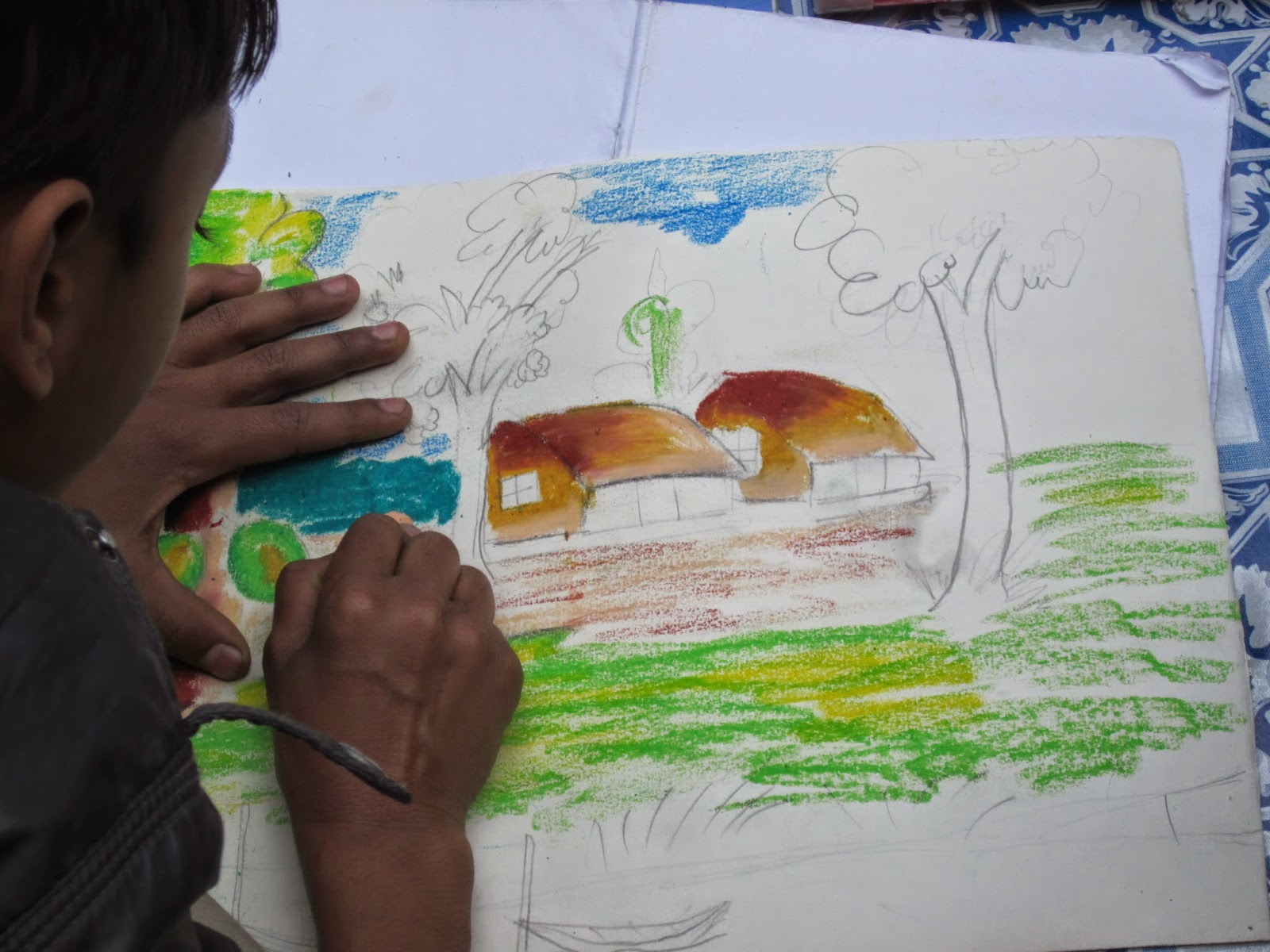
Child participating in a drawing competition for Sultan Utsob 2014 at the SM Sultan Memorial Art Gallery, Narail.

Not many evenings ago I reached a pleasant flat in the alleyways behind Dhaka’s Farm Gate. The location was enviable, featuring an open terrace – rare in the mayhem of the city. I was there to meet 60-year-old artist Bimanesh Chandra Biswas, an ex-chairman of Khulna University Fine Arts Institute and one of SM Sultan’s students.

Artist Bimanesh Chandra Biswas. 
He’s not an easy man to catch, commuting weekly back to his Narail home where he runs art workshops for children. We settle in the small living room that features various ongoing artworks – which seem to be the room’s real owners.

“What people underestimate,” he says, “is the spiritual quality of Sultan’s work. I believe he was the Subcontinent’s only truly spiritual artist. He had a strong faith.”

To illustrate his point, Bimanesh draws my attention to one of Sultan’s most famous paintings, First Plantation from 1975. The painting features a very muscular man planting a small tree. Overhead are two angels, alternatively nominated as images of Cupid.

While this painting has been described by research scholar Dr. Rafiqul Alam as demonstrating man’s power over nature – and he asserts Sultan confessed that he believed in mysticism rather than spiritualism,[3] to Bimanesh the painting depicts the Creator’s blessings bestowed upon humankind. In his view, the muscular image of the man arises from the nutrition and wealth represented in the tree, delivered by angels from God. The man’s strength is not a power over nature but from nature – how a small tree can make a man big.

An unfinished work by SM Sultan on display at the SM Sultan Memorial Gallery, Narail. SM Sultan's vision of introducing every human to the enlightenment of art is also still a work in progress.

Similarly, although it is asserted that the muscular rural figures common to Sultan’s work depict the working man as a hero, perhaps as Sultan wished they were and to the point of being a political statement, and concurrently reducing the natural scene to mere backdrop status,[4] Bimanesh does not agree. To him, Sultan was demonstrating nature-mankind interconnectedness.

Untitled. Bimanesh Chandra Biswas, 2014.
Bimanesh recalls his first meeting with the great artist. His father, Sultan’s former classmate, had taken him to Sultan’s house when he was nine years old. “When I saw Sultan’s hands drawing it was like magic,” he says. Bimanesh became Sultan’s student in the late 1950s.

He was impressed by Sultan’s devotion to Narail and the villages, the life his Guru chose over pursuing more materialistic success as an artist in Dhaka. It wasn’t easy to access paint materials in Narail, and Sultan often made his own paints from local pigments and used jute canvases. For varnish he used gaber gam, the resin of a local type of fruit tree. “You will notice that many of his paintings use only few colours, maybe two or three,” Bimanesh remarks, “and Sultan often did not fully finish a painting before moving on to the next.”

Bimanesh showed artistic promise. In 1975 Sultan took him to Dhaka to admit him into the Fine Arts Institute – the first of Sultan’s students to follow that path. Bimanesh did well and upon graduation was offered a job as a designer with the shoe company Bata, for a then-lucrative salary of 15,000 taka. They promised to send him to Europe to study shoe design. Bimanesh consulted his Guru.

Untitled. Bimanesh Chandra Biswas 2014.
“For the whole of your life you will design only shoes? You will not make your sons?” said Sultan. He encouraged Bimanesh to join the teaching staff at Khulna Fine Arts Institute, which set the course of his career. He wanted Bimanesh to make artists not footwear.

The last major exhibition of Bimanesh’s own work was a watercolour landscape series, “Rural Nature” hosted by Dhaka’s Bengal Gallery in 2011. It is unsurprising that a protégé of Sultan’s would find rural landscapes inspiring. “I thought about the motherland,” says Bimanesh.

But more recently his mind has become occupied with the Creator of that motherland’s beauty. His contemporary works are concerned with spirituality and feature religious symbols – all religions are paths to the one God – with terracotta relief elements and angels. “Artistic styles change as artists mature,” he says. I ask if he can paint a little. He pulls pots of paint from under the sofa.

Children's drawing competition.


SM Sultan Utsob 2014, organised by Shilpakala Academy.


At SM Sultan Memorial Gallery.


When Narayan Chandra Biswas understood it was Lal Mia who stood before him he was astounded. From childhood he had heard – Lal Mia could draw fine pictures, he had no family of his own and kept animals and pet birds. And in those few moments Narayan had learnt that speaking gently with good pronunciation was also a form of art.

Before he realised, the hour was gone. Narayan awoke from his trance at the sound of the Victoria College bell signalling the start of Krishna’s exam. He ran to the hostel but his brother had left.

“Did you get lost?” his brother asked after the exam. Narayan started to explain but before he finished his brother’s roommate interrupted, “Krishna, can it not be that your brother fell in love with Lal Mia’s song?”

Krishna saw the point. “Yes, some of Lal Mia’s disease is also in my brother.”


A self-portrait by artist Narayan Chandra Biswas, symbolising confusion and also his existence within the many aspects of nature - as SM Sultan would have appreciated.

Since childhood Narayan had pursued drawing as a hobby. Being from a poor family he knew not to dream of attending an art college, yet after his chance meeting with Sultan his enthusiasm grew. If only he could learn some techniques... But he was too shy to ask.

A rare piece of commercial style art by Narayan.
It was some years later when Narayan was already a teacher at Itna High School that the chance came for a proper introduction. A junior friend, Ali Azgar Raja, was already taking lessons from Sultan and encouraged Narayan to accompany him.

“If you agree, then sometimes...” Narayan said nervously to Sultan; but before he could finish the sentence Sultan laughed sweetly and said, “It is okay – sometimes you will come.” Noticing Narayan was older Sultan continued, “For learning there is no age limit. Rabindranath Tagore started his painting addiction when he was sixty.”

And when Narayan explained he could not think of attending an art college because his father was just a carpenter, Sultan replied, “My father was a mason. Those who are creating something, they are artists.” For SM Sultan, artistic thought and creative act was where merit lay, more than in the created article.

He also said, “If you want to learn art it is like focusing torch light on the night sky. The light will never find a boundary. If you want to learn such a thing, so start!”

Sketch of Sultan by Narayan Chandra Biswas.
Narayan continued to visit SM Sultan as he could, and Sultan sought to encourage him. Upon receiving an invitation to visit Itna, Sultan said if his Narayan Babu and Raja Saheb held an art exhibition there he was sure to be at the opening. As it happened progressive Itna was due to inaugurate their public library and in order to ensure Sultan’s attendance the local authorities offered funds for Narayan and Raja to organise their exhibition.

On 24 November 1993 SM Sultan took his first steps on Itna’s soil. “You see those birds playing? Do you know what it means?” he asked Narayan, “Those birds are ready to receive the newcomer. They are ready for me.”

It might be that Narayan’s paintings will never hang in a national gallery – but Sultan’s song is a cherished gift. According to Bimanesh, Sultan said that if a man had no money or property to donate as zakat he could donate knowledge. And with Sultan’s tuition, Narayan was brave enough to paint the image of his mother, who died when he was young, of whom there are no photographs. That is of course, no small thing.

In any case, to be a village artist is not to be less than one Rongolal – Sultan’s master.

Poster advertising the Biswas and Raja exhibition, Itna.

A Narayan Chandra Biswas landscape.


Narail graffiti Sultans.

SM Sultan's equipment as displayed at the SM Sultan Memorial Gallery, Narail.

If ever there was a small town more taken with art and creativity than Narail I have not seen it. With numerous celebrations of Sultan throughout the year and weekly art tuition for children it is easy to say that SM Sultan succeeded in his wish that art should flourish.

Niha Bela Saha.
And among the participants at the Sultan fairs and exhibitions, if you look you might just spot 80-year-old Niha Bela Saha. SM Sultan made his family of people close to him and Niha became as a daughter.

Although she was not his student, Sultan did not refrain from challenging her. On one occasion he took her to Narayanganj to a festival, and the organisers, on hearing Sultan’s daughter was in attendance, requested her to give a speech. Having never imagined she would do such a thing – she didn’t know how to handle the microphone or what to say – she was terrified. But due to the crowd’s pressure she stood there, and SM Sultan stood just behind her, quietly whispering the right words into her ear. “It was a really memorable day,” Niha recalls.

“I never met anyone like him,” she says, “He had no pride. Such a good person! Such an artist! There will be none like him.” Bimanesh and Narayan would both agree.

There were those who were quick to say that Lal Mia was a madman. It’s not surprising for one who did not value possessions or conformity to life’s predictable course to be labelled as such. If art can bring the self-assurance of self-knowledge that opens horizons to the broader world, when true caring for humans in general becomes possible: then from the life of SM Sultan we can understand that the true meaning of eccentric is, sometimes, wise.


Art is alive in Narail.


Events to celebrate Sultan inspire all kinds of creativity in Narail.


Performers at Sultan Utsob 2014.


Children's drawing competition.


Painting exhibition in Narail.


Entry to SM Sultan Memorial Gallery.


Traditional pitha cakes baked for Sultan Utsob 2014.


This article is published in Star Magazine, here: To the Tune of SM Sultan, Play On!


To the tune of SM Sultan, play on!


[1] The experiences of Narayan Chandra Biswas in this article researched from interview and his book in Bangla, Chitra o Modhumoti Parer Kotha.
[2] Details of SM Sultan’s life in this article researched from Subir Choudhury (ed), S.M. Sultan, Bangladesh Shilpakala Academy, Dhaka 2003.
[3] Ibid. p. 24
[4] Ibid. p.22