Showing posts with label society. Show all posts

Friday, 12 June 2015

Meeting the Locals


Arriving at the Moheshkhali ghat by speedboat.


Toys for sale, Adinath Temple fair.

A stranger in a tea shop says I have a Bengali face. “How so,” I ask. “Foreigners usually have a fat face,” he says. “So, do I look sick then?” It didn’t take long for the Moheshkhali locals to prove they’re not shy.

A trip to the island readily accessible by speedboat from Cox’s Bazar won’t leave the visitor feeling they’re not a part of it.

It’s advisable to walk in from the jetty to the start of the road before taking a rickshaw, for a better fare.  Anywhere in Gorakghata town will be about twenty taka. I’m lucky. I find an honest driver. But as he rides in others are excitedly calling out, “hoto!” meaning “How much?” in their local Bangla. They’re wondering how much overcharging has gone on, but when the driver calls back “one hundred taka!” they know he’s criticising them.

“Ah, Bengalis!” says the honest driver, shrugging his shoulders. But of course, he’s Bengali too.


No visitor to Moheshkhali is likely to feel left out.

For anybody without any Bangla accommodations are made. “Good night!” one man calls out, remembering whatever English he can. It hardly matters that it’s early afternoon.

Selling sitolpati mats.

Another man is busy buying roadside fish. He seems engrossed in the sale, but the sight of an outsider is too tempting. “How is your country?” he asks. Should I take him literally and start explaining how Australia is? Well, most of it is quite dry, desert in fact… It’s expensive compared to Bangladesh but it’s also quite materially developed… Large parts are flat but in other areas there are mountains… Or should I just say “Australia”, answering the “Which country are you from?” that he actually means?

At the Adinath Temple there’s a fair going on and one college professor has been tasked with making loudspeaker announcements. He stops me for a chat. As I walk away I hear a new announcement, “Thanks to our Australian friend who says he just ate jelabis!” It’s difficult to feel more welcomed than that!


The jetty and ghat in Moheshkhali.

In a local eatery I’m stunned. “Do you speak Bangla?” someone asked, a simple question but I’m lucky I caught it since it’s uttered in what sounds like one long syllable! I’m not used to Chittagonian Bangla. “I speak a little Bangla,” I’m thinking, “But do you?”

New shoes, anyone?


To the outsider, Bangla in Moheshkhali sounds a bit like an electric saw unsure if it wants to cut a tree. It sounds choppy like the speedboat getting there that banged, wave to wave, across the channel. It sounds like chewing on gum. It sounds a bit Burmese.

“Chittagong dialect,” reads the District Gazetteer, “is almost unintelligible even to the people of neighbouring districts like Noakhali and Comilla… The most noticeable feature that strikes the stranger is the tendency of the people to slur over consonants, to clip syllables and to substitute aspirates for sibilants.” I think that’s a more sophisticated way of saying the same as above.

By evening I find myself in Chandan’s tea shop. He’s smoking a respectable Gold Leaf, so I start to joke about how rich he must be, how he must have a car. Everybody’s laughing; while Chandan says he has two cars! “But I smoke cheaper brands too,” he says.

He says he’ll soon be married which is my cue to question him like a relative. “Is the girl from a good family? What’s her qualification? What does her father do?” He returns from the counter with an invitation card in shiny gold. “This is the very first invitation I’m giving,” he says, and he’s hoping for two hundred guests.


Passengers from Cox's Bazar town.

Meanwhile Jamal the betel seller over the road is concerned for my wellbeing. He gives his mobile number. “If you have any problem at all, you just call me!”

Evening at the temple fair.
I ask if that also applies if I’m in Cox’s Bazar and he says it does. “But what if I’m further away, like maybe in London or Tokyo? Should I call you then?” Bless him! He offers to shut up his betel shop and come to rescue me anywhere, worldwide, anytime!

In Moheshkhali, everybody’s watching the foreigner, but I’m told I’m lucky. “A few years ago two foreign women came here,” I hear, “and a crowd of at least a hundred followed them as they walked along the road.”

About the jetty are mudskippers basking, lounging and fighting for ground. Larger specimens are charging; forcing smaller ones to flee back into the tide. As I’m boarding a speedboat to follow the tide to Cox’s Bazar myself, I can only smile at the memories of friendliness and curiosity that the people of Moheshkhali have given me.


Transport.


This article is published in The Daily Star, here: Moheshkhali through a Foreigner's Eyes


Selling sweets at the Adinath Temple fair.
At the ghat, as I prepared to board the speedboat back to Cox’s Bazar there was a guy in a bright yellow t-shirt. In bold letters on his t-shirt was written “Three Lines, Up the Nose!” which is clearly a reference to cocaine snorting. In Bangladesh people often wear second hand clothes from the west. His made me chuckle to myself and I thought about explaining to him that he was advocating drug use, but then I thought if I said anything out of shame he might never wear that t-shirt again… and maybe he doesn’t have hundreds to choose from. So I let him be.

Thursday, 9 April 2015

Where People Are Still People


Dinajpur District hosts many elaborate Durga Puja pandals every year.

Initial observation: it was deep night as the bus from Dhaka crossed the border of Dinajpur District. A few minutes later a woman needed to get down. It spurred discussion among the driver, the conductor and other passengers. Was she sure? Was it okay to leave a woman alone on a dark road?

She repeated the place name. It was right. She got out.

The bus moved forward. The bus stopped. The bus reversed. No, it couldn’t be done. She was delivered instead to the safety of a late night barber’s shop nearby. And I wondered…

I’m not alone in anticipating that assuredly considerate temperament from people of the country’s northwest. Simply mentioning a person is from Dinajpur is a kind of character reference.

This writer was determined to find out: what makes the Dinajpuri?

Goods for sale at a Hindu fair.


Observation: in Dinajpur town no rickshaw driver asked for more than the exact fare; one can’t say that of all regional centres. Indeed twice I was unexpectedly called back. “You paid too much,” rickshaw drivers said, referring to the little extra knowingly given. Now that has hardly happened elsewhere…

I asked our local The Daily Star correspondent Kongkon Karmaker his opinion; and he himself exhibits many of the admirable qualities one might associate with Dinajpur, albeit just between us there’s a bit of Barishailla in his blood.

He spoke of Hindu families preparing shemai, vermicelli, for Muslim Eid al-Fitr; of Muslims leading Durga Puja committees, with some taking the chance to perform aroti dance in front of Ma Durga’s pandal. The town’s prominent temples seem to confirm religious tolerance.

“Dinajpur has one of the highest percentages of Hindus in the country,” Karmaker says, “Disharmony is rare.” The district is also diverse with ethnic minorities, principally the Santhals. Meanwhile, according to Karmaker, local hijras are better accepted and less pushy than elsewhere.

Perhaps there was more to learn in the villages.

Locals at the Nurul Mudir tea shop in Taiabpur, Birol.

At Mahadeppur village in Birol Upazilla, at a nameless shop in the row called Bashudev Supermarket, proprietor Sanatan Chandra Roy agrees to the premise, “People are good here. There’s no conflict between Hindus and Muslims. Why I don’t know. It just is so.”

“What’s in Birol?” proposes a customer. “Everything is here: betel, cigarettes and tea.”

And history agrees. The Dinajpur District Census Report of 1961 as reported in the government Gazetteer observed that Dinajpuris are “nostalgic to a degree, and unless they are very hard pressed they do not leave their homes.”

Kali Puja, Dinajpur. 
“Few experience the pangs of hunger as our own countrymen do in times of distress,” wrote a Briton, Major Sherwill, about Dinajpur, much earlier in 1860, “They may wholly abstain from labour for weeks or even months and still manage to feed and clothe themselves and their families. Their wants are few.”

According to the Gazetteer land has traditionally been more plentiful and population density less than other regions. Have these factors influenced an easygoing attitude?

“There is no district in Bangladesh as thanda [cool] as Dinajpur,” says Md Fazlul Haque at the Nurul Mudir tea shop in Birol’s Taiabpur village. The Upazilla administrative officer spent years in Khulna, which he liked, but “Dinajpur’s people are best.”

Dinajpur's Kali Temple.
His hypothesis: “People are occupied with their own business. Nobody has intention to harm someone. We don’t like conflict.”

“At any Durga Puja pandal,” interjects shopkeeper Mozammel Haque, “for every four Hindus there must be eight Muslims. Everyone enjoys. We are one.”

“The land is good,” he reflects, “That’s why people are gentle.”

“People here are very simple,” suggests farmer Sri Manmohan Chandra Roy of village Andharmucha in Chirirbandar Upazilla. “People are not much desperate so we don’t quarrel.”

Observation: evening on a narrow road in town and I’m surprised by overpowering music blasting from a red-light flashing amplifier, street-side. “Inconsiderate,” is the first thought, but then I notice the other side of the street: the long concrete wall of Dinajpur gaol. Perhaps somewhere inside a prisoner was smiling from hearing the distant rhythms of their favourite Bollywood and Bangla dance numbers? Perhaps a prisoner was having a birthday, knowing they were not forgotten? It takes volume to conquer concrete.

Motorcycle parking area at a Hindu fair. 
And yet the Gazetteer mentions mass migration into Dinajpur, especially at the time of Partition’s upheaval. It lists periods of famine. And news out of the district over the past several months is peppered with instances of violence, some political, others not. Surely such facts remind us: every rule has exceptions.


Regardless, in Dinajpur you’ll find it in general: that helpful, sincere majority – a little more tolerant perhaps, a little more peaceful perhaps…  Exactly why, I’m still unsure.

Kali  Puja in Dinajpur. 


 A ride at a village fair. 


Friday, 6 March 2015

At the Coalface


The lift shafts at Barapukuria Coal Mine.


Dhaka, Khulna, Rangpur and Barisal: Mr. Zhang likes to travel. “Bangladesh is poor,” he says, interpreted from Mandarin, “but people are very honest, especially in the northern villages.”

As a Buddhist, Mr. Zhang believes in reincarnation. According to him, everything in this life is the outcome of a previous life. Something in his previous life brought him to Bangladesh this time around.

Office buildings at the mine.


The office buildings at his workplace are white tiled on the outer walls, with blue tiled angular eaves to break the monotony of a flat roof. The driveway, like the exterior of the stairwells, is circular. There’s a garden with neatly trimmed hedges. It could be any random factory office in industrial China except it isn’t. Mr. Zhang works as an engineer at Barapukuria Coal Mine in Dinajpur’s Parbatipur, and has done for a decade.

“I mostly speak to local colleagues in English,” he says, “but with the help of books and audio material I also learnt some Bangla. In Bangla it’s interesting how when people introduce how many siblings they have they include themselves in the number.”

Garden in front of the office.
Barapukuria is run by Chinese contractors. It’s unsurprising that the canteen serves Chinese fare and that signs commonly feature Mandarin characters. What’s more interesting is the mosque built for local workers in a similarly Chinese style, with white tiles and blue trim.

“At the core,” says Mr. Zhang, “all religions are the same.”


Barapukuria offices.

The Barapukuria gateway has seen better days.


Coal mining is a risky business and Barapukuria has not been a project free of controversy. Some risks are inherent: opening a new coal face where the air may contain carbon monoxide or methane, where temperatures can be high or a sudden inrush of water may occur.

Despite planning that currently includes the services of a British consultant, Barapukuria has suffered from land subsidence affecting surrounding farmlands; locals have complained of adverse impact on the water table; and some years ago workers went on strike.

The main entrance. The mine thinks it's a tea plantation.

There was also an underground flooding disaster that has since resulted in refined safety measures, put in place one hundred metres ahead of the drilling; and a concrete wall being constructed along the northern side at significant cost, to prevent further waterlogging.

The lift shaft.
There have also been issues with compensating and relocating villagers on whose former land the mine sits; though according to management most of these issues have since been settled.

Yet Barapukuria provides over 1000 jobs at the mine and a further 300 plus for Chinese workers; and it provides much needed coal for the country, most of which is used in electricity generation at the nearby power plant. Of national significance, not only does Barapukuria restrict the need for imports but due to its low-sulphur content the local rock is less polluting in power generation than the most-common, Indian, substitute.

From the surface, the first level of the mine is 293 metres down, sitting at 260 metres below sea level. From there, 1.5 kilometres of roadway and train track tunnels slope to a final depth of 430 metres below sea level.

Father-of-two Md Atiur Rahman, 30, from Mashpur, a village one kilometre from the mine, takes the lift down into the mine every workday. He’s been with the mine for nine years. “I had no work before,” he says, “We only have one bigha of land so life was hard.”

Local miner, Md. Atiur Rahman.


Underground, Rahman is responsible for constructing the beams and legs of wood along the tunnel that provide safety support. It’s a risky position because the new sections of tunnel are often hot and hold the greatest chance of roof cave-in.

Due to the risks his wife wants him to find another job, and there was a time when Rahman was scared underground, with fears of falling in the dark. But with years of experience “there is no time for fear,” he says, and although it’s hard work the mine enables him to manage his family’s finances.

Local miners attract a monthly salary of 9000 taka with 20 kilograms of rice grain and bonuses. There are four six-hour shifts per day.

The lift into the mine.
Rahman’s colleague Kabirul Islam, 33, has been working at the mine for eight years. “I like it when we get through our work quickly,” he says. The miners are given a task for each shift and if they complete it in three to four hours rather than six they return to the surface early.

He’s not scared anymore – the fear gradually left him in his first few months. But still, when leaving home of a morning he does sometimes wonder if he will ever see it again.

In 2009 seventeen miners were trapped by a cave in and one Ranjeet Chandra Roy died. “Those working at the coalface have the biggest risk,” says Islam.

Miner Kabirul Islam, after finishing a shift underground.

Miners in the lift.

Shift over.
Coal train engine.
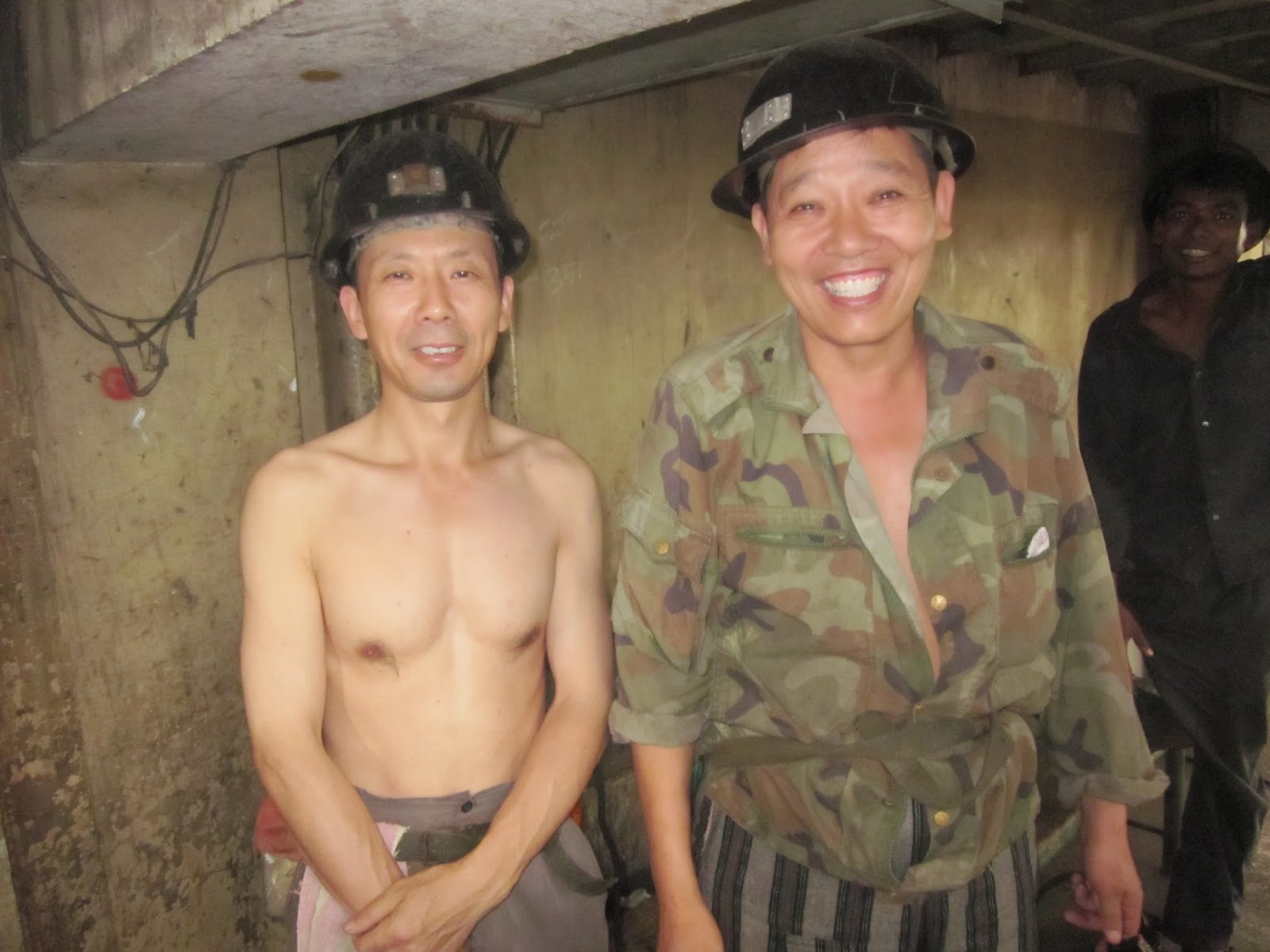
Miners at the end of a shift.

Miners pose for the camera.


About cooperating with his Chinese colleagues, Islam says local miners have learnt to understand some Mandarin. “Kem cha means ‘train’,” says Islam. The word for train in Mandarin is actually ‘hǔo chē’ but in a tunnel with the sounds of a coal mine going on and a train quite possibly approaching at the time of use, ‘kem cha’ undoubtedly suffices.

Mr. Li, 'Om', looking busy while we chat.
Like Mr. Zhang and most Chinese miners, Mr. Li, locally called by the nickname ‘Om,’ is from the city of Suzhou in Jiangsu Province. For five years he’s worked at Barapukuria and in very basic Bangla and English he praises the skill of some of the managers.

But he misses his native cuisine. “Some of the Chinese food here is good,” he says, “but the variety is limited.” To supplement, miners have taken to growing Chinese vegetables on land beside their quarters. As can be expected, Mr. Li misses his one-year-old daughter and family who he sees only on visits home every six months.

Life at Barapukuria is strenuous and not without risk. Yet despite the hardships Bangladeshi and Chinese miners manage to cooperate in bringing the underground wealth of Bangladesh to the surface and into use. “External forces are not issues,” says Mr. Zhang. “What matters is internal attitude, which can turn any challenge into an opportunity and bring good fortune. Good deeds make for happy endings.”

With thanks to Ms. Olivia Qu for interpreting from Mandarin.


Bangladeshi miners at Barapukuria.


Barapukuria landscape.

 
Chinese miners at Barapukuria.


Mine landscape.


As the canteen (not pictured above) serves Chinese fare...


...sometimes the Bangladeshi office staff prefer the tea shop. And who could blame them?

Thursday, 11 September 2014

Sreemangal Sevens

Seven-colour tea served at Lawachara National Park outside Sreemangal.

Ten-colour tea.


Beyond town is the Sathrong – the Seven Colours – Restaurant. According to the signboard it’s “fully air-condition,” and it will be, at some time after you arrive when they switch the air-conditioner on. Or you can sit street side. Those tables have air all the time, occasionally mixed with a hint of traffic exhaust. It’s hardly a secret that Moulvibazar’s Sreemangal harbours a tea secret. It has to be tried.

A warning to fussy diners – don’t expect details from the waiter. In the case of the signature seven-colour or the newer ten-colour tea it’s not worth asking. “I don’t know what’s in it,” twenty-six-year old waiter Joshim Uddin will say, “It’s made behind a curtain.” Indeed it is. It’s a secret.

Tea. Bangladesh runs on tea. There’s no corner of the country to escape it. Community bonds are built, tested, destroyed and re-imagined in tea shacks in every local market. Who’s stealing whose land, who bought the expensive fish and who’s facing the false case because their uncle doesn’t like them much – all local life details can be imbibed over a cup.


Sreemangal's Sathrong Restaurant. The layered tea is made in secret, behind a curtain.

Sathrong Restaurant, Sreemangal.


Villagers argue politics while sipping, with election posters hanging expectantly, longingly or ridiculously, depending on the candidate pictured – waiting to be referenced or discussed – and hopefully not mocked – by tea drinkers. Plans are made and negotiations settled as water boils in Bangladesh. Exactly whose goat was eating which tree – it almost requires a cup or two to sort that out.

Meanwhile in the city, it is tea that a Baridharan lady will turn to, what she will offer even to a not-entirely-welcome guest, possibly with a biscuit. There’s civility in it. Tea is a nod to decent society. And being so quintessential, when tea comes in unusual colourful bands like at the Sathrong, it’s really something to consider.

It’s unsurprising the innovation should belong to Sreemangal. With its renowned row-patterned hillsides of tea bush the town leaves no guess work that it’s a national tea growing hub. Take a few solid strides up the road from the Sathrong and you’ll be staring at a tea garden.

Count the colours. Make sure it tallies with the order.


After the magic behind the curtain is completed, Joshim Uddin returns with the very attractive coloured tea. There really are distinctive colour bands. You’ll need to count them... to be sure the number correctly tallies with the order. You might be tempted to pump for further information...

“I think there’s coffee in it,” Joshim Uddin guesses, “Milk, green tea, black tea, ginger and sugar. Each layer has its flavour.”

Despite the kitchen’s curtain the secret hasn’t been entirely safe. A handful of places around Sreemangal now serve layered tea. Some establishments have a prohibition on anyone else being inside the kitchen while it’s made. All still zealously guard the precise methodology.

Brown, buff, orange and white; then fawn, auburn and raw umber: those are the seven layered colours in the earliest version, top to bottom, impressive, down the glass. Take your colour chart if you will. Test it. Taste it.

But is it possible there’s a secret within the secret? That the colours of those Sreemangal-sevens conceal inner meaning?

Take brown for instance. It starts with brown. Brown is the colour of raw earth. It’s rustic and agricultural. In that is the farmer’s cycle surely, the hope in the seed-sowing that follows the plough? Brown is the struggle of the Bangladeshi delta, the source of growth and vitality. Brown is where we’ve come from. It’s where we all end up. It’s a place to stand.

We could say that brown is the thud of the base drum in the orchestra called Earthly life. It’s quite understandable it’s the first of the layers to reach the tastebuds.


But what do the colours mean?

Now buff is altogether different. It’s a more recent colour: an innovation. Its first recorded use as a colour name in English only dates from 1686. Buff is the colour of undyed leather.

From brown it must signify refinement. The harvest might have grown in the field but it’s stored in say, mud brick homes – consider the buff-coloured farmhouses traditional to North Bengal. Sacks of hessian are also roughly buff, aren’t they? In them food heads to the cities. Even leather – that primary stuff of buff – is the start of shoes – fit for walking. It’s easy to sense that the buff layer is about movement and progress.

Ten colour tea from Sreemangal.
Buff is archaeology, civilisation begun. It recalls the rushing rivers of the monsoon. It’s the colour of that line across the water to be seen from the Chittagong to Barisal ship, where the water of the Bay finally encounters the buff-coloured Meghna’s outflow. A quickening in the tempo of the human song is the buff.

The colour orange comes in at number three. That colour was once referred to as yellow-red. It didn’t find an English name until the first oranges, the fruit, arrived from the east in the late fifteenth century. It was first fruit, then colour.

Orange brings excitement: amusement, elation and joy. Orange stands for the excesses of jackfruit, the exquisiteness of mangoes and the frivolous indulgence of jelabis. Happy Krishna wears yellowish-orange as often as not.

With the brown of the land and the buff of progress taken care of, it certainly seems like the time for orange – there can be no mistake here. It’s the step toward literature and poetry and emotion. It’s the colour of human expression. It befits that the orange layer tastes intoxicatingly sweet.

The fourth of seven is white. In a western sense it could denote purity. In China it might signify death. But Sreemangal being a South Asian town it’s as likely to represent cow’s milk – perhaps exactly what it is. White is that fertility symbol that leads to family and society. It makes sense because it’s hardly worthwhile to be elated with orange if there’s no white to bring about those to share it with.

From the Renaissance European artists started to dabble in white, adding it to other colours to bring new brightness, and it’s not a solitary brightness, but of society, of the many...

Next comes fawn. It’s an interesting shade of brown, mostly used to describe furnishing or fashion or the lighter pelts of some dog breeds. At the Sathrong it will take some thinking – perhaps it’s as simple as luxury. By the time we’ve reached fawn the cities are built, society is there. It’s time to decorate: a nice sofa, a pure-bred, shiny pet dog?

Each layer has a distinctive flavour.


The penultimate colour is auburn – reddish brown – and it’s even more cryptic than the fawn. Auburn usually refers to hair colour – especially women’s hair. Ann Boleyn is said to have had auburn hair, and just because King Henry VIII beheaded her in the finish is not to say she wasn’t attractive. Her fate wasn’t driven by her looks. It’s just a guess – only the tea maker behind the curtain could ever be sure, but could auburn signify lasting beauty, or love? It’s beyond the fashion of fawn – something higher, something more valuable...

Raw umber, last – it’s a teaser, it must be. It’s ironic in being prehistoric. It was with iron oxide and manganese oxide, the powder called raw umber, that over 40,000 years ago mankind painted horses on the walls of European caves. Now that’s humour, isn’t it? To remind us that no matter how far we might think we’ve come we are never far from our primitive roots. Read the horrors in any newspaper and it’s clear. That final colour in the seven-coloured tea is actually the most ancient. Our end is our beginning.

Seven and ten-coloured tea is a little adventure. Analyse the colours, sample the flavours and wonder at the secret... because, ultimately, it’s tea. And tea, as much as anything, is what keeps Bangladesh running.


It's still tea... what keeps Bangladesh running.


This article is published in Star Magazine, here: Sreemangal Sevens


Test it. Taste it.