Showing posts with label mine. Show all posts

Friday, 6 March 2015

At the Coalface


The lift shafts at Barapukuria Coal Mine.


Dhaka, Khulna, Rangpur and Barisal: Mr. Zhang likes to travel. “Bangladesh is poor,” he says, interpreted from Mandarin, “but people are very honest, especially in the northern villages.”

As a Buddhist, Mr. Zhang believes in reincarnation. According to him, everything in this life is the outcome of a previous life. Something in his previous life brought him to Bangladesh this time around.

Office buildings at the mine.


The office buildings at his workplace are white tiled on the outer walls, with blue tiled angular eaves to break the monotony of a flat roof. The driveway, like the exterior of the stairwells, is circular. There’s a garden with neatly trimmed hedges. It could be any random factory office in industrial China except it isn’t. Mr. Zhang works as an engineer at Barapukuria Coal Mine in Dinajpur’s Parbatipur, and has done for a decade.

“I mostly speak to local colleagues in English,” he says, “but with the help of books and audio material I also learnt some Bangla. In Bangla it’s interesting how when people introduce how many siblings they have they include themselves in the number.”

Garden in front of the office.
Barapukuria is run by Chinese contractors. It’s unsurprising that the canteen serves Chinese fare and that signs commonly feature Mandarin characters. What’s more interesting is the mosque built for local workers in a similarly Chinese style, with white tiles and blue trim.

“At the core,” says Mr. Zhang, “all religions are the same.”


Barapukuria offices.

The Barapukuria gateway has seen better days.


Coal mining is a risky business and Barapukuria has not been a project free of controversy. Some risks are inherent: opening a new coal face where the air may contain carbon monoxide or methane, where temperatures can be high or a sudden inrush of water may occur.

Despite planning that currently includes the services of a British consultant, Barapukuria has suffered from land subsidence affecting surrounding farmlands; locals have complained of adverse impact on the water table; and some years ago workers went on strike.

The main entrance. The mine thinks it's a tea plantation.

There was also an underground flooding disaster that has since resulted in refined safety measures, put in place one hundred metres ahead of the drilling; and a concrete wall being constructed along the northern side at significant cost, to prevent further waterlogging.

The lift shaft.
There have also been issues with compensating and relocating villagers on whose former land the mine sits; though according to management most of these issues have since been settled.

Yet Barapukuria provides over 1000 jobs at the mine and a further 300 plus for Chinese workers; and it provides much needed coal for the country, most of which is used in electricity generation at the nearby power plant. Of national significance, not only does Barapukuria restrict the need for imports but due to its low-sulphur content the local rock is less polluting in power generation than the most-common, Indian, substitute.

From the surface, the first level of the mine is 293 metres down, sitting at 260 metres below sea level. From there, 1.5 kilometres of roadway and train track tunnels slope to a final depth of 430 metres below sea level.

Father-of-two Md Atiur Rahman, 30, from Mashpur, a village one kilometre from the mine, takes the lift down into the mine every workday. He’s been with the mine for nine years. “I had no work before,” he says, “We only have one bigha of land so life was hard.”

Local miner, Md. Atiur Rahman.


Underground, Rahman is responsible for constructing the beams and legs of wood along the tunnel that provide safety support. It’s a risky position because the new sections of tunnel are often hot and hold the greatest chance of roof cave-in.

Due to the risks his wife wants him to find another job, and there was a time when Rahman was scared underground, with fears of falling in the dark. But with years of experience “there is no time for fear,” he says, and although it’s hard work the mine enables him to manage his family’s finances.

Local miners attract a monthly salary of 9000 taka with 20 kilograms of rice grain and bonuses. There are four six-hour shifts per day.

The lift into the mine.
Rahman’s colleague Kabirul Islam, 33, has been working at the mine for eight years. “I like it when we get through our work quickly,” he says. The miners are given a task for each shift and if they complete it in three to four hours rather than six they return to the surface early.

He’s not scared anymore – the fear gradually left him in his first few months. But still, when leaving home of a morning he does sometimes wonder if he will ever see it again.

In 2009 seventeen miners were trapped by a cave in and one Ranjeet Chandra Roy died. “Those working at the coalface have the biggest risk,” says Islam.

Miner Kabirul Islam, after finishing a shift underground.

Miners in the lift.

Shift over.
Coal train engine.
Miners at the end of a shift.

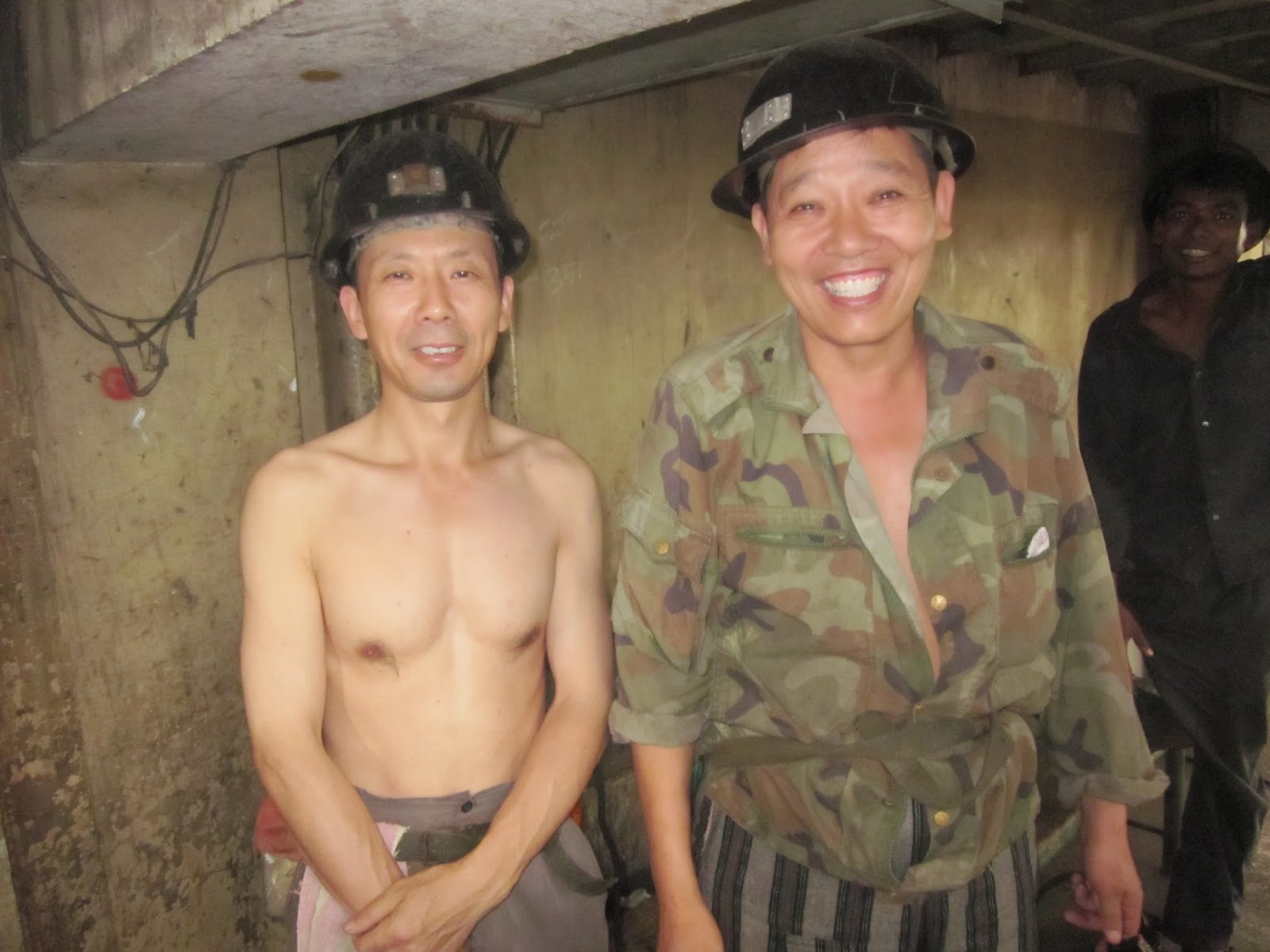
Miners pose for the camera.


About cooperating with his Chinese colleagues, Islam says local miners have learnt to understand some Mandarin. “Kem cha means ‘train’,” says Islam. The word for train in Mandarin is actually ‘hǔo chē’ but in a tunnel with the sounds of a coal mine going on and a train quite possibly approaching at the time of use, ‘kem cha’ undoubtedly suffices.

Mr. Li, 'Om', looking busy while we chat.
Like Mr. Zhang and most Chinese miners, Mr. Li, locally called by the nickname ‘Om,’ is from the city of Suzhou in Jiangsu Province. For five years he’s worked at Barapukuria and in very basic Bangla and English he praises the skill of some of the managers.

But he misses his native cuisine. “Some of the Chinese food here is good,” he says, “but the variety is limited.” To supplement, miners have taken to growing Chinese vegetables on land beside their quarters. As can be expected, Mr. Li misses his one-year-old daughter and family who he sees only on visits home every six months.

Life at Barapukuria is strenuous and not without risk. Yet despite the hardships Bangladeshi and Chinese miners manage to cooperate in bringing the underground wealth of Bangladesh to the surface and into use. “External forces are not issues,” says Mr. Zhang. “What matters is internal attitude, which can turn any challenge into an opportunity and bring good fortune. Good deeds make for happy endings.”

With thanks to Ms. Olivia Qu for interpreting from Mandarin.


Bangladeshi miners at Barapukuria.


Barapukuria landscape.

 
Chinese miners at Barapukuria.


Mine landscape.


As the canteen (not pictured above) serves Chinese fare...


...sometimes the Bangladeshi office staff prefer the tea shop. And who could blame them?

Thursday, 12 February 2015

Bangladesh Underground


Miners return to the surface after eight hours underground.


Out of the chute, large rocks tumble. Bang, crash, bang! The oversized shed is dusty, the noise deafening. People in hardhats and blue overalls with reflective strips can barely talk over the din. Working above ground, they’re watching granite chunks fall and move off along a conveyor belt. With lives shaped by geology, they’re supervising the crushing machine.

Western thought would have us as individuals. In the villages the pull of family bonds happily holds sway. But there are other ingredients in the human. There’s history. There’s climate. And there’s geology.

Bangladesh has a lack of surface hard rock, the inspiration for the hard rock mine.

The mine at Maddhapara, Parbatipur.


It’s nothing new. Bangladesh is a riverine country, most of it. It’s an alluvial landscape that favours rice. Geology rules the farmer’s hand and trains Bangladeshi tastebuds. Rocks are rare here – a scarcity that has, for centuries, impacted upon human society.

Ramsagar tank could hardly have been dug in rocky terrain. At Kantaji temple, building and sculpting in clay reached its zenith for a lack of stone. Both of Dinajpur’s icons testify to geology’s influence; it’s hardly surprising, then, if at Maddhapara in Dinajpur’s Parbatipur geology similarly rules.

Except that at Maddhapara it’s not a lack of stone that’s the driving factor but a rock deposit. The two premiere underground mines in Bangladesh are both in Dinajpur. Maddhapara hard rock mine has been operating for over fifteen years.

Sorting and crushing the stone.

Miners leaving the lift.

“Are you scared when you go underground,” I ask a passing miner outside the crushing machine shed, where words can be heard. “No,” he laughs, a little hesitantly. “What about the first time?” He thinks. He doesn’t like to tell. “I had three months training,” he says.

The idea to construct the mine arose from there being a lack of surface rock in the country. Crushed granite is used in apartment construction, coastal and river embankments, bridges, roads and as railway ballast. Modern Bangladesh can’t get by without it and the Maddhapara mine is projected to contribute 9.2 million tonnes over a six-year period, reducing import needs.

In the entry building to the mine, beyond the safety signs, the rows of head-worn lights and the stores of gum boots and hardhats, miners sign on to start their shift. Outwardly it appears to be a well-organised outfit – but it wasn’t always.

Rows of helmet lights at the ready.

Safety chart.
The mine was constructed and operated for the first fourteen years by a North Korean company. “They had about 17 deaths,” says Md. Zabed Siddique, General Manager of Germania Trest, the consortium consisting of a Belarusian state-owned company and a Bangladeshi company that was contracted to operate the mine since late 2013. “Now there are only minor incidents.”

As he speaks there’s a distant thud and the ground shakes a little. “There are five or six blasts daily,” says Siddique.

Miners descend via a large elevator, complete with an exit sign in both English and Korean, into the tunnels that are up to 300 metres below the surface and stretch for 1.5 kilometres, growing longer every day. There’s an underground railway to transport both rock and miners, who complete an eight hour shift. With three shifts per day, activity at the mine never ceases. 

Mine buildings with ventilation stacks.
Md. Zabed Siddique, General Manager.


“Our miners are mostly from poor families,” says Siddique, “But they don’t think about owning a fancy car or a big house. They’re hard-working and honest. For me, that’s one of the best things about working here. We’re lucky.”

Miners earn 18,000 taka without overtime and if they work underground there’s a 100% mining allowance. During an eight-hour shift there’s a one-hour break, below the surface. The mine directly employs over 700 people.

“There’s a prayer room which is a hole in the wall inside the mine,” says Siddique, “and a medical room.”

Miners coming out of the lift after their shift.

The lift shaft.
Maddhapara also employs 57 foreigners, engineers and managers earning up to $1000 per month, mostly from Belarus and Ukraine. It explains the four-star accommodation block with Russian cable TV and the cafeteria menu featuring Russian food – on that day scrumptious pilmeni, Russian dumplings.

“When the North Koreans were here, they weren’t allowed to leave the compound,” says Siddique, “but nowadays the foreign workers can visit Bogra or Rangpur on the weekends.”

One of the two lift shafts.


There’s a Russian physician on-site and a team of interpreters, though underground with the Bangladeshi workers communication consists more of basic Russian and Bangla words together with hand signals.

“The interpreters work hard. Sometimes we need them for long hours,” says Siddique, “and I have never known one to say ‘No I can’t, I’m tired.’ They’re very dedicated.”

Loading granite.

Signing off. They always know exactly who is underground.
Perhaps a less obvious sign of the presence of foreigners are the small bottles of nitric acid hanging at intervals along the building walls. “It’s to keep snakes away,” Siddique explains. You can’t help but laugh – to think of the many millions of Bangladeshi villagers who dare to live without such protection, including the miners living nearby. But then, snakes really must be scarier if you come from a country where they are less common and less venomous.

Yet despite the efforts made towards foreign comforts it can’t be easy. Braving a very little Russian, I strike up a conversation with a young guy chatting with his friends outside the cafeteria. Thankfully, he adds a very little English into the mix.

Loading a truck.
He says he’s from Dnepropetrovsk, a beautiful city on the Dnepr River in central Ukraine. Somehow I manage to ask what he finds difficult… He says he misses his family; and seems to say the heat – but it can’t be what he means. Dnepropetrovsk will easily reach forty degrees in the summer, except that it’s a dry heat – it’s the humidity he’s referring to. And he probably misses the dramatic season changes. Ukrainian winters reach minus twenty.

The mine has been operating for over 15 years.

Conveyor belts and stockpiles at the mine.
For the Bangladeshis there are also some drawbacks to working at the mine. Siddique is from Chandpur and can only meet his wife and daughter about once a month. 
 
The power of geology is undeniable. It can bring a man from Chandpur to North Bengal. It can entice fifty-seven from Europe. It can create livelihoods for about 700 local families. For the rest of us too, in the food we grow up with, in the way we live, in the culture we share – and even in our thinking – have no doubt, the influence of a little geology is there.

There's a bit of geology in all of us.


This article published in Star Magazine, here: Bangladesh Underground


Miners.