Showing posts with label environment. Show all posts

Friday, 6 March 2015

At the Coalface


The lift shafts at Barapukuria Coal Mine.


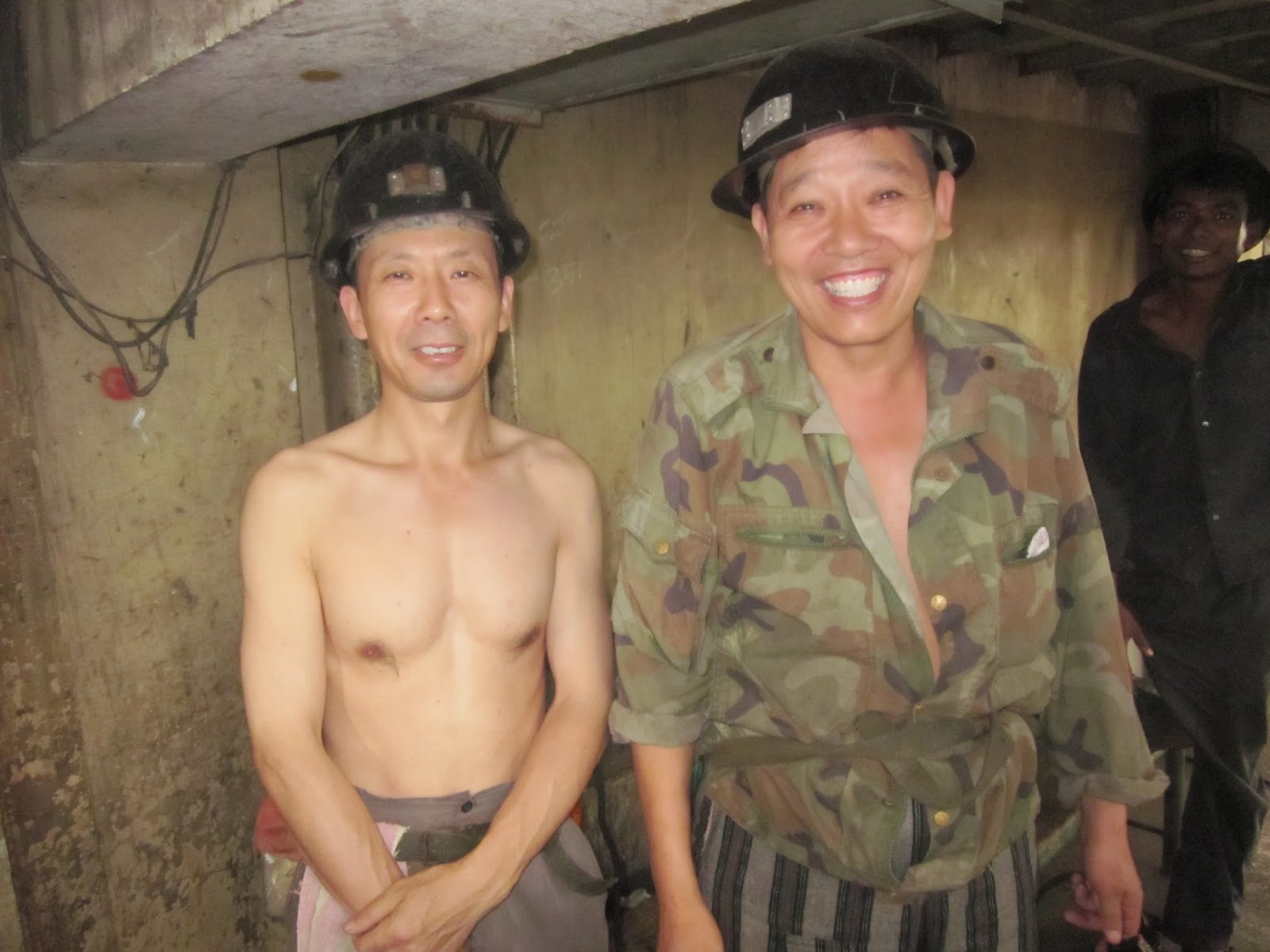
Dhaka, Khulna, Rangpur and Barisal: Mr. Zhang likes to travel. “Bangladesh is poor,” he says, interpreted from Mandarin, “but people are very honest, especially in the northern villages.”

As a Buddhist, Mr. Zhang believes in reincarnation. According to him, everything in this life is the outcome of a previous life. Something in his previous life brought him to Bangladesh this time around.

Office buildings at the mine.


The office buildings at his workplace are white tiled on the outer walls, with blue tiled angular eaves to break the monotony of a flat roof. The driveway, like the exterior of the stairwells, is circular. There’s a garden with neatly trimmed hedges. It could be any random factory office in industrial China except it isn’t. Mr. Zhang works as an engineer at Barapukuria Coal Mine in Dinajpur’s Parbatipur, and has done for a decade.

“I mostly speak to local colleagues in English,” he says, “but with the help of books and audio material I also learnt some Bangla. In Bangla it’s interesting how when people introduce how many siblings they have they include themselves in the number.”

Garden in front of the office.
Barapukuria is run by Chinese contractors. It’s unsurprising that the canteen serves Chinese fare and that signs commonly feature Mandarin characters. What’s more interesting is the mosque built for local workers in a similarly Chinese style, with white tiles and blue trim.

“At the core,” says Mr. Zhang, “all religions are the same.”


Barapukuria offices.

The Barapukuria gateway has seen better days.


Coal mining is a risky business and Barapukuria has not been a project free of controversy. Some risks are inherent: opening a new coal face where the air may contain carbon monoxide or methane, where temperatures can be high or a sudden inrush of water may occur.

Despite planning that currently includes the services of a British consultant, Barapukuria has suffered from land subsidence affecting surrounding farmlands; locals have complained of adverse impact on the water table; and some years ago workers went on strike.

The main entrance. The mine thinks it's a tea plantation.

There was also an underground flooding disaster that has since resulted in refined safety measures, put in place one hundred metres ahead of the drilling; and a concrete wall being constructed along the northern side at significant cost, to prevent further waterlogging.

The lift shaft.
There have also been issues with compensating and relocating villagers on whose former land the mine sits; though according to management most of these issues have since been settled.

Yet Barapukuria provides over 1000 jobs at the mine and a further 300 plus for Chinese workers; and it provides much needed coal for the country, most of which is used in electricity generation at the nearby power plant. Of national significance, not only does Barapukuria restrict the need for imports but due to its low-sulphur content the local rock is less polluting in power generation than the most-common, Indian, substitute.

From the surface, the first level of the mine is 293 metres down, sitting at 260 metres below sea level. From there, 1.5 kilometres of roadway and train track tunnels slope to a final depth of 430 metres below sea level.

Father-of-two Md Atiur Rahman, 30, from Mashpur, a village one kilometre from the mine, takes the lift down into the mine every workday. He’s been with the mine for nine years. “I had no work before,” he says, “We only have one bigha of land so life was hard.”

Local miner, Md. Atiur Rahman.


Underground, Rahman is responsible for constructing the beams and legs of wood along the tunnel that provide safety support. It’s a risky position because the new sections of tunnel are often hot and hold the greatest chance of roof cave-in.

Due to the risks his wife wants him to find another job, and there was a time when Rahman was scared underground, with fears of falling in the dark. But with years of experience “there is no time for fear,” he says, and although it’s hard work the mine enables him to manage his family’s finances.

Local miners attract a monthly salary of 9000 taka with 20 kilograms of rice grain and bonuses. There are four six-hour shifts per day.

The lift into the mine.
Rahman’s colleague Kabirul Islam, 33, has been working at the mine for eight years. “I like it when we get through our work quickly,” he says. The miners are given a task for each shift and if they complete it in three to four hours rather than six they return to the surface early.

He’s not scared anymore – the fear gradually left him in his first few months. But still, when leaving home of a morning he does sometimes wonder if he will ever see it again.

In 2009 seventeen miners were trapped by a cave in and one Ranjeet Chandra Roy died. “Those working at the coalface have the biggest risk,” says Islam.

Miner Kabirul Islam, after finishing a shift underground.

Miners in the lift.

Shift over.
Coal train engine.
Miners at the end of a shift.

Miners pose for the camera.


About cooperating with his Chinese colleagues, Islam says local miners have learnt to understand some Mandarin. “Kem cha means ‘train’,” says Islam. The word for train in Mandarin is actually ‘hǔo chē’ but in a tunnel with the sounds of a coal mine going on and a train quite possibly approaching at the time of use, ‘kem cha’ undoubtedly suffices.

Mr. Li, 'Om', looking busy while we chat.
Like Mr. Zhang and most Chinese miners, Mr. Li, locally called by the nickname ‘Om,’ is from the city of Suzhou in Jiangsu Province. For five years he’s worked at Barapukuria and in very basic Bangla and English he praises the skill of some of the managers.

But he misses his native cuisine. “Some of the Chinese food here is good,” he says, “but the variety is limited.” To supplement, miners have taken to growing Chinese vegetables on land beside their quarters. As can be expected, Mr. Li misses his one-year-old daughter and family who he sees only on visits home every six months.

Life at Barapukuria is strenuous and not without risk. Yet despite the hardships Bangladeshi and Chinese miners manage to cooperate in bringing the underground wealth of Bangladesh to the surface and into use. “External forces are not issues,” says Mr. Zhang. “What matters is internal attitude, which can turn any challenge into an opportunity and bring good fortune. Good deeds make for happy endings.”

With thanks to Ms. Olivia Qu for interpreting from Mandarin.


Bangladeshi miners at Barapukuria.


Barapukuria landscape.

 
Chinese miners at Barapukuria.


Mine landscape.


As the canteen (not pictured above) serves Chinese fare...


...sometimes the Bangladeshi office staff prefer the tea shop. And who could blame them?

Thursday, 4 September 2014

That Forest Feeling


Bark.


A troop of Phayre's leaf monkeys in the distance, moves through the deciduous and semi-evergreen forests of Lawachara National Park in Moulvibazar.
Why do forests inspire?


How is it that a bunch of trees and living things can lift spirits and free souls? What magnificent ingredient or elixir does the forest bring to enchant, inspire and release? Does anybody know?

I’d say it’s a lack of lines – in the sway of the giant bamboo stalks, in the leafy patterns of mulch we tread. Birth is the delicate curl of a new fern frond. Survival is the arch of a leech reaching out. Death is the decay of the forest floor – various stages – a mosaic free of squares, boxes and categories. Even the in-betweens – life’s joy in the sounds of bird and insect are hardly arranged as sheet music. They follow no tested, approved of chord progression. In the forest life is unrestrained. In randomness it finds the perfect circle.

A gorjon tree, Lawachara.
I’d say it’s a lack of lines but it can’t be. It isn’t true. The staunch, towering trunks of the ironbarks and gorjon trees in Moulvibazar’s Lawachara – they’ve thickened but otherwise not moved a millimetre in decades... they beat off the breeze, stretch up to hold the rain clouds. They put paid to that.

The forest has always been one of our best remedies. As the heart pumps to circulate blood to the toes it’s the forest that sends life-giving oxygen to the soul’s extremities. It’s as valuable as water, as soothing as the sea. The forest is in us. The forest is us.

There’s a troop of Phayre’s leaf monkeys, the chosmapora banar, in the distance – one of Lawachara’s four monkey species. The trees are deciduous, there’s a spindly network of branches outlined across an afternoon’s grey sky. The troop’s moving, one by one in bulky silhouette, taking turns out to the last branches. Then, jump! It’s suspenseful. It’s cinema. Into the clutches of a far tree’s green they land. Crash! They’re on the other side. How do they dare rely on those outermost, thin twigs? How do they know those barely-branches will not snap?

A Phayre's leaf monkey, taking a break...
Hours have passed. The monkeys are close. Their spectacled faces – slaty grey with white around the eyes – are looking down. They’re headed for distant flowers at the canopy’s top and this time as they jump it’s easier to observe the systems. The balance of the tail, the planning, the grab of arms and fingers...

The baby monkeys are trailing, frolicking as much as seriously knowing where they go... they trust their mothers will wait for them to safely negotiate the gaps. They’ll climb aboard her stomach, cling on as she jumps. It’s too far for them. Then, when secure, as she looks behind from concern for the next monkey crossing or to see what’s been achieved, the baby hops off to scamper along a new branch free of parental oversight.

Mid-air monkey!
The squirrels are fussing too, flicking their tails – short, sharp flicks – and calling with a chuk-chuk-chuk. They’re looking black from a distance – it’s confusing. They’re too small and the wrong shape for black giant squirrels – and this might be the wrong forest for those. They’re supposed to be orange-bellied Himalayan squirrels. They should be greyish – although their Bangla name, kalo kathbiral, refers to black... But where are their brilliantly bright bellies?

In the night when tranquillity makes impossible any tension – when the forested darkness curls around, threatens to make everyone a novelist, poet or painter, there’s a yellow frog – motionless, a statue, on the brickwork by the bungalow. It’s got those alien fingers with bulbous circular pads. It should be climbing a tree? There’s a mosquito biting its nose – drinking frog’s blood. How does a frog with padded fingers scratch? Why doesn’t the frog eat it? It would have to be the gecho bang, the Asian brown tree frog – nocturnal and crepuscular – common to all Bangladesh. They lay eggs on cream-coloured foam nests just above a water body.

An Asian brown tree frog.
How does a frog scratch?


By morning it’s time for humans. Buses stop, groups move about making too much noise. Md Ahad Miah has arrived. He’s 22, a little late, apologetic... a local guide – we’d arranged to set out at dawn. But he’s a forest resident too. He has fever. I like his attitude. Mahogany, chapalish, dumor – he knows the trees. “The forest is deciduous,” he says, “But after rain, say twenty days, the leaves return; the forest becomes dark.” He’s taken us deep, along leaf-covered deer trails. He dreams of opening a guest house, of knowing more about his wild patch of the Earth. He’s inspired – like me, like the city folk. Even more so – for him, his forest is some heavenly drug. He has a forest addiction.


Md. Ahad Miah, 22, tries the village flute. He has a forest addiction!
A bamboo stand. Lawachara.

There’s a rhesus macaque, incredibly bulky, at the highest heights of a tree. He’s sitting like a gentleman and it looks ridiculous – not at all agile or sleek like yesterday’s monkeys. I’m extremely concerned he’ll fall. Should he really be doing that? He may as well be a dolphin in that tree. It looks that natural.

And the leeches – ten, twenty on my shoes! They’ve made round blood circles on my ankles. There’s a price for wandering the animal domain. I would have spent the next two hours trying to remove them but Ahad is expert – he’s in sandals and not a single leech has caught him – with a stick he’s de-leeched my shoes in short minutes. He does this several times. “Do the leeches only bite foreigners?” I ask him. “Your blood is sweeter,” he says. But I don’t take sugar in my coffee?

Bamboo brings lines.
A forest oasis in a crowded country.
Lawachara: oxygen for the soul.
Butterfly on a railway sleeper.


A teak (shegun) tree.


But wait. Listen? “You’ll never see it,” says Ahad, “They’re extremely shy. Listen!” It was the dog-like bark of the barking deer. And high above – we’re looking for hoolock gibbons – it’s a squirrel of the type that doesn’t seem inclined to fit its taxonomy. And then, by chance, it jumps across a patch of sky. For a very tiny second there’s a flash – yes, a bright orange belly – you can’t see it twice. Ahad is likewise excited. “You know,” he says, “that’s the first time I saw that colour.”

We’re returning – no gibbons – but they’re not hard to find. Gibbons, you see, are incredibly loud and indiscrete. “Kuragao, kuragao” I type into my phone, trying to capture what they’re shouting with high pitched, sing-song voices beside the road. It’s just one of many sounds they make. They’re calling to warn other families not to encroach on their forest patch – in one direction others call back, in the other still more. Ahad explains the colours – males and children are dark while females are blondes. “There are about seventy gibbons in Lawachara,” says Ahad – he’s interested in everything, “from 16 families. And it’s crowded. The park isn’t suited to hosting many more.”

Ahad chooses the less-trodden paths.

Deep Lawachara.


Lawachara treetops.


Hoolock gibbons are endangered. From more than 100,000 individuals across their range from Assam to parts of Myanmar several decades ago there are no more than 5,000 now – in all Bangladesh there are 200. The hoolock gibbon is South Asia’s only ape. Lawachara is the best place to find them.

We move closer – through the trees we see – some are resting on branches, some jumping about, swinging effortlessly tree to tree. It’s true – they have no tails but when they dive into the air, catching a tree with those trusted long arms they own the forest, as though even phayre’s leaf monkeys barely know how to climb. They’re evening and morning watchmen. They’re boisterous and agile. They’re having fun.

Birth is an unfolding fern frond.

The forest excites. The soul is brimming with inspiration. Everyone’s a novelist, an artist, a poet... at least temporarily. Lawachara breathes life and space into this crowded land. We all need a little of that. “I am a part of nature,” says Ahad, “And nature is a part of me.” He’s right of course.


An ironbark tree.
The main entry to Lawachara.


After rain the leaves regrow.


Into the woods...


Lawachara's bounty.


This article is published in Star Magazine, here: That Forest Feeling


Me and a forest train.


Thursday, 17 July 2014

The Hijol Tree


Do you see? Do you see the hijol tree? Note its cracked, thirsty bark and the determinedness of its stance. With majestic bird’s-nest-in-crown and orderly ant lines it brings connectedness. It stands alone... they stand in clumps and pairs across the plain. Scan the empty lowland horizon between depressed watery stretch and rice field to find those lasting symbols.


Birds-nest-in-crown, the hijol tree.


Lal Miah, 45.


In the vast open lands that have come to be, where there is not even a hijol close at hand, he’s pottering, inspecting the paddy. Shirtless and in lungee, he says his name is Lal Miah, 45. His skin is darkened by the sun. “Maybe thirty-five years ago there was jungle,” he says, “everywhere.” His hair is grey and largely gone.


It used to be a forest.


There used to be a great forest in Moulvibazar’s Hakaluki that stretched as far as the imagination, even a little further. It was so thick with unkempt growth – branch and trunk – that every hope of finding a way through seemed lost. It wasn’t only the hijols’ home. There were koros and boron trees too. They were the main arboreal forms.


Birds nest.


We can imagine the walking in circles not being sure of the forwards from the backwards or of knowing in which direction lay the way out and which the way home. The canopy, the vines, a wealth of green so abundant that even the harsh sun’s rays must’ve been a little shy to shine there, knowing, chances were, they’d never touch the ground.


The landscape is open and empty.


Of an afternoon it would’ve been stifling with humidity – it still is as we stand in the open with Lal Miah – and crawling with insects, then. Who could’ve heard their thoughts when the green hell was decked with the din of the jhi-jhi poka cicadas? For the darting crows, jumping bough to twig, it must’ve been a heavenly supermarket in that season, with those delectable insects in their millions to be snatched as easily as leaf litter by the bucket could be lifted from the forest floor.


The few hijol trees are symbols of what was.


Wild elephants passed by, stomping, crushing, playing with bamboo stalks as toothpicks in their trunks – Lal Miah remembers. Rhesus macaques, capped leaf monkeys and the choshma bandor – the phayre’s leaf monkeys which wear the ghostly imprint of spectacles – they called loudly. Guardians of their territories those primates must’ve held confidence in where the tastiest flower-fruit-bug morsels were.


Sunlight finds the hijol.


The full moon must’ve been the decorator then, sprinkling light panes down into the first of the leaves. And to the moon the jackals raised their voices, with hundreds howling as if to triumphantly summon the shadowy places to stalk with liberty and loiter through the forest night.

When the sun sets over Hakaluki there are still a few jackals to hear; of a day a few monkeys, if you can find them.


The hijols grow in pairs, here and there, or stand alone.

But that forest was special – not just any forest – because it delighted less in ages and lunar cycles and roving pachyderms, and more in drenching rains.

When the monsoon comes it will recreate that inland sea.


Hakaluki, waiting to be submerged entirely.


When monsoon reached Hakaluki the trees waded, they got used to that – soothed and soaked all the way up their lower trunks to the first of their boughs. In those months that forest swam: a great forest submerged in an even greater but temporary inland sea. Fancy that!


The Hakaluki water is clear and as a garden underneath.


Hakaluki dreaming.


Wind-called waves leapt up at tree snakes sheltering in the nautical treetops, then, with several snakes, if Lal Miah’s memory holds true, in each and every tree. “The forest protected our houses,” he says, “Where we stand will be under ten feet of water in the monsoon.”


Hakaluki's abundance.

And along the road, stationed in the dry fields we saw the yellow nouka boats looking absurd. Even now Hakaluki is still that type of wetland called a haor. Even now a clacking frog is at work making percussion in the reeds beside the deepest permanent water body; and somewhere spotted flapshell and hardshell turtles are wondering how long before the sea returns.

The 40,000 hectares of the Hakaluki Haor area forms one of the remnant wetland ecosystems that dot the up to 25,000 km² of the Sylhet Basin. To go back further, before the howling jackals, before the cicadas, before the serpents in trees... in ancient times the whole Basin was underwater. A true inland sea, the so-called Ratnag stretched from Meghalaya’s cliffs to Tripura’s uplands, then, and provided a maritime home for the mysterious Kirata people.

The vast Sylhet Basin used to be underwater.
Hakaluki Haor, towards the summer.


Long afterwards, probably when Hakaluki was already forested, there was a locality, some place somewhere, where the local Bengali people took to pronouncing the letter ‘s’ as ‘h’. It’s from such custom that the word morphed, so it is believed: when the Bengali sagor, meaning sea, became the large seasonal wetland, haor.


Freshwater mussel shells.


Oh, and see the freshwater mussel shells – someone has eaten those – scattered along the summer shoreline? Sometimes they held pearls.


Hingai.


Oh, and see the youths with the grape-sized, devil-faced hingai fruit in their basket? Sweet like the rose apple, it grows underwater in the shallows of the dry season only to disappear when the sea arises.


Fishermen. The local fish catch is not what it used to be.


Paddy at Hakaluki Haor.


There was a plentiful piscine society bustling among the roots of the trees underwater, then. With 107 identified species to some extent there still is, but 32 species are currently threatened and the fish catch has dwindled.


Some birds are migrants, others remain.


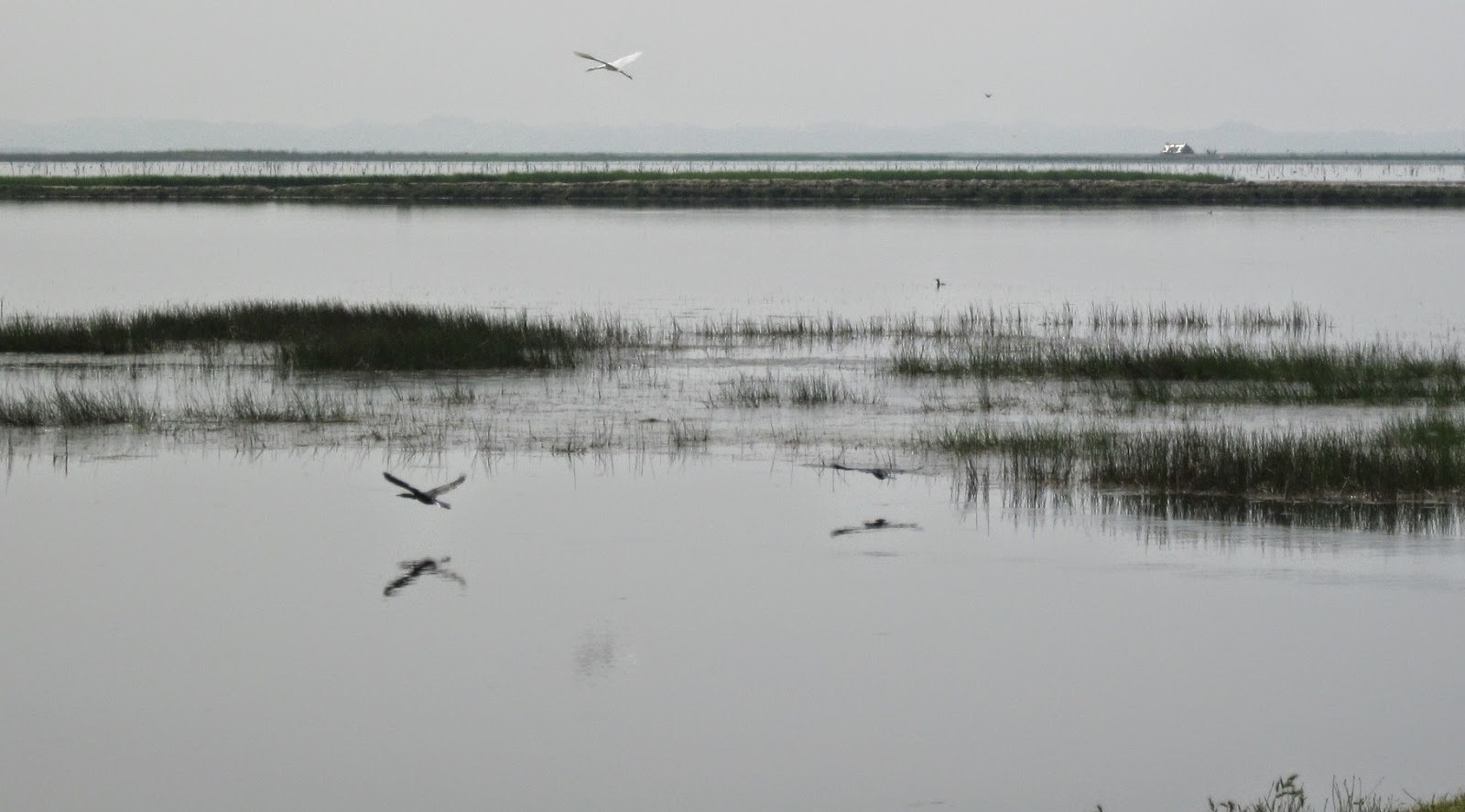
And the birds – locals and winter migrants: the egrets, the little greb, the pheasant-tailed jacana... Some fly in from as far as Siberia to be gone by the summer; all are attracted to Hakaluki’s possibilities: the purple swamphen, the Asian openbill, the little cormorant and the country’s smallest duck species, the cotton pygmy goose...


Egrets are still to be found in numbers.


“When the forest was here we couldn’t sleep for the sound of the birds,” says Lal Miah.


Egrets preparing to roost not far from the edge of the haor.


The mammals meanwhile, greater and lesser, retire to the fringes when the sea arrives. They can hardly live on boats. The porcupine, fishing cats and various civets, excluding the palm civet which may prefer to climb one of the remaining trees... Only when the water recedes will they rediscover their usual stamping ground.

Lal Miah remembers how it was.


And beyond the animals, the birds and fish, there were other things that dwelt in that forest, then. “In the jungle time nobody would dare to venture off alone at night,” says Lal Miah, “They would go in groups, if they had to, of at least five people. There were some forest places where bad things, maybe jinn spirits, killed people – time to time they’d find bodies.”


Some efforts are being made to restore Hakaluki. Since 1999 it’s been declared as an Ecologically Critical Area by the Department of Environment and projects are afoot. The Dutch are investing. This year three new bird species, the black headed ibis, the glossy ibis and the painted stork, found elsewhere in Bangladesh, were sighted for the first time. And beehives, absent since 2006, returned – three or four of them. These are signs of increasing biodiversity.

It would be a great dream to see, one day, that submerged forest rise again. Maybe it will never be. For now we can only imagine, knowing that secret past while inspecting the hijol tree.

Do you see? Do you see the hijol tree?


Another day dies.


Will the forest ever arise again?


Lastly, you know, a strange thing happened in Hakaluki which you won’t believe. It was when we’d walked a few hundred paces away from Lal Miah – still in the open vastness, not a single tree to hide behind, no rise to the land. But when we turned, looked back and scoured the scene, it was more than a little perplexing... that Lal Miah... he was gone; vanished as if into thin air.


Sunset at Hakaluki Haor, Barlekha, Moulvibazar, Bangladesh.


This article is published in Star Magazine, here: The Hijol Tree

With thanks to Bashir Ahmed of the ECA Management Unit, Department of Environment, for introducing the haor ecosystem.