Showing posts with label Barlekha. Show all posts

Friday, 17 October 2014

The Spirit of Madhabkunda


Madhabkunda waterfall, Barlekha, Moulvibazar.


Madhabkunda Falls.


“Shhh! There need be silence,” she says, “A white chicken will meet its death.”

If there is any kind of water-spirit lingering beneath Barlekha’s renowned Madhabkunda waterfall in Moulvibazar District, what kind of spirit would she be? The gentle falls and cool, dark pool certainly look like a place where a spirit might dwell.

Perhaps she’s benign and helpful, a sort of Bengali pari related to the ones people talk of that sometimes clean the house during the night. Perhaps she’s mischievous like a prai of the old Khasi belief. Prais make people sick. Do you think the Madhabkunda spirit might dance mystically to the rhythm of water falling, in secret, long after the crowds have gone home – under the wild, full moon’s charms?

Such a spirit would know things. Ancient local knowledge tells, for example, that where lightning touches the ground from stormy sky the earth reached is tainted. To the words of a reem, in an old Khasi ceremony, a sacrifice is needed to heal such a place. “A white chicken will meet its death,” she says.

In Madhbob Kundo Punjee, the Khasi village across the stream adjacent to the falls, the villagers can vaguely speak of it. But they’ve forgotten their old ritual’s words. They’re 50-50 Catholic Presbyterian now.

The gate to Madhabkunda Eco-park.


“Roll up! Roll up!” she says. “Get your clothes, plastic dolls, toys, chip packets and chanachur! Stock up on cold drinks or bottled water – my waterfall’s charms might make you thirsty. Fried snacks can satisfy, souvenirs bring joy!” The spirit of Madhabkunda is not shy of modernity.

The pathway to the falls.
She allows the bonanza bazaar noise before the gate. She knows the worth of a waterfall to city-dwellers in a flat and crowded land. She values marketing, surely.

And the buses and the hired CNGs duly arrive, carting tourists in from the highway through the sculpted rounded landscape of tea garden hills – families, college winter picnicians, elderly, young, everyone... The spirit of Madhabkunda spies as passengers queue along bus aisles in anticipation of that first step into the air of the car park. “Let them eat and shop on their way to the ticket window,” she says. Let beauty, as it does, attract all comers.

She’s allowed them a pointed, triangular gateway of red brick – with iron gates to be locked each evening. Across the gateway is written in Bengali “Forest Division. Madhabkunda Eco Park.” The ticket collector sits on a stool just inside.

The spirit of Madhabkunda is hardly an environmental zealot unaware of the need for paved paths, metal railings and revenue. She must be of the spirit type to hear the rattle of currency in the prefix “eco”. The spirit consumes the convenience of rotundas and cafes – she calculates the contribution of painted stork statues. This spirit has seen the rise of this country’s middle class joy seeker – and she’s joined them.

A kitchen in Madhab Kundo Punjee.


She’s watching too – she must be – as the kettle boils on an old wood-fired stove in a Khasi kitchen on the other side of things, a room in smoke-stained blue that feels like it belongs in the snowy, dark winter of some faded Taiwanese hill town.

In the punjee.


She’s listening I imagine, further uphill as I speak to Wanbor Longdohgiri, the 32-year-old Montri – the headman of his village. He’s been the Montri for two and a half years now. His older brother held the post for nine before he retired. Another villager was then elected but it didn’t work out. So they chose him. “It’s like the work of ten people,” he says.

Montri Wanbor’s life is filled with betel business and minor village concern now. There are no land disputes in Madhob Kundo Punjee and he’s yet to face anything major – but they’re hoping for that bridge across the river which their MP was talking about last year, because at the moment everything has to be hauled in by hand – stone-hopping across the stream.

“Take a raw chicken egg,” she says. “Put rice grains upon it and cut it open in a dash. Then let it fall on that leaf they call the sli lemet.” The Spirit of Madhabkunda must remember the old healing.

Montri Wanbor "looking wise".
“If my father was alive he could do it,” says Montri Wanbor. “From the way the egg falls on the leaf he could read the problem.” If it was a normal sickness the efforts of a traditional healer wouldn’t help... but if the sickness was caused by a prai...

I want him to smile for a photograph. She knows. He’s the Montri so I ask him to “look wise.” She hears. It causes laughter as he tries to imagine what a wise look might look like. The camera clicks. No doubt she’s laughing with us.

Madhabkunda waterfall is a Facebook star.


“Now concentrate!” she says. It’s not the only photography going on. In the late afternoon the young lads are lining up, finding space. Watch them perch on the slippery rocks that edge the waterfall’s pool. In best checked shirt one outstretches arms as if to hold the sky. In the glowing white purity of nearly-brand-name sneakers he falls slightly backward while tilting head and smiling, as if fashionably struck by lightning.

Facebook posing at Madhabkunda.


His friend’s smart phone captures each post-able “Been to Madhabkunda” still. The water spirit must welcome each electronic click – as her waterfall’s fame grows. 

Another one, another pose – he makes a half-crouch this time, a resting of the chin in photogenic contemplation upon the hand. Sunglasses are on. Then sunglasses have retreated to rest atop the head. They are here. They are here now, looking cool.

With thousands of faces in hundreds of thousands of poses the spirit of Madhabkunda must be a social media champion. Her waterfall, whose pose changes only periodically with rain, is a perennial super-liked Facebook star.

A house in the punjee.


And, just an aside, perhaps those lads are seeking young ladies with those poses; but perhaps in the waterfall background, unseen, she is already there.

Take care with your belongings – a group was hijacked along that short path that very afternoon. Don’t leave anything behind. Take care when swimming. Don’t swim. “Two to three drown in that river every year,” says Montri Wanbor, “but we Khasis always swim and it’s never happened to us.” Is the spirit of Madhabkunda one to immorally takes sides or is it that the locals understand better her river’s tricks?

The path to the falls at Madhabkunda.
Families are enjoying their leisure time in eco style: sitting, walking, wandering and talking. In the socialising is the rekindling of the bonds of human affection. A young couple are hoping to make memories, learning what to expect from days shared of which they yet hope there will be many. Babies are being carried – heads bobbing, eyes gazing. Grandparents take their time...  Bangladeshis all – the nation is carving out a better future. It’s an accessible, more upwardly mobile sort of a waterfall that she has. The Madhabkunda spirit is on the move.
Madhabkunda and the hint of a rainbow.


But what sort of spirit is she really? Is she a benevolent pari or a malevolent prai? She remembers the wilderness. She’s hostess of the Eco Park. She’s observed the future coming. Every day she watches crowds leaving. And just maybe she dances under the full moon. Ancient, modern, pleasure, accident, crime, ritual, photo, plastic doll souvenir and chanachur: in that busy place the water spirit bears witness to humanity, all.

With the fortune of a waterfall in a flat land as her treasure, she’s built herself half a rainbow – you can see it just above the pool. “Shhh! The future is on its way,” she says, “and it’s featured on Facebook.”


This article is published in Star Magazine, here: The Spirit of Madhabkunda

Thursday, 7 August 2014

In the Service of the Fungus

In Sujjannagar there are two large factories and one thousand household distilleries.

Spikes added to an agarwood branch.

For centuries those of ambition not predestined to be born of royal lineage or to some stocky, loaded philanthropist have sought fortune and fame. It’s a matter of being noticed by the right people, of being talked about, written about. What’s needed is an attractive trait, a charming disposition – to move in the right circles. Then, ultimately, one becomes indispensible. Nobody cares about the origins of a prized companion.

In the villages of Sujannagar Union of Moulvibazar’s Barlekha it’s possible to observe that this age-old strategy is not exclusively pursued by humans but may be adopted by other life forms too. There, an upwardly mobile fungus, phaeoacremonium parasitica, has done rather well.


At the Noor Hazi Miah factory.

The air at the large Noor Miah Hazi factory in Shartika village is corky sweet. Village men are sitting along the veranda corridor each holding a lump of wood by their feet and chiselling. They’re focused on the dense heartwood patches and chiselling. They know the lighter, healthy parts of the wood are of little value. For 500 taka per day they’re working for the factory. In a way, they’re also working for the fungus...

Neither plant nor animal, fungi demand their own kingdom. They have always been special. This particular fungal species, phaeoacremonium parasitica, infects agar trees by habit. The autoimmune response of the trees is to produce a resin designed to stop further fungal growth. In the process the infected wood emits that exclusive, pungent smell known as agar-attar or oudh. 

Chiselling...


It’s a scent that’s never been reproduced artificially. It’s a corky sweet scent so sought after that, at premium quality, agarwood has attracted prices abroad of up to $10,000 per kilogram. Agarwood is reputed to be the world’s most valuable living raw material. It’s the agar-attar scent, in the wood or when steam-distilled into oil – a small sacrifice – that has been the secret of phaeoacremonium parasitica’s success.


At work in Sujjannagar.


Because when they’re not chiselling, Sujjannagar’s villagers are busily maintaining plantations of the fungus’s favourite agar tree. Although it takes an agar tree a century to reach maturity, saplings can be harvested after ten years, encouraging many to dedicate lands to the species – and for the fungus that surely makes for a more civilised arrangement than a forest.


Phaeoacremonium parasitica keeps people busy in Barlekha.
While in the wild, only seven percent of trees will become infected with the fungus, Sujjannagar is organised to achieve a one hundred percent infection rate. 

While other fungi must rely on animals, wind or water to rather randomly disseminate their spores, phaeoacremonium parasitica has cajoled humans into that task too – not only do workers deliberately infect new trees, they even hammer nails up and down the trunks a few years prior to harvest to permit the fungus untroubled entry.

Indeed, with almost every family engaged in the agar-attar industry in several villages, a bright and secure future for the fungus is assured. All it requires is the sacrifice of some of its members to the fame-enhancing agar-attar scent industry. It’s certainly not a bad arrangement for a parasitic dark-walled mould to have.


Agarwood infected by phaeoacremonium parasitica.

New agarwood arrives at the factory.


Still, the social rise of phaeoacremonium parasitica hasn’t occurred overnight. From time immemorial Malaysian aboriginals, the Orang Asli, have harvested wild agar trees for the agar-attar that in Malaysia is called gaharu, using a slashing technique that reveals the infected heartwood without felling the tree. Thereby the Orang Asli can re-harvest from the same tree a few years later... and the fungal community continues to thrive.


The agarwood chips are first soaked.


The fungus’s future certainly received a boost through references to agar-attar in the Sanskritic Vedas. It also features in Chinese author Wa Zhen’s third century chronicle “Strange Things from the South,” which records the collecting of agarwood from the mountains of Rinan, now central Vietnam. The product is included as a medicinal product in several ancient texts, and in Xuanzuang’s travelogues of the seventh century agarwood products are recalled as being used for writing materials and oil in ancient Assam’s Kamarupa – traditions that persist.


Distilleries at the Ansarul Hoque agar-attar factory.

With the rise in renown of the agar-attar scent evidenced and furthered by these writings, phaeoacremonium parasitica has indirectly achieved an enhanced pedigree beyond its humble mouldy origins, which must’ve led to its later finding favour at the Mughal court. For centuries the wood-mould by-product has been quite at home at royal parties; dabbed here and there on the clothes and in the underarms of princes.


The humans put nail holes along the agar trunk to allow the fungus unhindered entry.

In Japan there has even developed a tradition of ‘listening’ to the agarwood, with a burning chip taking centre stage in a closed room while aficionados meditate in its scent. All of this has been good news, no doubt, for the fungus.

Agar-attar businessman Afjal Uddin.


In Sujjannagar the agar-attar industry dates from the 1940s when the harvest of wild agar trees began. These days there are two large factories and perhaps one thousand household distilleries in the area. There are middlemen such as Afjal Uddin, 40, of Gankul village, who sell to exporters, constantly renewing the scent’s acclaim around the world and in particular in today’s principal markets which include Mumbai, Singapore and especially the Middle East.


Agarwood chips in a steam distillery, Barlekha.
“The scent lasts for six months,” says Afjal in favour of the product, “It does not leave any spot or stain on the clothes.” In addition, agar-attar is popular in Muslim majority countries because unlike most western perfumes the scent is not alcohol-based. While according to Afjal agar-attar is not overly suited to the domestic market due to its being price inhibitive, export-oriented production has brought long-term prosperity to both phaeoacremonium parasitica and the villagers of Sujjannagar.

Md Yusup at the factory distilleries.


Md Yusup, 46, is a prime example. He has been working as supervisor at the Noor Miah Hazi factory for 17 years. He controls the distillation process that produces the oil. With three staff he is able to process up to one hundred trees per month; and it’s the agar-attar that’s brought him the income to send his daughter to college. The oil is most often exported to Dubai and Kuwait.


This agar tree is worth about $1200.
Bangladeshi agar-attar production competes with plantations in Cambodia, Vietnam, Malaysia, Indonesia and elsewhere in South Asia. Afjal says agarwood can sell for up to 80,000 taka per kilogram domestically, though its rate has recently reached a new market low of 20,000 taka. He is not sure of the reason for the fall but believes unscrupulous traders who inserted ball-bearings into the wood for extra weight before on-selling to Chinese importers may have damaged the reputation of the Bangladeshi product.
Agar-attar production has brought prosperity.

“One big tree can net its owner anywhere from 1.5 lacs taka to five lacs,” says Afjal.

In Sujjannagar, phaeoacremonium parasitica, on the back of the charming scent producing reaction of its host the agar tree, has created for itself an ideal environment in which to be valued and prosper. Having avoided the unceremonious anonymity of many other fungal species, which clearly made the evolutionary error of being either poisonous or otherwise dull, so as to preclude human cultivation, phaeoacremonium parasitica has joined the exclusive ranks of edible mushrooms, the fungi used in cheeses and yoghurts and of course the yeast that’s made its niche in bread.

Agarwood, the world's most valuable living raw material.


This fungus has mixed with royalty, enjoyed the enduring fame that arises from being written about through the centuries and continues to enjoy a privileged existence, not least in Sujjannagar where whole communities shall remain self-motivated and dedicated to its bright and enduring fungal future.

The steaming vats at the Ansarul Hoque factory.


In nature all things are connected – and in the pyramid of life, from phaeoacremonium parasitica’s perspective, the humans, the workers, take their rightful place at the lowest rung in the ladder.


Workers at the Ansarul Hoque attar factory, Sujjannagar.
Agar-attar oil.
Rows of new agar trees.


This article is published in The Star Magazine, here: In the Service of the Fungus


This bottle of agar-attar oil is worth about $800 locally and much more overseas.


Thursday, 17 July 2014

The Hijol Tree


Do you see? Do you see the hijol tree? Note its cracked, thirsty bark and the determinedness of its stance. With majestic bird’s-nest-in-crown and orderly ant lines it brings connectedness. It stands alone... they stand in clumps and pairs across the plain. Scan the empty lowland horizon between depressed watery stretch and rice field to find those lasting symbols.


Birds-nest-in-crown, the hijol tree.


Lal Miah, 45.


In the vast open lands that have come to be, where there is not even a hijol close at hand, he’s pottering, inspecting the paddy. Shirtless and in lungee, he says his name is Lal Miah, 45. His skin is darkened by the sun. “Maybe thirty-five years ago there was jungle,” he says, “everywhere.” His hair is grey and largely gone.


It used to be a forest.


There used to be a great forest in Moulvibazar’s Hakaluki that stretched as far as the imagination, even a little further. It was so thick with unkempt growth – branch and trunk – that every hope of finding a way through seemed lost. It wasn’t only the hijols’ home. There were koros and boron trees too. They were the main arboreal forms.


Birds nest.


We can imagine the walking in circles not being sure of the forwards from the backwards or of knowing in which direction lay the way out and which the way home. The canopy, the vines, a wealth of green so abundant that even the harsh sun’s rays must’ve been a little shy to shine there, knowing, chances were, they’d never touch the ground.


The landscape is open and empty.


Of an afternoon it would’ve been stifling with humidity – it still is as we stand in the open with Lal Miah – and crawling with insects, then. Who could’ve heard their thoughts when the green hell was decked with the din of the jhi-jhi poka cicadas? For the darting crows, jumping bough to twig, it must’ve been a heavenly supermarket in that season, with those delectable insects in their millions to be snatched as easily as leaf litter by the bucket could be lifted from the forest floor.


The few hijol trees are symbols of what was.


Wild elephants passed by, stomping, crushing, playing with bamboo stalks as toothpicks in their trunks – Lal Miah remembers. Rhesus macaques, capped leaf monkeys and the choshma bandor – the phayre’s leaf monkeys which wear the ghostly imprint of spectacles – they called loudly. Guardians of their territories those primates must’ve held confidence in where the tastiest flower-fruit-bug morsels were.


Sunlight finds the hijol.


The full moon must’ve been the decorator then, sprinkling light panes down into the first of the leaves. And to the moon the jackals raised their voices, with hundreds howling as if to triumphantly summon the shadowy places to stalk with liberty and loiter through the forest night.

When the sun sets over Hakaluki there are still a few jackals to hear; of a day a few monkeys, if you can find them.


The hijols grow in pairs, here and there, or stand alone.

But that forest was special – not just any forest – because it delighted less in ages and lunar cycles and roving pachyderms, and more in drenching rains.

When the monsoon comes it will recreate that inland sea.


Hakaluki, waiting to be submerged entirely.


When monsoon reached Hakaluki the trees waded, they got used to that – soothed and soaked all the way up their lower trunks to the first of their boughs. In those months that forest swam: a great forest submerged in an even greater but temporary inland sea. Fancy that!


The Hakaluki water is clear and as a garden underneath.


Hakaluki dreaming.


Wind-called waves leapt up at tree snakes sheltering in the nautical treetops, then, with several snakes, if Lal Miah’s memory holds true, in each and every tree. “The forest protected our houses,” he says, “Where we stand will be under ten feet of water in the monsoon.”


Hakaluki's abundance.

And along the road, stationed in the dry fields we saw the yellow nouka boats looking absurd. Even now Hakaluki is still that type of wetland called a haor. Even now a clacking frog is at work making percussion in the reeds beside the deepest permanent water body; and somewhere spotted flapshell and hardshell turtles are wondering how long before the sea returns.

The 40,000 hectares of the Hakaluki Haor area forms one of the remnant wetland ecosystems that dot the up to 25,000 km² of the Sylhet Basin. To go back further, before the howling jackals, before the cicadas, before the serpents in trees... in ancient times the whole Basin was underwater. A true inland sea, the so-called Ratnag stretched from Meghalaya’s cliffs to Tripura’s uplands, then, and provided a maritime home for the mysterious Kirata people.

The vast Sylhet Basin used to be underwater.
Hakaluki Haor, towards the summer.


Long afterwards, probably when Hakaluki was already forested, there was a locality, some place somewhere, where the local Bengali people took to pronouncing the letter ‘s’ as ‘h’. It’s from such custom that the word morphed, so it is believed: when the Bengali sagor, meaning sea, became the large seasonal wetland, haor.


Freshwater mussel shells.


Oh, and see the freshwater mussel shells – someone has eaten those – scattered along the summer shoreline? Sometimes they held pearls.


Hingai.


Oh, and see the youths with the grape-sized, devil-faced hingai fruit in their basket? Sweet like the rose apple, it grows underwater in the shallows of the dry season only to disappear when the sea arises.


Fishermen. The local fish catch is not what it used to be.


Paddy at Hakaluki Haor.


There was a plentiful piscine society bustling among the roots of the trees underwater, then. With 107 identified species to some extent there still is, but 32 species are currently threatened and the fish catch has dwindled.


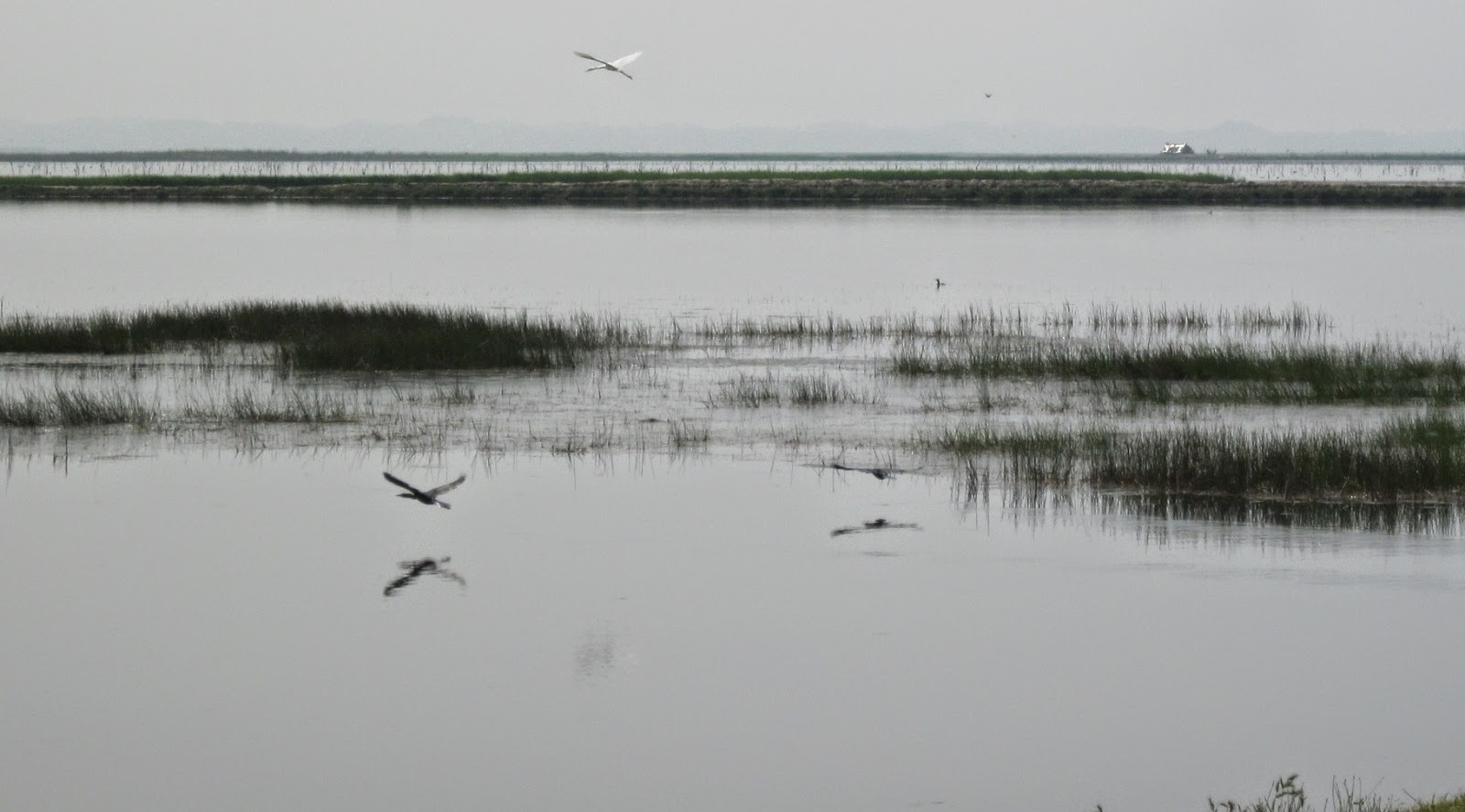
Some birds are migrants, others remain.


And the birds – locals and winter migrants: the egrets, the little greb, the pheasant-tailed jacana... Some fly in from as far as Siberia to be gone by the summer; all are attracted to Hakaluki’s possibilities: the purple swamphen, the Asian openbill, the little cormorant and the country’s smallest duck species, the cotton pygmy goose...


Egrets are still to be found in numbers.


“When the forest was here we couldn’t sleep for the sound of the birds,” says Lal Miah.


Egrets preparing to roost not far from the edge of the haor.


The mammals meanwhile, greater and lesser, retire to the fringes when the sea arrives. They can hardly live on boats. The porcupine, fishing cats and various civets, excluding the palm civet which may prefer to climb one of the remaining trees... Only when the water recedes will they rediscover their usual stamping ground.

Lal Miah remembers how it was.


And beyond the animals, the birds and fish, there were other things that dwelt in that forest, then. “In the jungle time nobody would dare to venture off alone at night,” says Lal Miah, “They would go in groups, if they had to, of at least five people. There were some forest places where bad things, maybe jinn spirits, killed people – time to time they’d find bodies.”


Some efforts are being made to restore Hakaluki. Since 1999 it’s been declared as an Ecologically Critical Area by the Department of Environment and projects are afoot. The Dutch are investing. This year three new bird species, the black headed ibis, the glossy ibis and the painted stork, found elsewhere in Bangladesh, were sighted for the first time. And beehives, absent since 2006, returned – three or four of them. These are signs of increasing biodiversity.

It would be a great dream to see, one day, that submerged forest rise again. Maybe it will never be. For now we can only imagine, knowing that secret past while inspecting the hijol tree.

Do you see? Do you see the hijol tree?


Another day dies.


Will the forest ever arise again?


Lastly, you know, a strange thing happened in Hakaluki which you won’t believe. It was when we’d walked a few hundred paces away from Lal Miah – still in the open vastness, not a single tree to hide behind, no rise to the land. But when we turned, looked back and scoured the scene, it was more than a little perplexing... that Lal Miah... he was gone; vanished as if into thin air.


Sunset at Hakaluki Haor, Barlekha, Moulvibazar, Bangladesh.


This article is published in Star Magazine, here: The Hijol Tree

With thanks to Bashir Ahmed of the ECA Management Unit, Department of Environment, for introducing the haor ecosystem.