Showing posts with label moheshkhali. Show all posts

Friday, 22 May 2015

The Lives and Loves of Moheshkhali's Betel Vines


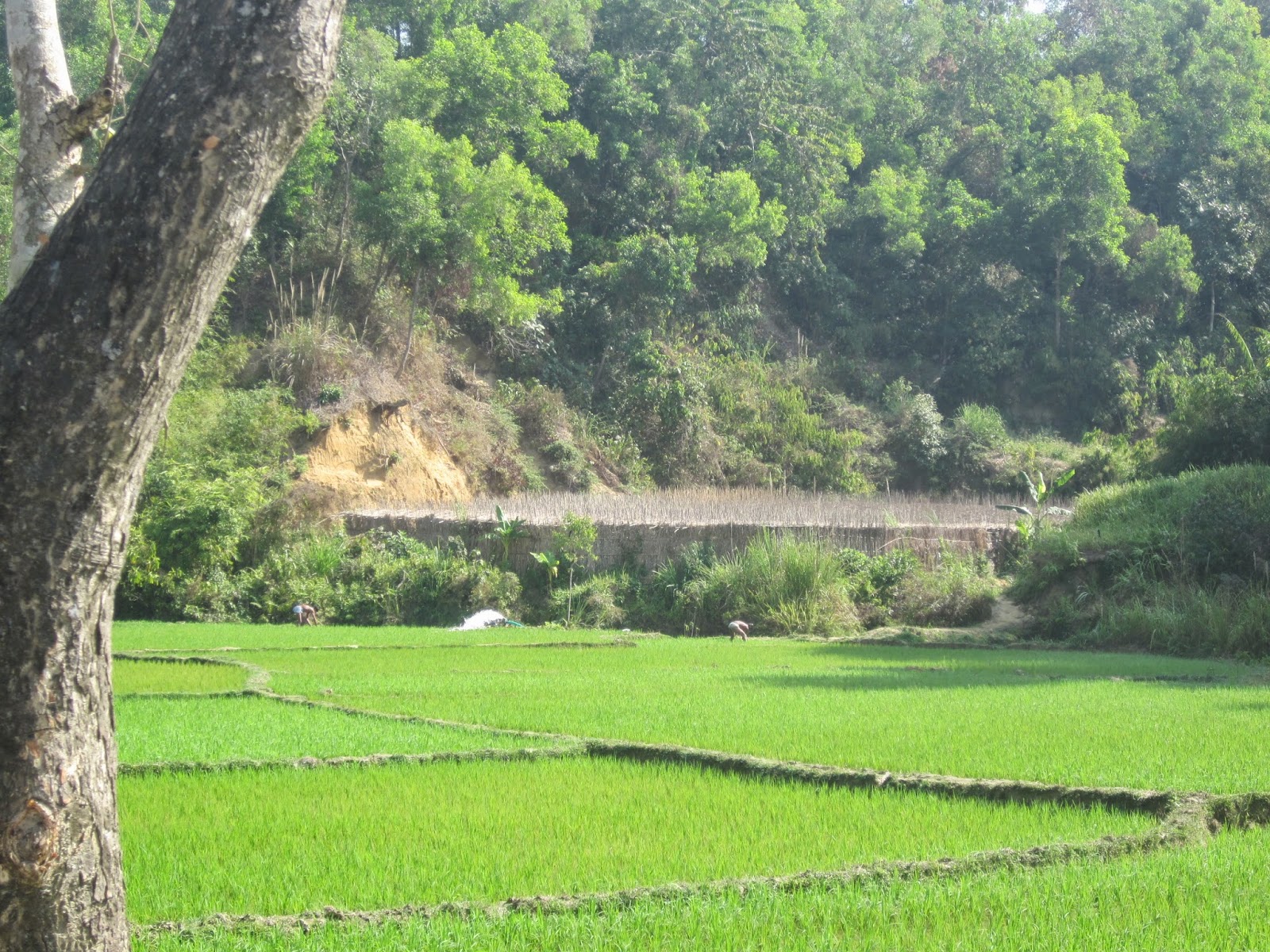
Beyond the paddy, a paan barouj. Moheshkhali's paan is famous for its sweet flavour.

“Man's dearest possession is life. It is given to him but once, and he must live it so as to feel no torturing regrets for wasted years, never know the burning shame of a mean and petty past; so live that, dying he might say: all my life, all my strength was given to the finest cause in all the world—the fight for the Liberation of Mankind.

Paddy and paan on the Shaplapur Road.
Life: one could spend time contemplating the above clunky quote of early twentieth century Soviet socialist realist writer Nikolai Alexeevich Ostrovsky, doubtless finding in it some worthwhile intent. Alternatively, one could let go and chew on a Moheshkhali betel leaf, a Moheshkhali paan.

Hear the harmonium start to turn its churning phrase? Is that the dotara that’s plucking out the first beats of rhythm? Don’t worry: the folk song voice of the late Shefali Ghosh isn’t far off; on the subject of Moheshkhali’s paan she’s got something to say…

But before we hand over to Shefali’s recording, let’s meet Jamal Hossein, 25, the betel seller at the front of his family’s tea shop in Gorakghata. Watch him set to work! Clearly he could go elaborate on us: cardamom, anise, cloves, shredded coconut, chewing tobacco, a mukhwa digestive mouth-freshening mix and sugar coated fennel seeds; but as well he keeps it simple.

Tending paddy below, paan barouj above.
A few shreds of areca nut, fresh or dried, and a dollop of builder’s lime, chun, on the side. Be sure the areca in either form is from Teknaf, that the leaf is Moheshkhali’s own… though with Jamal the expert for five taka there’s nothing to worry about, so don’t give it a second’s thought.

Watch how with adept fingers he folds the paan khili into its usual conical package shape; watch how… Hey presto! It’s ready…


A tea shop in Gorakghata

But wait… Abu Taher’s beaten us to it. At the first tea shop bench in from the street he’s already chewing. The 40-year-old truck driver from Chittagong carts cement to Moheshkhali, six-hours each way, up and down every day. When work is done, he knows to savour an island paan before climbing back into his rig.

A map of Moheshkhali Island.
“You can’t get paan like this elsewhere,” he says, “The soil is honey; Moheshkhali’s paan is sweet.”

I’m not sure Taher’s face as it chews is beautiful in any usual sense though his wife probably likes it. Yet for Moheshkhali his face is new, even if it’s a new face that re-arrives daily. Jodi shondor akkhan mukh paitam, Jodi notun akkhan mukh paitam… Shefali’s begun: “If I come across a beautiful face; if I come across a new face…”

Moheshkailla paaner khili tare bhanai khaoaitam! “I’ll make for him a Moheshkhali paan-khili, for him to chew,” sings the queen of Chittagonian folk music, who started her music career at age seven and was famed for the dramatic on-stage presentation of her songs.

Yet if for Shefali our island paan means love, let’s not forget 28-year-old Rokshana Aktar. She’s not with us at the tea shop right now. She’s at home in Choto Moheshkhali Union, and if not sewing with the eldest of her three daughters then she might be mixing fertilizer or organising accounts, her contribution to the family’s paan garden business, the tasks she can complete without leaving the house.

Paan / Betel leaf, ready for sale.
For Aktar, Moheshkhali paan is less about love and more about livelihood. Her family have taken up the task of the barui, the paan cultivator. “Harvest begins after one month,” she knows; after two it’s even better.

First the stick and straw barouj, the paan’s shade house is constructed, often in tight valleys or on slopes of Moheshkhali’s otherwise-difficult-to-farm hills. Twenty days after cuttings are planted fertilizer is applied, cow dung, potassium, magnesium… Two weeks later stakes are affixed to hold the burgeoning vines.

“Insects are the biggest risk,” Aktar says, “If they attack the whole plant dies.”


Betel vines growing in a barouj.

Ek dinelai rakhi tare, Housher pirit shikhaitam… sings Shefali. “I will keep him for a day. I will teach him sweet love.” And for Shefali’s one day of Moheshkhali paan fostered love, Aktar’s husband and one of her two sons attend to the barouj daily. They only hire outside help at peak times.

Rokshana Aktar.
As vines lengthen they are pulled down with the low stem portions curled and covered in soil to promote further growth. Leaves are harvested from the top of the vine and, insects aside, a betel vine produces for several years.

“Poush to Falgun are the most profitable months,” says Aktar the accountant, referring to the December – March days of winter to early spring. During this period the supply of betel leaf is less and prices rise. During the monsoon months the opposite applies. Yet in all twelve months there is paan to be harvested.

Noya mukher noya kotha, Sunite shondor…
Mazemaze paan cibaito, Hashiro bhitor.

“A new face’s new words sound beautiful,
Sometimes he will chew paan while laughing inside.”

“We used to grow tomatoes, brinjal and chilli on rented land,” says Aktar, “My husband did carpentry or any odd job.” But for the last three years it’s paan’s words that have them laughing. “The income is good,” she says, “To invest 1 lakh taka is to get 2 lakhs in sales.”

Paddy and paan, leading up a valley.
As for its taste, Aktar says, “If you try it, you’ll like it. Other betel is tart.”

Four leaves make one gonta and 80 gontas make one birra; and one birra sells for between 150 – 300 taka depending on quality: the sums one needs to know in the betel game. Every Tuesday and Friday the largest betel market on the island is held at Boro Moheshkhali’s Notun Bazar. Aktar’s husband goes fortnightly, returning with about 20,000 taka.


Paan for sale in Notun Bazar, Big Moheshkhali.

And while he’s at the market he might meet Mohammed Zakaria, 35, just as easily as we’ve met him on the second bench from the street, back in Jamal’s tea shop. He’s chewing paan while Shefali takes rest for a short instrumental break.

It's a busy scene at Notun Bazar paan market on Tues, Fri.
Zakaria has a barouj of his own. He’s a Notun Bazar regular. “My garden is the size of this shop,” he explains.

But he doesn’t only go to Notun Bazar to sell; he also speculates. “I feel the weight,” he says of how he chooses betel to buy that he thinks he can resell minutes later at a higher rate. “One birra can weigh as much as a kilogram, though it’s usually only 300 to 400 grams.”

Shefali’s accompanying him now… Premer mala dono hate, Tare golai poraitam… “With two hands I place love’s lei onto his neck.” It’s probably how Zakaria feels when he’s gambled well and re-sold paan at a healthy profit.

Negotiations underway at Notun Bazar.
“Moheshkhali paan tastes good because of the soils,” the connoisseur says.

Meanwhile at the third bench in from the street is 37-year-old Sultan Mohammed Khan. A more local than this local would be hard to find. His family has been in Moheshkhali for generations; an ancestor was chairman of half the island in the eighteenth century, according to Khan, when Hiram Cox was the running governor.

His grandfather once exported salt by sampan to Kolkata. His father established shrimp farms while Khan is a landholder who leases out family land on a fifty-fifty share basis to both salt producers and shrimp farmers. And Khan enjoys his paan. “Moheshkhali’s paan has heavy taste!”

Rosher kotha, Rosher pirit, Jodi na jane… Duyan ekhan kotam tare, Premer karoner, Shefali continues.

Areca nut / Shupari. The best comes from Teknaf.
“Romantic talk, romantic love, if he doesn’t know… A little sweet talk to him, for the sake of love…” Ah, the little tea shop talk of Moheshkhali’s paan might not be romantic, but it’s likewise sweet!

Khan’s lifestyle allows him to travel. He’s been to all but 17 districts of Bangladesh, he claims, and in 1994 ventured as far as a Kolkata book fair in search of a tome by one of his favourite authors: Nikolai Ostrovsky. Yes, he’s a landlord who appreciates a staunchly communist writer; apparently he can contemplate Ostrovsky’s heavy phrases and chew heavy-tasty paan at the same time.
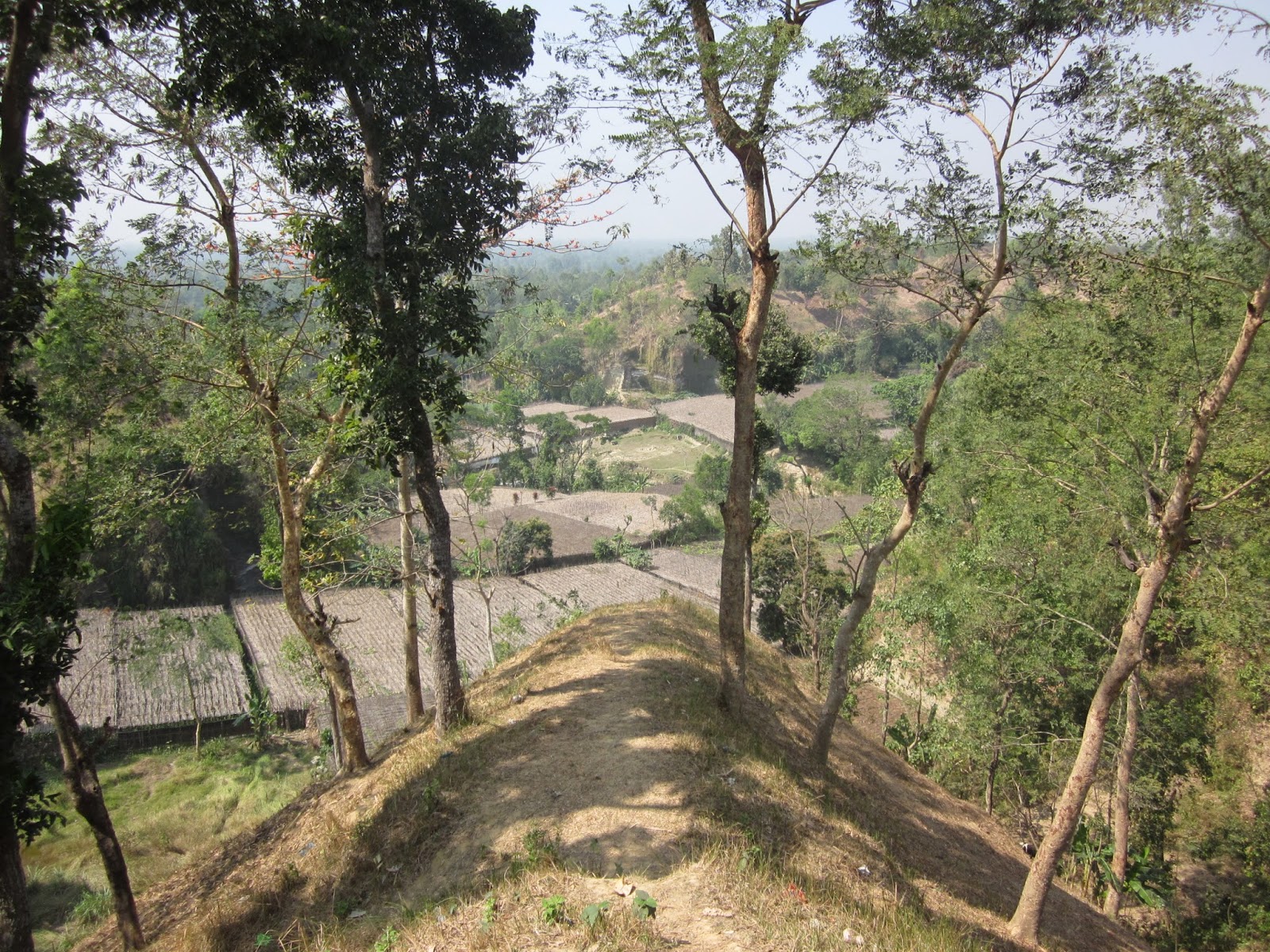

Paan growing at the foot of Adinath Hill in Little Moheshkhali.


Paan is one of the main crops on Moheshkhali.
“Nutrition and taste are different things,” Khan opines, “The paan here is both more nutritious and tastier than in other districts, where paan tastes bitter.” A mention of Bhola’s betel leaf provokes him to screw his face with displeasure. No words are needed.

As for Indian betel he’s still less impressed. “It looks nice,” he recalls, “and it’s grown with more scientific methods; but the taste isn’t so good.”

Noronarir housher pirit, Ki moza tare bujaitam… she sings. “Sweet human love, how nice it is he will know.”

Let the final spoken words be from Jamal the betel seller. He’s explaining that not all Moheshkhali paan is the same. “The paan from older, hillside gardens is the best,” he says, “Paan from newer gardens is a little less tasty and softer.” And it can’t be certain even Shefali knew that.

Paan, sold by the birra.

It really does taste sweeter. I tried one before I'd even heard of Moheshkhali paan and I thought "Wow! That was a tasty paan."


Moheshkhali paan. Immortalised in folk song.
Moheshkailla paaner khili tare bhanai khaoaitam! “I’ll make for him a Moheshkhali paan-khili, for him to chew!” Shefali’s fading now, her song’s almost done. But of course the singer who died before her time, of a brain haemorrhage in 2006, always lives on in her music.

So whether it’s for livelihood or speculation, as a truck stop treat or while considering the wisdom of a Soviet writer, whether its hillside or new garden variety, while chewing Moheshkhali’s paan and imbibing its distinctively sweet, easy recognisable flavour, you might just find thrown into the bargain a hint of Shefali’s immortal tones, of love’s serenade.

Had he known of it, even Ostrovsky could not have objected to that. 


A paan barouj in Moheshkhali will often be located in a valley or on a hillside.


An abridged version is published in The Daily Star, here: Lovers of Moheshkhali Betel


An aside: after visiting the paan market one hot morning in Big Moheshkhali, it was time for breakfast. I found a local hotel and before long two local paan traders joined me at the table. Of course we got to talking and they said they'd just sold - their pockets were full of cash. Partly from feeling flush and partly from general hospitality, when I finished (before them) they insisted on paying for my breakfast too. Knowing there was no way to get around that I agreed and walked to the front counter where, talking to the manager, I secretly paid theirs instead! The manager was so impressed he gave a discount. Meanwhile those two just understood what I'd done as I left... too late to stop me! 


Friday, 15 May 2015

Once Was a Bird Hunter

The sand and mud shoals of Sonadia in Cox's Bazar are ideal shore bird habitat.
Muslim Miah in his tailor shop.


Nowadays, 33-year-old Muslim Miah of Cox’s Bazar’s Moheshkhali earns his living as proprietor of a tailor shop in Ghotibanga Bazar of Kutubjom Union. When business is good the retired fisherman’s son earns 5 – 10,000 taka per month from his shop – a modest income but enough to keep the bachelor on his feet financially.

For Miah it’s a career change. He used to be a bird hunter.


The shoals of southern Moheshkhali and Sonadia are rich habitat for shorebirds. The area attracts numerous species including the nordmann’s greenshank and spoon-billed sandpiper, endangered migrant species from the Siberian Arctic that arrive each winter after a long journey south. Worldwide there remain as few as 1,000 mature individuals of the former species and 200 of the latter.

Prior to October 2011, Miah, together with more than 20 other hunters, would head for the shoals at low tide and set up expansive nets along the shoreline. The only other income generating activity they had was collecting wood from the forest.

“It was dirty, difficult work,” says Miah, who had the opportunity to study to class V.


A shoal near Sonadia and Moheshkhali Islands, Cox's Bazar.

The hunters would wait for shorebirds to entangle themselves as they landed, knowing the wild flapping of any caught bird would attract yet more.

Eurasian curlew, black-tailed godwit, common kingfisher, Indian pond heron and black-headed ibis: these species were common fare at Ghotibanga dining tables. “Shorebirds were a usual food item in the market,” says school teacher Morshedul Hoque, “We never thought about it.”

The northern shoveller, a common duck species, was particularly sought after for being tasty.


Mangroves growing on a shoal.


As a bird hunter Miah’s income was significantly higher than today. A single Eurasian curlew, locally known as ‘totlarku’ and considered to be “better than chicken” would fetch 150 taka in the market. By selling 7 – 10 birds per day Miah could make up to 1500 taka.


But in 2011 the Bangladesh Spoon-billed Sandpiper Conservation Project (BSCP) which was founded two years earlier with the goal of protecting the local habitat for spoon-billed sandpipers, signed conservation agreements with 25 identified active hunters including Miah.

Resources were provided for alternative livelihoods, with Miah receiving 12,000 taka to buy a sewing machine and cloth stock. Through loans he was able to reach the 70,000 taka needed to establish his shop.


Ghotibanga Bazar, Kutubjom Union, Moheshkhali.
A bird chart at Ghotibanga Primary School.


“Some of the hunters are now fishermen,” he says. Yet others took to watermelon cultivation, livestock rearing or grocery stores.

As important as providing alternate livelihoods, was to change the mentality of both hunters and the local community towards eating wild birds. This was attempted through ongoing awareness raising activities including lectures, film screenings, photographic displays, folk songs and staged drama events.


According to conservationist Mohammed Foysal, 29, of South Keraniganj, involved with the BSCP project since 2010, villagers were presented with two main conservation arguments. “One is the scientific argument,” he says, “about the value of healthy ecosystems while the other is philosophical, that all creatures have a right to exist.”

Muslim Miah with his friends in the bazar.
He believes the latter approach proved the more persuasive, as it was explained that if they continued to hunt there would come a day when there simply weren’t any spoon-billed sandpipers left in the world.

To date, awareness-raising efforts have met with some success. Miah is apologetic for his past profession. “We did it out of need,” he says.


Ironically Miah believes he has never seen a spoon-billed sandpiper, the signature species of local conservation efforts, since hunters focused on the lucrative larger species and paid little attention to a by-catch bird barely 16 centimetres in length.

The tailoring business has not proved easy for Miah. In a small market like Ghotibanga, cloth is often acquired after an order is placed and this year with the dual challenges of political shutdown and a low fish catch, which means for many customers a shortage of taka to spend on clothes, business has been particularly tough. Weeks have passed without Miah receiving a single order.

Nonetheless he attends his shop daily and believes in the future of his newfound, more eco-friendly profession. “Business will be good when the fish bite,” he says.

Afternoon on one of the shoals that used to be Muslim Miah's workplace - now a haven for birds.


This article is published in The Daily Star, here: Once was a Bird Hunter


Thursday, 14 May 2015

A Prayer for Nepal


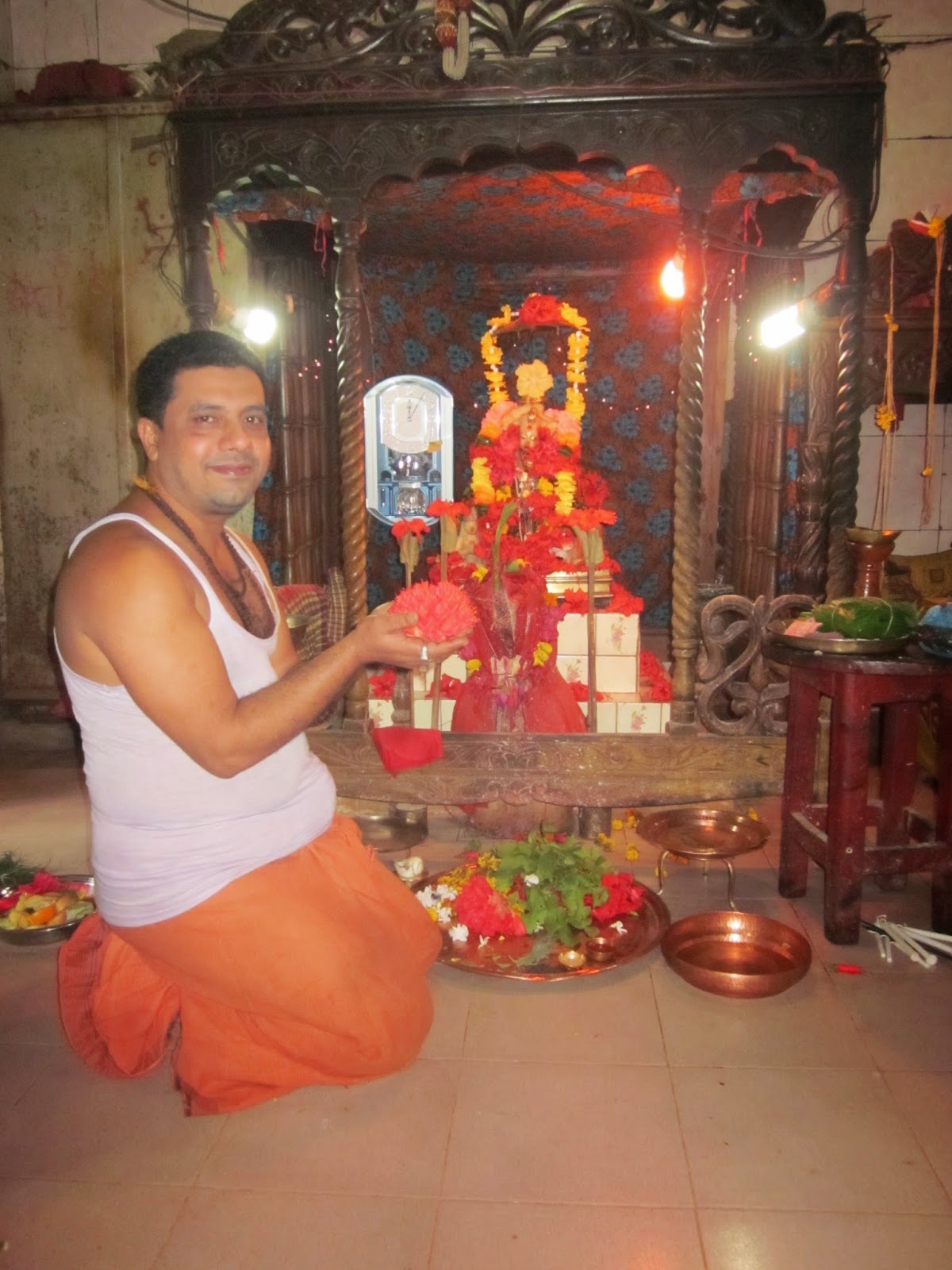
Devotion at the Sree Sree Adinath Temple in Moheshkhali during the Shiva Choturdoshi festival held each Falgun month.
Moheshkhali's unique hilly terrain.


Unique among Bangladeshi islands for its hilly terrain, Moheshkhali in Cox’s Bazar is assumed to have separated from the mainland some centuries ago. It is recorded that Moheshkhali Channel, dividing island from mainland, first arose in 1559 as the result of a devastating cyclone coupled by a powerful earthquake.


Moheshkhali’s hills are essentially the most seaward extension of the Chittagong Hill Tracts, a part of a range linked through northeast India to the Himalayas; and it’s not solely this geography, nor a history of earthquakes, that ultimately joins Moheshkhali to Nepal. There is a spiritual connection.

The Sree Sree Adinath Temple, Little Moheshkhali.


Atop Mainak Hill in Little Moheshkhali Union, with sweeping views across the interior, the channel and mainland, Sree Sree Adinath Temple has attracted pilgrims for centuries. It is said to be the site where Ravan, primary antagonist of the Ramayana, set down a sacred Shiva Linga stone he had promised Lord Shiva to carry uninterrupted from Kailash to Lanka in return for being granted immortality.

In Moheshkhali efforts failed him and the Shiva Linga remained there. But the story of the temple's beginning is not the origin of the connection with Nepal. Rather it stems from the experience of a solvent Moheshkhali Muslim named Noor Mohammad Shikdar.

The Shiva Linga.


Trouble began when one of Shikdar’s cows suddenly stopped giving milk. At first he blamed his cowherd who in turn sought to discover the cause of the matter. The cowherd watched the cow one night, to find that during the dark hours it left the barn and made its way to the Shiva Linga where milk began to instantaneously flow over the black stone. Only when the flow of milk stopped did the cow return to the cowshed.

Shikdar did not, however, believe the cowherd’s narration of events; until he had a dream to tell Moheshkhali’s Hindu zamindar landlord to build a temple at the site.


In a subsequent dream, in 1612, Shikdar was ordered to steal a protima statue of Lord Shiva from the Nepal State Temple to place on Mainak Hill. To complete the task he assigned one Naga Sannyasi who was, unfortunately, caught in the act. On the night before his trial however, the Sannyasi found favour with Lord Shiva who appeared before him, advising that he simply tell the truth and answer the judge’s trial questions calmly.


 It is said the protima was brought by Nepal's king, fulfilling the divine wishes of Lord Shiva.

On the following day the judge asked the colour of the protima. While the King of Nepal replied that the statue was a touchstone colour, the Sannyasi said it was white. As the latter answer was correct it was understood the Sannyasi had divine blessing in his task. As such, the Nepalese king asked forgiveness and on his own initiative arranged for the protima to be brought to Mainak and with due honour.

Inside the shrine.


Since that time the Adinath Temple that has become an icon of Moheshkhali Island has been honoured by the Nepalese, with Nepal’s government continuing the tradition of providing grants, including recently, according to locals, to construct the impressive jetty below the hill adjacent to the channel which provides for easier temple access.

Pilgrims from near and far continue to seek out the temple every year, especially during the renowned two-week Shiva Choturdoshi festival each Falgun month, including pilgrims from Nepal. There it is common to tie string around tree branches in the temple grounds as a request for a blessing, with strings untied and puja performed once a divine blessing has been granted.

In recent days at Moheshkhali’s Adinath it would be as well to offer a prayer for Nepal, to ask for the blessing of a speedy recovery from the recent earthquake devastation, at a Bangladeshi place that’s spiritually connected to the Himalayan land. The strings of any such wish – let’s hope they can be soon untied.

Pilgrims at the Sree Sree Adinath Temple in Moheshkhali during the Shiva Choturdoshi festival held each Falgun month.
Pilgrims.


This article published in The Daily Star: Moheshkhali's Adinath: a prayer for Nepal


The Adinath Temple jetty.


The jetty.


Bangladeshis seem to have added a tea shop underneath the jetty. 

Adinath Temple jetty of an afternoon.


Passengers leaving the jetty.


From Moheshkhali, island of hills.


Friday, 8 May 2015

The Textile Seller of Moheshkhali


Liri, 40, likes to vary her sales pitch.

“Sometimes I invite the customer to look,” says Liri, 40, a small-time seller of clothing and textile items, explaining her sales strategy. “‘Bhai, this is homemade’, I will say, or, ‘This is pure cotton.’ If they’re convinced they might buy something.”

Liri with her goods.
At other times customers make purchases without her saying anything. It’s all a bit random. “It depends on luck,” she says.

But more than luck the ethnic Rakhine widow relies on a steady stream of passersby. Without them, there’s nobody to see her wares.

Business can guide us to a better future. Large businesses, at their best, offer employment, improved goods and services, and contribute to the national well-being. For the millions of small-scale enterprises across the country meanwhile, the goals are closer to home. For Liri, business is about survival.

The gate to Adinath Temple in Little Moheshkhali.
Inside the temple.


At about 9 a.m. each day she arrives at the steps leading to the famous Adinath Temple on Cox’s Bazar’s Moheshkhali Island. There, she unpacks her stock of shirts, two-piece suits, sheets and bed covers, setting up her stall among several others in readiness for the day’s trade. While some items are purchased on the open market others are bought from Rakhine weavers in Moheshkhali, and some Liri weaves herself. She took a Tk 50,000 loan this year to buy stock.


The temple steps, where Liri has her stall.


In a normal month profits reach Tk 3,000, enough to cover loan repayments and feed herself and her son, who works as a mechanic. The best profits, of up to Tk 5,000 for the month, are made during festivals when hundreds of visitors and pilgrims crowd the temple steps.

“When sales are good,” says Liri, “We eat fish with our rice. Now we are lucky to eat green chilli, vegetables and salt. Everyday I’m making a loss.”


The Rakhine textile sellers of Moheshkhali.


The current political turmoil means only a handful of visitors reach the temple daily. By that afternoon Liri had made no sales, and the on day before she sold just two items worth Tk. 400.

She says Bhagawan – God – is running her family these days.


Of course she’s hardly the only small entrepreneur to suffer. When you think of the initiative involved in establishing any business, of the courage it must take for people like Liri to embark on a venture, of the struggle to bring themselves just a little further out of the clutches of poverty, the current transport embargo is really a kick in the teeth. 


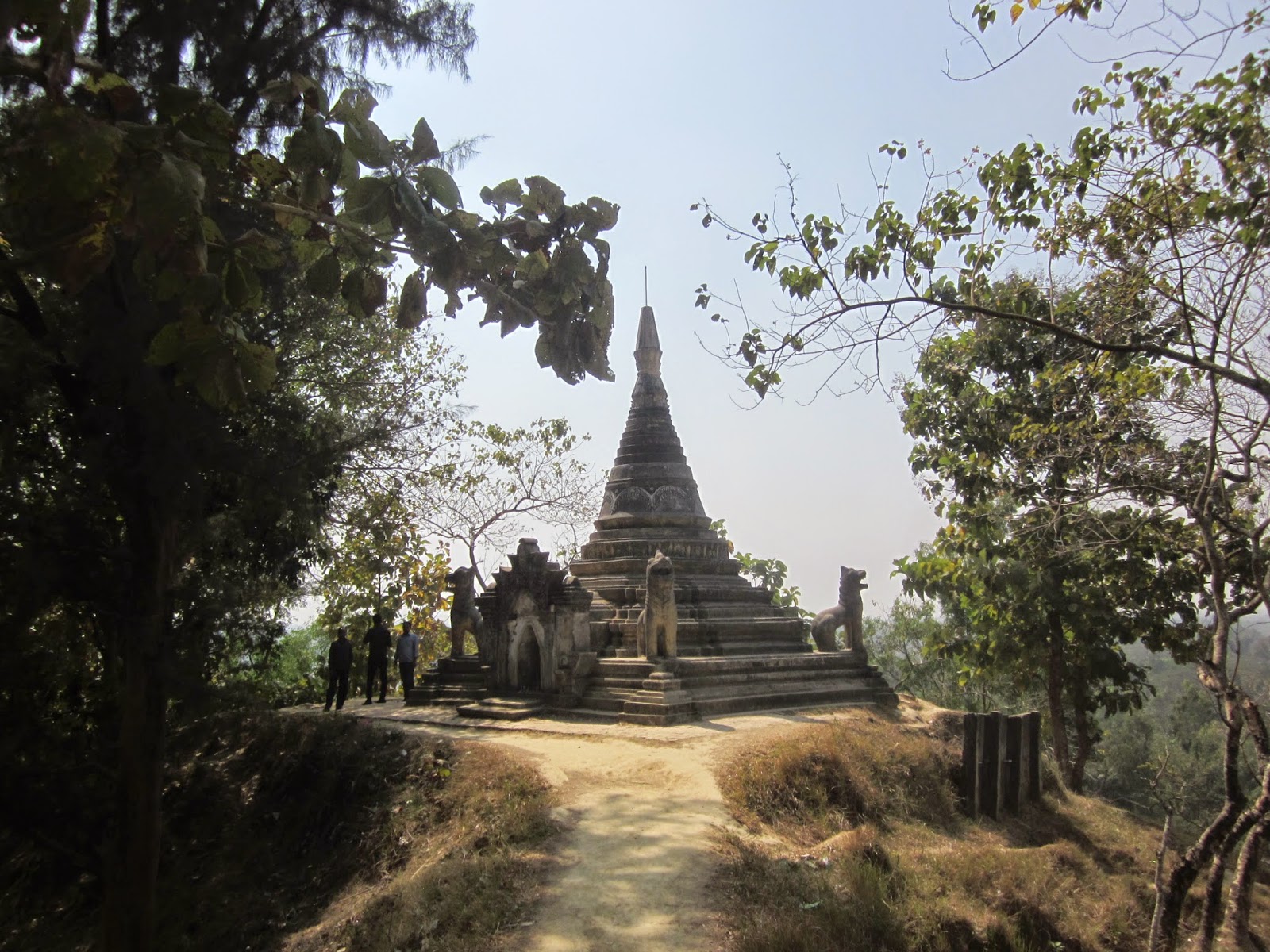
The Rakhine Buddhist stupa further up the hill from the Adinath Hindu Temple.
On guard at the stupa.


Stupa detail.

The lower Adinath gate.


This article published in The Daily Star, here: The Textile Seller of Moheshkhali

Liri hopes for better business times.