Showing posts with label entrepreneur. Show all posts

Friday, 19 June 2015

Himchhari's Live Kitchen

Sun Dancer Cafe & Restaurant, Himchhari, Cox's Bazar.

 
S.H. Mahbub, entrepreneur.
For some people it’s the geography of the capital which appeals. They may wish to climb the corporate ladder or be near the centre of national decision-making. For others there’s nowhere better than a farm with clean air, simplicity and open space. Still others are enticed by the call of the sea.

When S.H. Mahbub of Kishoreganj arrived in Cox’s Bazar for a vacation in 1999, little could he imagine he’d stay there. “Cox’s Bazar has the atmosphere of a never ending fair,” he says, “People are always coming and going. I like this the best.” 


Marine Drive, Himchhari.


Instead of returning home he took a job at a guest house, later a hotel and finally at the renowned Mermaid Café. With fifteen years of hospitality experience behind him, two years ago Mahbub decided to branch out, to bring his own brand of dining to the beachside Himchhari restaurant strip.


The restaurant strip at Himchhari, between the beach and the hills.

 
Sunset over the Bay of Bengal.


“In most Cox’s Bazar restaurants you can view either the sea or the sunset but not both,” he says while sitting in the relaxed wooden-built restaurant he established. “Here you can sit and watch the sun dance, which is why I called it the Sun Dancer.”

Along with a few neighbouring restaurants, Sun Dancer pursues the modern culinary philosophy of a ‘live’ kitchen. Mahbub explains that it’s something like a live cricket match where the action occurs right before the customers’ eyes.


The beach at Himchhari, part of the longest sea beach in the world.

There’s an open menu that takes into account each customer’s wishes: one can basically order anything. Mahbub says available cooking styles include fried, curried, bhuna masala, grilled, baked and steamed; in international, local and traditional food categories. “But we only serve fresh sea fish, not project fish,” he says.

Wherever possible, dishes are prepared from scratch with fresh ingredients, in the kitchen that’s in full view of diners. “Guests can even go in and cook for themselves if they want,” he says, noting that the restaurant sometimes features celebrity chefs.


S.H. Mahbub is hopeful the live kitchen and relaxed atmosphere will attract customers to the Sun Dancer.

 
The Sun Dancer, Himchhari, Cox's Bazar.

He hopes Sun Dancer can welcome customers in formal attire as easily as those who’ve just stepped off the beach, aiming to create an information and entertainment hub that showcases the district through tour options and visiting musicians performing rural, philosophical and life-related songs. Fire spinners regularly display their skills.

But the road hasn’t been smooth with political turmoil leading a tourism nosedive in Cox’s Bazar earlier this year and a regular nine-month low season to contend with. In an attempt to extend tourism potential the town hosts full moon parties in June and July when the waves are high. At Sun Dancer this brings in some Bangladeshi and Indian customers during the traditional off-season.

Despite such business difficulties Mahbub is pleased with his life choice. “Every day is new here,” he says, “I came to Cox’s Bazar today. It always feels like that, even now.”


Marine Drive. Himchhari is a popular spot for beach-side dining.


The restaurants at Himchhari.


Hibiscus welcomes early spring to Himchhari Beach.

Himchhari Beach with sandbags to prevent erosion.


Himchhari, a part of the world's longest sea beach.


This article is published in The Daily Star, here: Redefining Hospitality and Cuisine at Himchhari


Relaxing at the Sun Dancer.


Friday, 8 May 2015

The Textile Seller of Moheshkhali


Liri, 40, likes to vary her sales pitch.

“Sometimes I invite the customer to look,” says Liri, 40, a small-time seller of clothing and textile items, explaining her sales strategy. “‘Bhai, this is homemade’, I will say, or, ‘This is pure cotton.’ If they’re convinced they might buy something.”

Liri with her goods.
At other times customers make purchases without her saying anything. It’s all a bit random. “It depends on luck,” she says.

But more than luck the ethnic Rakhine widow relies on a steady stream of passersby. Without them, there’s nobody to see her wares.

Business can guide us to a better future. Large businesses, at their best, offer employment, improved goods and services, and contribute to the national well-being. For the millions of small-scale enterprises across the country meanwhile, the goals are closer to home. For Liri, business is about survival.

The gate to Adinath Temple in Little Moheshkhali.
Inside the temple.


At about 9 a.m. each day she arrives at the steps leading to the famous Adinath Temple on Cox’s Bazar’s Moheshkhali Island. There, she unpacks her stock of shirts, two-piece suits, sheets and bed covers, setting up her stall among several others in readiness for the day’s trade. While some items are purchased on the open market others are bought from Rakhine weavers in Moheshkhali, and some Liri weaves herself. She took a Tk 50,000 loan this year to buy stock.


The temple steps, where Liri has her stall.


In a normal month profits reach Tk 3,000, enough to cover loan repayments and feed herself and her son, who works as a mechanic. The best profits, of up to Tk 5,000 for the month, are made during festivals when hundreds of visitors and pilgrims crowd the temple steps.

“When sales are good,” says Liri, “We eat fish with our rice. Now we are lucky to eat green chilli, vegetables and salt. Everyday I’m making a loss.”


The Rakhine textile sellers of Moheshkhali.


The current political turmoil means only a handful of visitors reach the temple daily. By that afternoon Liri had made no sales, and the on day before she sold just two items worth Tk. 400.

She says Bhagawan – God – is running her family these days.


Of course she’s hardly the only small entrepreneur to suffer. When you think of the initiative involved in establishing any business, of the courage it must take for people like Liri to embark on a venture, of the struggle to bring themselves just a little further out of the clutches of poverty, the current transport embargo is really a kick in the teeth. 
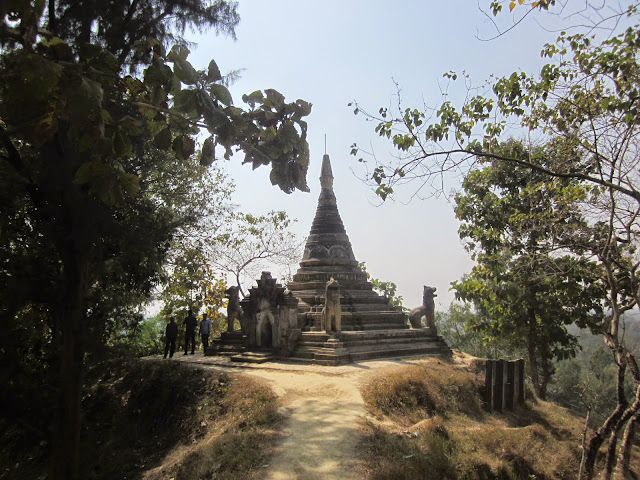


The Rakhine Buddhist stupa further up the hill from the Adinath Hindu Temple.
On guard at the stupa.


Stupa detail.

The lower Adinath gate.


This article published in The Daily Star, here: The Textile Seller of Moheshkhali

Liri hopes for better business times.