Showing posts with label Rakhine. Show all posts

Thursday, 20 August 2015

Teknaf Police Station, A Love Story

Cotton trees, paan gardens and the mountains, on a road east of Teknaf.

“It’s difficult to say what decision I would make,” says Ataur Rahman, officer-in-charge of Teknaf police station and a man clearly used to making decisions. “I’ve never had to face such a situation. Only if I did could I tell you what the decision would be.”

Cotton tree pods.
Rahman, from Sirajganj, is speaking of the conundrum of having to choose between an ailing father in Kolkata and a pending wedding to a betrothed Rakhine princess in Teknaf. While Rahman has never experienced such a dilemma, his early twentieth century colleague, Diraj Bhattacharya, famously did.

When police officer Bhattacharya was first posted to Teknaf to the south of Cox’s Bazar it’s unlikely he was thrilled. He was a town-man, born in Jessore, while Teknaf at the time was beyond-remote, barely accessible by road. For a young man like Bhattacharya, Teknaf must’ve seemed the end of the Earth.


Teknaf was once remote, barely accessible by road.

History says after settling into the residence in the police compound Bhattacharya found there was little to do. He idled away hours roaming aimlessly. He routinely sat in his rocking chair on the veranda, relaxing.

There wasn't much to do but roam and see.
Such an excess of leisure time is a circumstance Rahman could only dream of. “Teknaf was an outpost and Bhattacharya was alone,” he says. “These days it’s a police station with upwards of twenty officers and forty constables, all working hard.”

Besides, he could hardly sit in a rocking chair on the veranda even if he found the time. “There is no veranda,” explains Rahman. “That building was long-ago replaced. And anyway, I don’t have a rocking chair.”

What does remain is an old, preserved well in one corner of the police compound. It’s the well that Bhattacharya could see from his rocking chair, then the only well in the area.


Ma Thin's well, in the police compound, used to be the only well in the area.

In the course of each day the local Rakhine women would arrive to fetch water. It’s fair to say that in their colourful blouses and thami skirts they were pleasing to a police officer’s eye. Their lively chitchat brought cheerful enthusiasm to the compound, to resonate as far as the veranda.

Ma Thin's well. Preserved as a symbol of love.
Then one day Bhattacharya noticed Ma Thin, the daughter of a wealthy Teknaf landlord. She was particularly attractive and nicely dressed, such that there was little for a police officer to do but fall in love.

“In my experience, Teknaf police compound is no more or less romantic than any other,” says Rahman, contemplating how such love could have blossomed, “But the area is very beautiful. Teknaf is surrounded by the sea and mountains, with the historic Naf River nearby.” It’s geography in which Rahman believes love could understandably have flourished.

Fortunately for Bhattacharya, Ma Thin took similar note of the handsome officer, and there developed a habit for Ma Thin to arrive at the well before dawn where Bhattacharya would be waiting, on the veranda. The two enjoyed exchanging adoring glances.

Over time their relationship intensified and a wedding date was set. In the meantime, however, Bhattacharya’s family had come to know of the affair and one day he received a letter saying his father was sick and he should return home urgently.


Boats moored in the Bay of Bengal south of Teknaf. The coastline is Myanmar.

According to his family’s wishes Bhattacharya left for Kolkata, where they then lived. Although he promised to return, Ma Thin was devastated.

“The decision was up to him,” says Rahman, not one to judge, “It’s his business.”

The Naf River, to the north of Teknaf.
The affair didn’t end well. Bhattacharya never returned to Teknaf. Eventually he left the police service to become a movie star; and he wrote a book called “When I Was a Police Officer,” which includes an account of his love for Ma Thin.

Ma Thin was so heartbroken that she confined herself to bed, refusing all food and water until, prematurely, she died.

Unlike Bhattacharya, Rahman says he has never considered leaving his policing career in favour of becoming a movie star. “Diraj was handsome and it helped him a lot,” says Rahman, who points out he is already around 40 and has three children. “I am not like him. I don’t have such opportunities.”

A chilli field, east of Teknaf.

In any case, Rahman is uncertain that being a movie star would be a better job than a police officer. “The two careers are like sweet and sour, both good but entirely different.”

Among the current staff members of Teknaf police station, Rahman is unaware of any officer having to choose as Bhattacharya did, between a sick father and a Rakhine princess. While he is unsure if perhaps the police service has become less romantic than it used to be, he does state that times have changed and police are busy with all sorts of work related activities these days.

Nonetheless, Rahman is unwilling to conclude that a love story similar to Bhattacharya and Ma Thin’s could never recur at Teknaf police station. “Love happens naturally,” he says, “How could anyone say it couldn’t happen now? There’s always a possibility.”


This article is published in The Daily Star, here: Teknaf Police Station, A Love Story


Love. Who's to say it couldn't happen again?


Wednesday, 5 August 2015

Continuity


A shrine at the Teknaf Buddhist Temple.

When the garden’s silence meets the quiet of dawn, U Nanda Loka, 50, begins his prayer of meditation and whispers. At 5.30 a.m. for half an hour he will seek blessings for all the people of the world, just as he has done every day for the past twelve months since he first took up the post of sole monk at the roughly 200-year-old Teknaf Buddhist temple.

While the temple grounds are largish the congregation is small. There are only 14 Rakhine families remaining in Teknaf town, joined by the handful of other Buddhists who have moved there for work.

“There should be at least one monk,” says 19-year-old Mong Swui Thing, a Marma teenager from Ramu sent by his father, a farmer, to take advantage of the temple’s tranquillity in preparing for school exams. He aspires to a government job eventually.


Buddha's footprint at the Teknaf temple.

Due to the small size of the community adjustments have been made. Where in a larger location it is customary for monks to walk through morning markets carrying pots into which people place food, all that the monks will eat for that day, in Teknaf the fourteen families organise to supply the provisions for the monk and temple staff on a rotation basis.

“The issue is continuity,” says temple visitor Aung Kyaw Tha, “Temple goers are few but it doesn’t matter; we want our religion to stay.”

Gautama Buddha said if there is a quiet place it has its own happiness, explains Tha. “Alone or with people, in town or village, no matter where, one has to keep Buddha’s teachings in mind in order to live peacefully.”


A smaller temple in the garden complex. Note the distinctive Rakhine style roof.

The temple complex which consists of a main building raised on stilts in Rakhine tradition, together with a smaller temple to one side and a golden stupa featuring a footprint of Buddha towards the back, is tucked away from the road, barely visible.

Once its grounds were larger still but roadside portions were progressively sold as many of Teknaf’s Rakhines moved to Myanmar in the 1990s.

Tea shop talk says the then-majority Rakhine community was favoured in the British era. There are tales of how the few Bengalis in earlier times used to take off their sandals to carry them underarm while passing a Rakhine shop in the bazaar, as a sign of respect. It was considered improper for a Bengali to wear a wristwatch or open an umbrella in front of a Rakhine house, people say.

The temple was undoubtedly busier then.


U Nanda Loka, the sole monk at the Teknaf temple.

Such talk of political history stands in contrast to the views of the monk. When asked to speak of other religious communities he says, “Of Hinduism, Christianity and Islam I have no knowledge. I don’t understand. I only do what Buddhism says.”

Mong Swui Thing, a Marma youth sent to the temple by his father to study.
Central to his beliefs is the importance of avoiding any form of envy or jealousy; one reason why it cannot be fruitful to consider how others practice religion. This tenet does not mean, however, neglecting concern for non-Buddhists. “Everyone in the world I will bless,” says the monk.

Similarly when I was foolish enough to ask the monk his favourite food he struggled to answer. When the goal is to seek enlightenment away from one’s physical being and the physical world, the question makes no sense. “What is given, I like,” he says, “My preference is nothing.”

By tradition monks eat only one plate of rice, without looking up to see what others are eating while they complete a meal. A second serving is to risk gluttony; to see what others eat risks envy. Moreover at Teknaf Buddhist temple the monk will eat nothing after lunch at midday, until the next morning’s breakfast.


The stupa at Teknaf Buddhist Temple complex.

U Nanda Loka says he first became a monk after his parents died when he was 16 years old. “I didn’t like regular life anymore,” he says. With his two sisters married he moved to the temple.

Secondary temple at Teknaf complex.
Being a monk is not inherently a permanent position but one that lasts “as many days as it makes you happy,” though most commonly it is for life.

In describing Buddhism, the monk refers to five principal tenets: don’t kill because life is sacred; don’t take what isn’t yours; treat women respectfully; don’t lie and; don’t use alcohol or drugs, including stimulants such as betel leaf. “To explain more than these basic beliefs,” says the monk, “is to embark upon an ocean of knowledge.”

The latter part of each morning is spent reading texts, completing bath and lunch and retiring for half an hour’s rest. In the afternoon is more prayer while it is common in the evenings for people to arrive at the temple to seek the monk’s advice.

The pattern of each day is simplicity repeated right up until it meets once more the quiet of dawn. These are traditions followed in temples around the world, right back to the 4th – 6th century BCE, the time of Gautama Buddha. The Teknaf Buddhist temple is but a footnote in a far greater story of continuity.


Teknaf Buddhist temple, said to be over two hundred years old. The main building.


This article is published in The Daily Star, here: A Prayer for Continuity

Thursday, 16 July 2015

Termites and a Dream of Prosperity

 
An old banyan tree at Bazar Para in Sabrang. Once this was the centre of town.

Who is it that would live in a house full of termites?

Termite mound under veranda roof.


Away from the beach in Sabrang south of Teknaf town, shady country laneways meander between household flower garden and heavenly stand of areca palm. Adding a meditative symmetry of vertical lines to the landscape, the areca plantations bring renowned to Teknaf, contributing to the district’s areca nut fame. A few hundred metres short of the Naf River, local conditions favour areca nut flavour and everybody knows.


Country laneway, Sabrang, Teknaf.


In the calm, subtropical greenery, that neighbourhood of rustic households built not only on areca but quite often on remittance from labour migration as well, it’s easy to imagine that nature’s quiet is humankind’s ultimate prosperity.


Areca palms.


Yet it’s a locality that’s undergone significant change, evidence of which can be found at the old pond in Bazar Para. Flanked by two banyan trees, reminiscent of the fig under which Gautama Buddha achieved enlightenment in India’s Bodh Gaya, Sabrang was once inhabited by Buddhist Rakhines and the pond during the British era was the centre of town. Nowadays its ghat is crumbled; the pond’s significance has faded into the rural landscape. With just a few groceries stores Bazar Para is a market in name only.

Areca palm plantation, Sabrang.
“There used to be a Buddhist temple,” says local Saifuddin Khaled, 41, “But when the Rakhines left for Myanmar the land was eventually sold.” Where once Sabrang was ruled by Rakhine landlords, today there are only two Rakhine families remaining.

The home of Mong Pru, 57, is of weathered timber, raised on stilts as in Rakhine tradition. Pru has four daughters, two married to jewellery technicians and his daughters sit upstairs on the old balcony that slopes from age, passing a relaxing afternoon with household tailoring work.

Pru says most of Sabrang’s Rakhines left for Myanmar in the 1990s. “We had no land there,” he explains of his decision to stay, “There was nothing to go to. We were very poor then.”


An old well in the yard of the termite house.


Yet it’s not his house but that of his neighbour, in a similar architectural style, which is unique in featuring a termite mound in the middle of its veranda. Its current owner is also a jewellery technician and his shy wife Lamia, who is originally from Royasanka in Myanmar, has been in Bangladesh with her husband for fifteen years but is not confident to speak Bangla.


The termite house, waiting for prosperity.

The termite house.


She does say that the termites don’t eat the wooden house.

“The house is about 50 years old,” recalls Pru, “And the termite mound was even taller when it was built.” They had to cut the mound slightly to fit it under the veranda roof.


The yard of the termite house.


At the time a Buddhist monk advised the family not to break the termite mound. “If you let it grow it will bring you prosperity,” the monk foretold. The termite mound is regarded as a blessing and a place to offer prayer.


A Rakhine alphabet chart.


“It’s always been there,” says one of Pru’s daughters. “Now it’s mainly for beauty.”


The termite mound in the veranda area.

And when it comes to prosperity it seems that Pru’s neighbour is still waiting, although it’s not certain that they weren’t poorer when the house was built. Or perhaps it’s a lesson that nature’s quiet more than money is humankind’s ultimate prosperity.

Mong Pru, 57, with his grandson Owen Twey.


Standing in the garden with his young grandson Owen Twey in his arms, Pru is pleased his family didn’t follow the other Rakhines across the Naf River. “In Myanmar there are too many problems,” he says, “Life is better here.” His family like that of his neighbour is counting on a peaceful and bright Bangladeshi future.


Two of Pru's daughters.


Bazar Para pond. In the British period it was the centre of town.

Bazar Para pond.


This article is published in The Daily Star, here: Sabrang's Termite House and a Dream of Prosperity


Carving a traditional weight, for exercise.

Wednesday, 1 July 2015

Many Words for Water


Across the Naf River is Myanmar.


Bank of the Naf.


North of Teknaf town, afternoon has reached sleepy Hnila’s Old Bazar, a few hundred metres west of the Naf River. There’s not much activity: most people are probably taking a rest after completing lunch.


Sitting at the temple.


We’re sitting in a perennial building site that’s half-flooded. It has planks of wood to balance across to venture inside. It’s here the local Hindu community worship and a good number of them are gathered in the front of the building just beyond the gate. They’ve arranged plastic stools from somewhere to sit on. A fruit platter is being passed around.


“This is the southernmost Kali temple in Bangladesh,” says community leader Bipul Pal. “It’s the only Kali temple south of Cox’s Bazar.”

Hnila countryside.


The Naf River is narrower in Hnila. On its far bank the periodic watchtowers of Myanmar are clearly visible, about the only evidence of habitation along an otherwise wild bank. The common view of Myanmar to be heard in Teknaf’s tea shops seems to ring true here: “Myanmar has lots of land,” people say, “but little development.”


The southernmost Kali Temple in Bangladesh, Hnila, Teknaf.

Touring Hnila with local Hindu leaders.


The river wasn’t always the border it is today. In the British period then Burma was like Bengal under British administration; and the Teknaf Peninsula was primarily inhabited by Buddhist Rakhines. Bengalis by all accounts were rare. Hindus were rarer.


Canal. Looking towards the Teknaf Range.


“We are fifteen families,” concludes Pal after a moment’s mental count. “Hindu families in Hnila run simple businesses like dairies and tailoring shops.” At least one fulfils an administrative role with an NGO. “None of us is rich.”


The Kali protima in Hnila Old Bazar.

The financial condition of the small community means that completing the refurbishment of the temple, in brick and on a grander scale than the original structure founded in 1833, will take time. Progress is slow.

Altar at the Radha-Krishna Temple.

Proud of their town, before evening there will be a tour of  a handful of other temples, tin shed and dilapidated village constructions dedicated to other incarnations of God. At the Krishna temple there lives a solitary monk who teaches meditation and yoga. The temple keeps a cow and he offers fresh milk to visitors.


Hindu monk. 'There are many words for water.'

“What is important is what is in the heart,” he says, “Islam says ‘don’t steal,’ Buddhism says ‘don’t steal’ and Hinduism says the same. If there is love for mankind in the heart it doesn’t matter if you go to a temple, a church or a mosque. Some say paani, some say jol… There are many words for water.”


As can be anticipated Hnila’s Hindus revere all of the local temples but the historic Kali Temple is the community’s focal point. “We don’t know when we’ll be able to finish its reconstruction,” says Pal.


Members of the small Hnila Hindu community at the forever ongoing reconstruction site of the historic Kali Temple.

Thursday, 28 May 2015

A Little Southeast Asia in Bangladesh


Entry to the Buddhist temple complex in Moheshkhali's Rakhine Para.

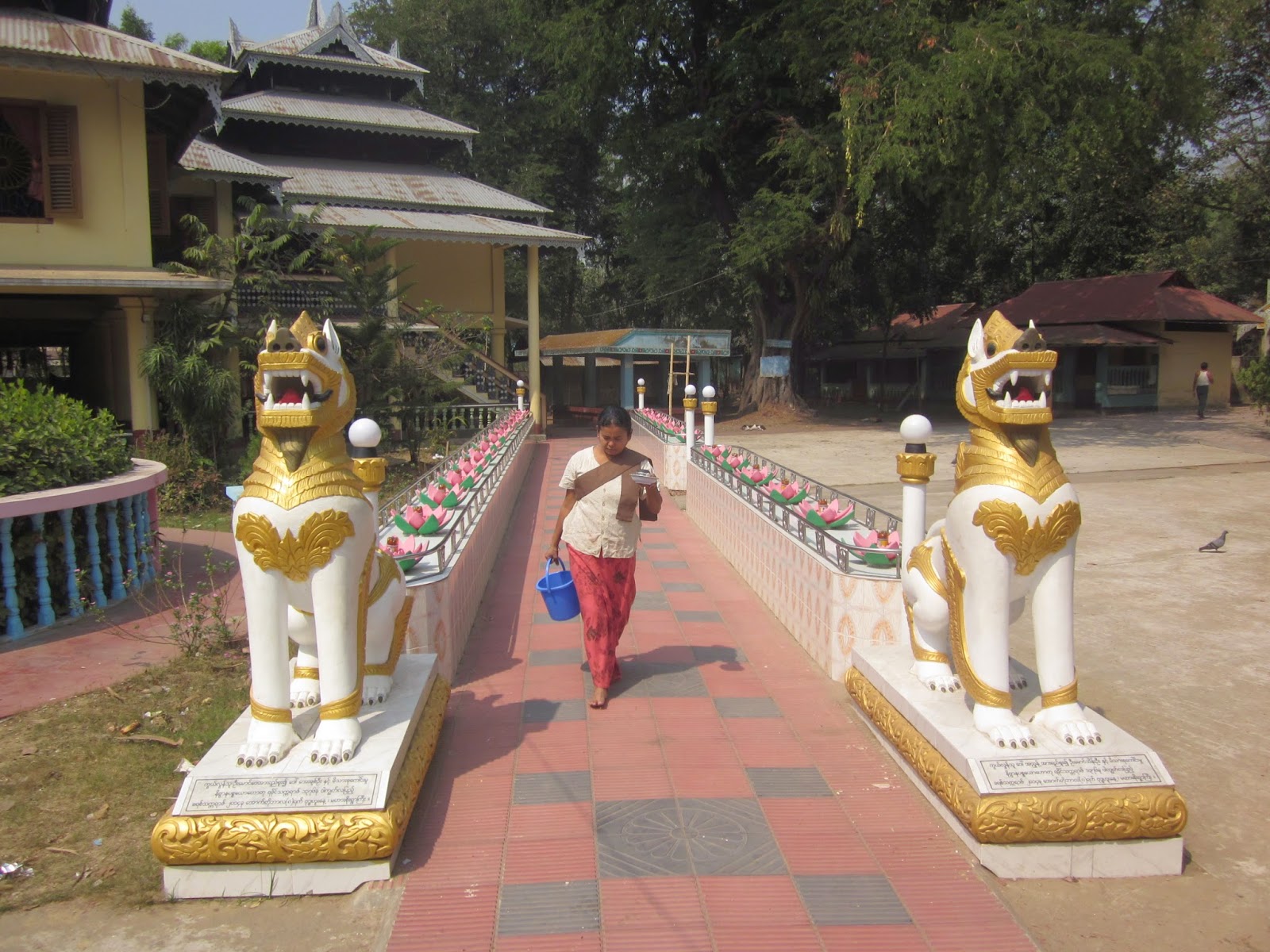
To venture into Rakhine Para of Moheshkhali Island’s Gorakghata is to step into Southeast Asia. It’s not only the Buddhist temple complex, glittering in gold, or the Rakhine faces of residents. In the back alleys the faded frilly facades of some of the old apartment blocks could, to the newcomer, easily belong in suburban Rangoon. There are examples of beautiful wooden homes perched on stilts, where family and friends relax beneath, chatting and taking advantage of the architectural shade. Rakhine Para evidences a diverse Bangladesh.

Detail from the temple complex.


It feels like a neighbourhood where life returns in familiar patterns with each dawn, year after year. But to speak with Kyaw Ching, a retired petty naval officer and area resident, in his goldsmith and pawnbroker’s, is to appreciate that the Rakhines have adopted contemporary ways.

It used to be that the Rakhine community primarily engaged in fishing. Ching’s father had four sailing boats for the purpose; but nowadays in the whole community it’d be difficult to find one.


At the temple, Rakhine Para.


“Fishing was dangerous,” says Ching, a father of three. “Many people died. There’s hardly a family in the village where someone didn’t die at sea.” Over a decade ago the last of Moheshkhali’s Rakhine fishing nets were stowed for a final time.

For Rakhine women economic activity also changed. “Our women don’t sit down,” says Ching, “They like to help support the family and there used to be a handloom in every house. But there are no handlooms now.”


Kyaw Ching with his wife in their goldsmith and pawnbroker business office in Gorakghata's Rakhine Para.

Cost increase in the price of cotton and low retail rates for finished items made the area’s longstanding weaving tradition unviable. These days while local women still try their hand at sewing, the distinctive Rakhine textiles sold in the market opposite the temple are imported from Cox’s Bazar or Myanmar.

One of the temple buildings in Rakhine Para.

Change has also come to education. Whereas earlier not every child attended school they now do; yet the younger generation is losing touch with the Rakhine language, especially the ability to read its Burmese script. “We used to have a Rakhine teacher,” says Ching, who explains the difference between the Burmese and Rakhine languages as akin to the difference between Chittagonian and standard Bangla. “I wish the government could make provision for a teacher.”

Local Rakhine women still wear traditional thamis.


Formerly known as Arakanese, Rakhines trace their heritage to the establishment of the first independent Rakhine kingdom by King Marayu in 3325 BCE at Dhanyawadi northeast of Myanmar’s Sittwe. It is said that Gautama Buddha visited the civilisation during his lifetime. 


Subsequent centuries saw the Rakhines establish a prosperous trading society that stretched into modern day Chittagong Division and beyond, along the shores of the Bay of Bengal. With British documents to demonstrate their long-established local presence, the approximately 3,000 Rakhines living in six Moheshkhali villages are considered indigenous to the island.


Rakhine women relaxing in the shade under a traditional stilt house.


In place of traditional livelihoods a younger generation of Rakhines have become technicians, mechanics and master tailors. Goldsmith shops and pawnbroker businesses are prominent.

A home in traditional Rakhine style.


“A few have taken government jobs,” says Ching, who had some work to do to convince his parents decades back to let him sign up to the Bangladeshi navy where he worked for twenty years. “They thought of war and worried,” he says, “but afterwards they came to accept it.”

The Rakhines often favour business they can carry out close to home, fearing discrimination if they embark on lucrative ventures further afield. “It’s for safety,” says Ching, “We cannot easily spread out because we don’t have a strong position.” Yet he is the first to acknowledge Rakhines face no difficulties in Moheshkhali.


Temple building in Rakhine Para.


While modernity has brought change to Rakhine daily life, other aspects remain the same. Women still favour the Burmese sarong-like thami while among Rakhine men the signature longyi (lungee) tied with a prominent knot at the front and worn with shirt tucked in, is ubiquitous. And at mealtimes of crab, fish or meat with vegetables it can come as no surprise to detect the wafting aroma of the signature shrimp and chilli paste called napi, which also forms part of the cuisine of some hill tracts peoples.


Nowadays Rakhine textiles are imported from Myanmar.


This article is published in The Daily Star, here: The Changing Traditions of Moheshkhali's Rakhines


Temple view, Rakhine Para, Moheshkhali.