Showing posts with label coxs bazar. Show all posts

Thursday, 16 July 2015

Termites and a Dream of Prosperity

 
An old banyan tree at Bazar Para in Sabrang. Once this was the centre of town.

Who is it that would live in a house full of termites?
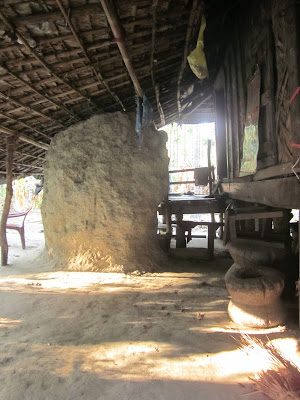
Termite mound under veranda roof.


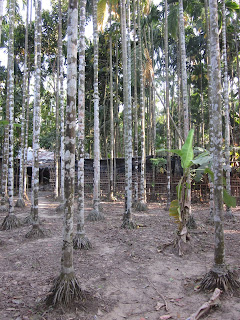
Away from the beach in Sabrang south of Teknaf town, shady country laneways meander between household flower garden and heavenly stand of areca palm. Adding a meditative symmetry of vertical lines to the landscape, the areca plantations bring renowned to Teknaf, contributing to the district’s areca nut fame. A few hundred metres short of the Naf River, local conditions favour areca nut flavour and everybody knows.


Country laneway, Sabrang, Teknaf.


In the calm, subtropical greenery, that neighbourhood of rustic households built not only on areca but quite often on remittance from labour migration as well, it’s easy to imagine that nature’s quiet is humankind’s ultimate prosperity.


Areca palms.


Yet it’s a locality that’s undergone significant change, evidence of which can be found at the old pond in Bazar Para. Flanked by two banyan trees, reminiscent of the fig under which Gautama Buddha achieved enlightenment in India’s Bodh Gaya, Sabrang was once inhabited by Buddhist Rakhines and the pond during the British era was the centre of town. Nowadays its ghat is crumbled; the pond’s significance has faded into the rural landscape. With just a few groceries stores Bazar Para is a market in name only.

Areca palm plantation, Sabrang.
“There used to be a Buddhist temple,” says local Saifuddin Khaled, 41, “But when the Rakhines left for Myanmar the land was eventually sold.” Where once Sabrang was ruled by Rakhine landlords, today there are only two Rakhine families remaining.

The home of Mong Pru, 57, is of weathered timber, raised on stilts as in Rakhine tradition. Pru has four daughters, two married to jewellery technicians and his daughters sit upstairs on the old balcony that slopes from age, passing a relaxing afternoon with household tailoring work.

Pru says most of Sabrang’s Rakhines left for Myanmar in the 1990s. “We had no land there,” he explains of his decision to stay, “There was nothing to go to. We were very poor then.”


An old well in the yard of the termite house.


Yet it’s not his house but that of his neighbour, in a similar architectural style, which is unique in featuring a termite mound in the middle of its veranda. Its current owner is also a jewellery technician and his shy wife Lamia, who is originally from Royasanka in Myanmar, has been in Bangladesh with her husband for fifteen years but is not confident to speak Bangla.


The termite house, waiting for prosperity.

The termite house.


She does say that the termites don’t eat the wooden house.

“The house is about 50 years old,” recalls Pru, “And the termite mound was even taller when it was built.” They had to cut the mound slightly to fit it under the veranda roof.


The yard of the termite house.


At the time a Buddhist monk advised the family not to break the termite mound. “If you let it grow it will bring you prosperity,” the monk foretold. The termite mound is regarded as a blessing and a place to offer prayer.


A Rakhine alphabet chart.


“It’s always been there,” says one of Pru’s daughters. “Now it’s mainly for beauty.”


The termite mound in the veranda area.

And when it comes to prosperity it seems that Pru’s neighbour is still waiting, although it’s not certain that they weren’t poorer when the house was built. Or perhaps it’s a lesson that nature’s quiet more than money is humankind’s ultimate prosperity.

Mong Pru, 57, with his grandson Owen Twey.


Standing in the garden with his young grandson Owen Twey in his arms, Pru is pleased his family didn’t follow the other Rakhines across the Naf River. “In Myanmar there are too many problems,” he says, “Life is better here.” His family like that of his neighbour is counting on a peaceful and bright Bangladeshi future.


Two of Pru's daughters.


Bazar Para pond. In the British period it was the centre of town.

Bazar Para pond.


This article is published in The Daily Star, here: Sabrang's Termite House and a Dream of Prosperity


Carving a traditional weight, for exercise.

Wednesday, 1 July 2015

Many Words for Water


Across the Naf River is Myanmar.


Bank of the Naf.


North of Teknaf town, afternoon has reached sleepy Hnila’s Old Bazar, a few hundred metres west of the Naf River. There’s not much activity: most people are probably taking a rest after completing lunch.


Sitting at the temple.


We’re sitting in a perennial building site that’s half-flooded. It has planks of wood to balance across to venture inside. It’s here the local Hindu community worship and a good number of them are gathered in the front of the building just beyond the gate. They’ve arranged plastic stools from somewhere to sit on. A fruit platter is being passed around.


“This is the southernmost Kali temple in Bangladesh,” says community leader Bipul Pal. “It’s the only Kali temple south of Cox’s Bazar.”

Hnila countryside.


The Naf River is narrower in Hnila. On its far bank the periodic watchtowers of Myanmar are clearly visible, about the only evidence of habitation along an otherwise wild bank. The common view of Myanmar to be heard in Teknaf’s tea shops seems to ring true here: “Myanmar has lots of land,” people say, “but little development.”


The southernmost Kali Temple in Bangladesh, Hnila, Teknaf.

Touring Hnila with local Hindu leaders.


The river wasn’t always the border it is today. In the British period then Burma was like Bengal under British administration; and the Teknaf Peninsula was primarily inhabited by Buddhist Rakhines. Bengalis by all accounts were rare. Hindus were rarer.


Canal. Looking towards the Teknaf Range.


“We are fifteen families,” concludes Pal after a moment’s mental count. “Hindu families in Hnila run simple businesses like dairies and tailoring shops.” At least one fulfils an administrative role with an NGO. “None of us is rich.”


The Kali protima in Hnila Old Bazar.

The financial condition of the small community means that completing the refurbishment of the temple, in brick and on a grander scale than the original structure founded in 1833, will take time. Progress is slow.

Altar at the Radha-Krishna Temple.

Proud of their town, before evening there will be a tour of  a handful of other temples, tin shed and dilapidated village constructions dedicated to other incarnations of God. At the Krishna temple there lives a solitary monk who teaches meditation and yoga. The temple keeps a cow and he offers fresh milk to visitors.


Hindu monk. 'There are many words for water.'

“What is important is what is in the heart,” he says, “Islam says ‘don’t steal,’ Buddhism says ‘don’t steal’ and Hinduism says the same. If there is love for mankind in the heart it doesn’t matter if you go to a temple, a church or a mosque. Some say paani, some say jol… There are many words for water.”


As can be anticipated Hnila’s Hindus revere all of the local temples but the historic Kali Temple is the community’s focal point. “We don’t know when we’ll be able to finish its reconstruction,” says Pal.


Members of the small Hnila Hindu community at the forever ongoing reconstruction site of the historic Kali Temple.

Friday, 15 May 2015

Once Was a Bird Hunter

The sand and mud shoals of Sonadia in Cox's Bazar are ideal shore bird habitat.
Muslim Miah in his tailor shop.


Nowadays, 33-year-old Muslim Miah of Cox’s Bazar’s Moheshkhali earns his living as proprietor of a tailor shop in Ghotibanga Bazar of Kutubjom Union. When business is good the retired fisherman’s son earns 5 – 10,000 taka per month from his shop – a modest income but enough to keep the bachelor on his feet financially.

For Miah it’s a career change. He used to be a bird hunter.


The shoals of southern Moheshkhali and Sonadia are rich habitat for shorebirds. The area attracts numerous species including the nordmann’s greenshank and spoon-billed sandpiper, endangered migrant species from the Siberian Arctic that arrive each winter after a long journey south. Worldwide there remain as few as 1,000 mature individuals of the former species and 200 of the latter.

Prior to October 2011, Miah, together with more than 20 other hunters, would head for the shoals at low tide and set up expansive nets along the shoreline. The only other income generating activity they had was collecting wood from the forest.

“It was dirty, difficult work,” says Miah, who had the opportunity to study to class V.


A shoal near Sonadia and Moheshkhali Islands, Cox's Bazar.

The hunters would wait for shorebirds to entangle themselves as they landed, knowing the wild flapping of any caught bird would attract yet more.

Eurasian curlew, black-tailed godwit, common kingfisher, Indian pond heron and black-headed ibis: these species were common fare at Ghotibanga dining tables. “Shorebirds were a usual food item in the market,” says school teacher Morshedul Hoque, “We never thought about it.”

The northern shoveller, a common duck species, was particularly sought after for being tasty.


Mangroves growing on a shoal.


As a bird hunter Miah’s income was significantly higher than today. A single Eurasian curlew, locally known as ‘totlarku’ and considered to be “better than chicken” would fetch 150 taka in the market. By selling 7 – 10 birds per day Miah could make up to 1500 taka.


But in 2011 the Bangladesh Spoon-billed Sandpiper Conservation Project (BSCP) which was founded two years earlier with the goal of protecting the local habitat for spoon-billed sandpipers, signed conservation agreements with 25 identified active hunters including Miah.

Resources were provided for alternative livelihoods, with Miah receiving 12,000 taka to buy a sewing machine and cloth stock. Through loans he was able to reach the 70,000 taka needed to establish his shop.


Ghotibanga Bazar, Kutubjom Union, Moheshkhali.
A bird chart at Ghotibanga Primary School.


“Some of the hunters are now fishermen,” he says. Yet others took to watermelon cultivation, livestock rearing or grocery stores.

As important as providing alternate livelihoods, was to change the mentality of both hunters and the local community towards eating wild birds. This was attempted through ongoing awareness raising activities including lectures, film screenings, photographic displays, folk songs and staged drama events.


According to conservationist Mohammed Foysal, 29, of South Keraniganj, involved with the BSCP project since 2010, villagers were presented with two main conservation arguments. “One is the scientific argument,” he says, “about the value of healthy ecosystems while the other is philosophical, that all creatures have a right to exist.”

Muslim Miah with his friends in the bazar.
He believes the latter approach proved the more persuasive, as it was explained that if they continued to hunt there would come a day when there simply weren’t any spoon-billed sandpipers left in the world.

To date, awareness-raising efforts have met with some success. Miah is apologetic for his past profession. “We did it out of need,” he says.


Ironically Miah believes he has never seen a spoon-billed sandpiper, the signature species of local conservation efforts, since hunters focused on the lucrative larger species and paid little attention to a by-catch bird barely 16 centimetres in length.

The tailoring business has not proved easy for Miah. In a small market like Ghotibanga, cloth is often acquired after an order is placed and this year with the dual challenges of political shutdown and a low fish catch, which means for many customers a shortage of taka to spend on clothes, business has been particularly tough. Weeks have passed without Miah receiving a single order.

Nonetheless he attends his shop daily and believes in the future of his newfound, more eco-friendly profession. “Business will be good when the fish bite,” he says.

Afternoon on one of the shoals that used to be Muslim Miah's workplace - now a haven for birds.


This article is published in The Daily Star, here: Once was a Bird Hunter


Thursday, 14 May 2015

A Prayer for Nepal


Devotion at the Sree Sree Adinath Temple in Moheshkhali during the Shiva Choturdoshi festival held each Falgun month.
Moheshkhali's unique hilly terrain.


Unique among Bangladeshi islands for its hilly terrain, Moheshkhali in Cox’s Bazar is assumed to have separated from the mainland some centuries ago. It is recorded that Moheshkhali Channel, dividing island from mainland, first arose in 1559 as the result of a devastating cyclone coupled by a powerful earthquake.


Moheshkhali’s hills are essentially the most seaward extension of the Chittagong Hill Tracts, a part of a range linked through northeast India to the Himalayas; and it’s not solely this geography, nor a history of earthquakes, that ultimately joins Moheshkhali to Nepal. There is a spiritual connection.

The Sree Sree Adinath Temple, Little Moheshkhali.


Atop Mainak Hill in Little Moheshkhali Union, with sweeping views across the interior, the channel and mainland, Sree Sree Adinath Temple has attracted pilgrims for centuries. It is said to be the site where Ravan, primary antagonist of the Ramayana, set down a sacred Shiva Linga stone he had promised Lord Shiva to carry uninterrupted from Kailash to Lanka in return for being granted immortality.

In Moheshkhali efforts failed him and the Shiva Linga remained there. But the story of the temple's beginning is not the origin of the connection with Nepal. Rather it stems from the experience of a solvent Moheshkhali Muslim named Noor Mohammad Shikdar.

The Shiva Linga.


Trouble began when one of Shikdar’s cows suddenly stopped giving milk. At first he blamed his cowherd who in turn sought to discover the cause of the matter. The cowherd watched the cow one night, to find that during the dark hours it left the barn and made its way to the Shiva Linga where milk began to instantaneously flow over the black stone. Only when the flow of milk stopped did the cow return to the cowshed.

Shikdar did not, however, believe the cowherd’s narration of events; until he had a dream to tell Moheshkhali’s Hindu zamindar landlord to build a temple at the site.


In a subsequent dream, in 1612, Shikdar was ordered to steal a protima statue of Lord Shiva from the Nepal State Temple to place on Mainak Hill. To complete the task he assigned one Naga Sannyasi who was, unfortunately, caught in the act. On the night before his trial however, the Sannyasi found favour with Lord Shiva who appeared before him, advising that he simply tell the truth and answer the judge’s trial questions calmly.


 It is said the protima was brought by Nepal's king, fulfilling the divine wishes of Lord Shiva.

On the following day the judge asked the colour of the protima. While the King of Nepal replied that the statue was a touchstone colour, the Sannyasi said it was white. As the latter answer was correct it was understood the Sannyasi had divine blessing in his task. As such, the Nepalese king asked forgiveness and on his own initiative arranged for the protima to be brought to Mainak and with due honour.

Inside the shrine.


Since that time the Adinath Temple that has become an icon of Moheshkhali Island has been honoured by the Nepalese, with Nepal’s government continuing the tradition of providing grants, including recently, according to locals, to construct the impressive jetty below the hill adjacent to the channel which provides for easier temple access.

Pilgrims from near and far continue to seek out the temple every year, especially during the renowned two-week Shiva Choturdoshi festival each Falgun month, including pilgrims from Nepal. There it is common to tie string around tree branches in the temple grounds as a request for a blessing, with strings untied and puja performed once a divine blessing has been granted.

In recent days at Moheshkhali’s Adinath it would be as well to offer a prayer for Nepal, to ask for the blessing of a speedy recovery from the recent earthquake devastation, at a Bangladeshi place that’s spiritually connected to the Himalayan land. The strings of any such wish – let’s hope they can be soon untied.

Pilgrims at the Sree Sree Adinath Temple in Moheshkhali during the Shiva Choturdoshi festival held each Falgun month.
Pilgrims.


This article published in The Daily Star: Moheshkhali's Adinath: a prayer for Nepal


The Adinath Temple jetty.


The jetty.


Bangladeshis seem to have added a tea shop underneath the jetty. 

Adinath Temple jetty of an afternoon.


Passengers leaving the jetty.


From Moheshkhali, island of hills.