Showing posts with label vegetables. Show all posts

Thursday, 21 August 2014

Those Were the Days

Busy Moulvibazar has all the hallmarks of a Bangladeshi regional centre.
The shrine of Hazrat Shah Mustafa.


There’s no shortage of vibrancy to Moulvibazar town. The bazaar area is a kaleidoscope of dusty, coloured political banners and business signs. Electric wires entangle the streetscape and hundreds of notices once important to someone have papered over the best part of every electricity pole. It’s that usual dollop of localised chaos that signifies a district hub.

It’s not easy to imagine: this is the town named for a resident Islamic preacher, a maulavi descended from Hazrat Shah Mustafa, a companion of the famous sufi saint of Sylhet, Hazrat Shah Jalal. Hazrat Shah Mustafa’s shrine is in Moulvibazar.

Shoppers and passersby crowd footpaths and in the hotel restaurants there’s barely a vacant table. As has become the regional centre hallmark across Bangladesh there’s been that invasion of whirring electric buggies with their synthetic lollipop sirens. No, aside from the buggies, Moulvibazar’s commercial centre feels like a few square blocks of suburban Dhaka.

Hazrat Shah Mustafa's shrine, Moulvibazar.
Abdur Rouf Torufder, 75


Yet just a few rickshaw-minutes from the small-time traffic jams of the centre, still very much in town, Abdur Rouf Torofder, 75, has found a moment’s peace. He’s sitting in a rather happening cane rocking chair at his shop, Fouzia Cane House, waiting for customers and brushing off flies. Torofder remembers an altogether simpler Moulvibazar.

“There was the hospital, the high school where I studied and the police station,” he says, “Those were the three brick buildings. There was nothing... open land with dirt roads. There were horse carts and ox carts and we used to walk barefoot – only outsiders wore shoes. There were hardly any shops that sold them. A tin shed building in Moulvibazar was luxurious when I was young.”

From a time when perhaps only two hundred people lived in the town, Torofder remembers the twice weekly market days, the only relatively busy days. “Hawkers sold peanuts and mori puffed rice snacks – much tastier than you can find now. Half a kilogram of peanuts cost fifty paisa. We could enjoy bakery biscuits but there was no ice cream.”

“The town has become very big since,” he says.

The high school was one of three brick buildings in the town, decades ago.


On her way home to her daughter’s house in one of the side streets at the start of the Sreemangal Road, Fatema Begum, 70, likewise remembers the food. Born in Sylhet, she arrived in Moulvibazar some forty-five years ago to stay with her daughter who currently works as a maid. There, she discovered wonderfully fresh milk and curd. “People used to eat really well,” she says, “Now everything is expensive.”

The paradox is that like the other districts of Sylhet Division, Moulvibazar has benefited from large scale migration over many decades, principally to the United Kingdom – the Londoni phenomenon. Foreign remittances brought greater prosperity to many. “There was lots of open land, ponds...” Begum says, “Rich people were few – but now they are available. Now, too many people are fraudulent. They used to be very kind.” And kindness is an attribute she demonstrates by stopping to chat – we are lucky. “I’ve had two strokes, you know,” she says.

Before she continues her walk home she pauses – she’s had another thought. “In 1971 I saw the Pakistani army catching brothers and sisters. I saw everything.”

Vegetable seller Faruk Miah, 60.

Meanwhile at the market in front of the court house, father of three Faruk Miah, 60, originally from Chamorkuna village, is selling vegetables – he started as a retailer when he was thirteen. “My father died when I was seven,” he says, “I was alone. I stayed on government khas land and eventually started business. At first I sold betel nut – and for the last thirty-five years, vegetables.”

The Moulvibazar court house complex.
He remembers a damp Moulvibazar of open fields. “Taro plants grew wild in the town. At that time vegetables were seasonal – now they run year-round. Moulvibazar used to supply rice to other districts but now we import. All the vegetables were local too.”

Faruk still trades in local vegetables but remarks that the town has since been “attacked” by wholesalers and it’s become harder for the local sellers. “It used to be good – and the court market is still better than other places,” he says, “But now I have no peace.”

“Before people didn’t have anything,” Faruk recalls, “They used to sell their house land for hand-to-mouth crisis. In 1980, 30 decimals of land cost about 200 taka. Now one decimal is five to seven lakhs taka. Yet in those days people didn’t bargain.”

The courthouse hill, Moulvibazar town.
He remembers the floods before the barrage was constructed on the Manu River. In 1984 the whole town was under water except the small hill where the court is situated.

“I was a member of a theatre group,” he says, “and we used to sing songs all night – then in the morning we’d cultivate land, with everyone joining in.” It’s hardly surprising he has no time for modern entertainment. “Now it’s all cinema-ninema,” he says, “It’s all circus... not like before.”

“You know, the country was poor then,” he comments, “Many went to your country to make money.” He’d surely be right if I was born in the United Kingdom.

The Manu River, Moulvibazar town.
Md Salam Box with his son Noyon


Beside the Manu River weir is a tea shack called the Brother-Sister Variety Store. It’s the business of Md Salam Box, 51, from Matakarpon village. He’s somebody who believes in hard work. “In our family there are seven,” he says, “and I am the chairman. If I tell my family, ‘Today you will eat rice’ and they don’t eat it, who is at fault?”

From his sense of responsibility he wanted his children to study. But a few years ago circumstances changed. “My intestine busted,” he says, “It had a six by two inch hole in it, and after I became sick I couldn’t work like before. I opened this tea shop.” His thirteen-year-old son Noyon was unable to continue studying and took a job as a brickfield labourer.

“My son works very hard,” he says, “but these days so many young men like to stay in their houses and eat. Nor do they wish to study. These days the kids want a Honda to go to college, but if you give them an English newspaper they can’t read it.”

“Thirty years ago, I was very afraid of my father. It’s not like that now. There was no zom-zom then,” says Box, referring to noise and bustle.

He also fondly remembers yesteryear’s food. “There were many pineapple gardens. We had coconuts, palm syrup, mangoes, jam, jackfruit... There was room to grow vegetables everywhere – now it’s all buildings. The river was full of fish.”

Now Moulvibazar is all buildings. It's all zom-zom bustle.


“I miss bhubis and nashpati pears,” he says, referring to local fruits, the former called langsat or lanzones in English. “I miss latiall and kasalath rice.” These are traditional Sylhet-region rice species. Latiall is recalled as small grained with a nice aroma, while kasalath is an aus variety.

Yet he also considers that more development could have been achieved. “In other countries, how happy they are!” says Box. “Everything is already digital there.”

As we speak, Box’s dust-covered son Noyon appears, on a break from the nearby brickfield. He asks for a cold drink and before he leaves – he’s been taught responsibility – pays.

Meanwhile, back at Fousia Cane House, Torofder also attests to changed values. “People used to keep promises,” he says, “People didn’t lie. Even a murderer would say sorry back then.”


It was when he was twenty that Torofder finally got his first shoes, a parental gift that cost one taka – the same price as a large hilsa fish. “They were tyre-belt, wooden chappals,” he remembers, “I really liked them. At first it was strange to wear shoes but I got used to it. It was luxury and I felt like a king!” 


The Manu riverbank.
The Manu river from the weir.

The Manu River weir, Moulvibazar.

The weir sluice gates.

Behind the weir.


This article is published in Star Magazine, here: Those Were the Days
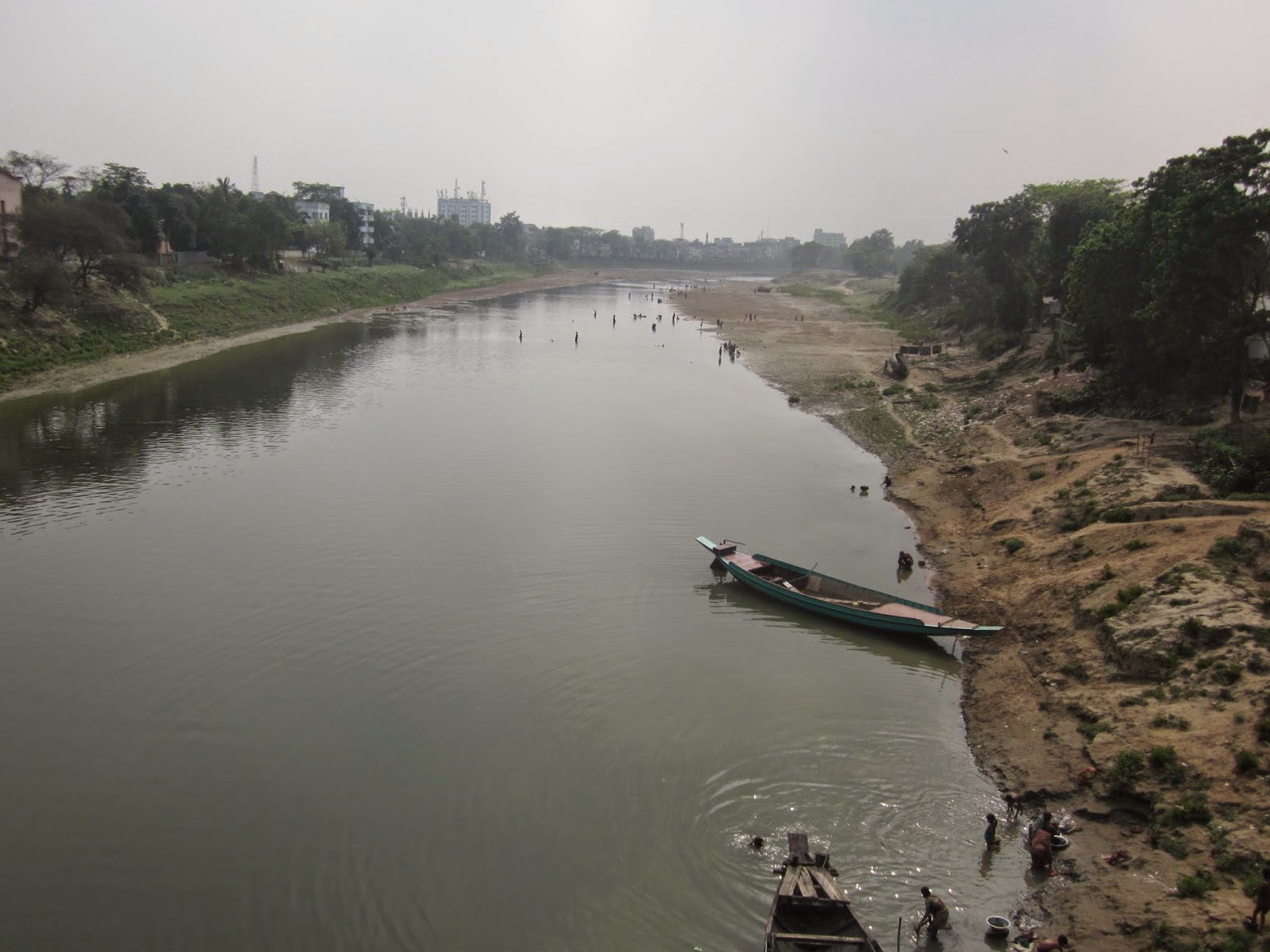


The Manu River.


Thursday, 26 December 2013

Shutkani Torkari à la Kurigram


The shutkani torkari ready to eat!

How to make shutkani torkari etc. in 12 easy steps:-

Opening note: the following process would’ve been much simpler had I’d met my friend’s younger brother stationed at Ulipur fire station at first, as described last week. But that was on the second arrival in Ulipur in the space of days, while discovering shutkani torkari, a Kurigram District specialty, was a task of the first. I didn’t know any Ulipur locals then. Anyway, let’s get started...

The locals at the Al Shad Hotel, College Road, Ulipur will prove enthusiastic accomplices in the quest to discover the local cuisine

Ingredients
250 grams fresh puti fish
3 onions
2 cloves of garlic
15 – 20 small chillies
25 grams jute leaves
2 pinches salt
2 teaspoons turmeric
half a glass of water
cooking oil
2 brothers and 1 sister-in-law
1 village kitchen
a generous serving of Ulipur hospitality

Method
Step 1: For the best result in experiencing shutkani torkari you’ll first need a bou, amma or apa – a wife, mother or older sister from Kurigram District, preferably from a village, who will be expert in cooking. Local dishes are not served in restaurants and homemade food is best. Political correctness aside, it remains a general truth that the ladies of a household are the culinary master chefs.

However, finding one of these relatives at short notice isn’t easy – and in the case of a bou the endeavour will be complicated and have lifelong consequences. But don’t despair – a suitable substitute is to find a generous bhabi or elder sister-in-law. It is well-known that a Bangladeshi bhabi is a close relation akin to a friend and that bhabis by habit take care of their choto bhais or little brothers, especially when it comes to food.

The good news is that bhabis are easier to find. Bangladesh is full of bhabis – all you need to do is to first locate a kindly bhai or brother.

Step 2: A recommended starting point for locating a bhai in Ulipur is the Al Shad Hotel on College Road. With the hotel managers and patrons it will be easy to quickly establish cordial relations and enquiries regarding a desire to sample the local cuisine will be received with enthusiasm and lively discussion.

If possible, try to raise the subject when Health Assistant Md. Shohidur Rahman has stopped by for a bite to eat. It is likely he will kindly volunteer the cooking skills of his own bhabi in Bisnubhallabhe village of Dhamsreni Union, some ten kilometres from the town.

It might be that he is able to call ahead to ask if it is okay, at which point his bhabi, Umma Habiba Mitu, will likely agree. Any offer to buy the ingredients before setting out on his Honda will be firmly refused – everything is available at the house, you will be told. In such a case, one may be on the way to the beautiful village by Shohidur Bhai’s motorcycle within minutes.

Health Assistant Shohidur Rahman in primary discussion


Step 3: Shohidur Bhai will likely stop to show the fishing nets in the waterlogged land beside ricefields at the entrance to the village where the pint-sized puti fish are caught. In the meantime, Bhabi will have started, unasked, to sort the various ingredients onto plates, chopping and washing the onions, garlic and chillies in preparation – so it looks like a TV cooking show set before your arrival. She will have the clay oven fired.

Bhabi will have neatly arranged all the ingredients in advance, so the kitchen looks like a TV cooking show set
Step 4: There will be introductions with Shohidur’s older brother Md. Mizanur Rahman Bipul and of course, with Bhabi. In due course you will be shown to the kitchen.


Step 5: Next, take the dried jute leaves and mix in water, slightly crushing them in the process. While doing this, Shohidur will explain how the jute leaves are harvested when the plants are young, no taller than his nephew. It is the new leaves which are chosen – a process which does not destroy the jute plant. It continues to grow, to provide the golden fibre. The harvested jute leaves are subsequently dried in the sun for 2 – 3 days. Put the washed jute leaves into a pan, adding the fresh puti fish.

Bhabi will periodically stir the torkari while it cooks for 15-20 minutes


Step 6: Add the onions, garlic and chillies followed by salt, turmeric, water and oil. Lightly mix by hand, and please note that one can be actively involved in this process. All the work need not be left up to Bhabi.

The torkari simmering on Bhabi's stove. 

Step 7: Place on village stove to cook for fifteen to twenty minutes. While Bhabi lightly turns the torkari as it cooks, Bipul Bhai will bring the conversation to a boil concerning that other Kurigram delicacy, shidal – a dish made from shutki, which is dried, emaciated and shrivelled fish and kochu pata, or aram leaves.

The process for making shidal is first to dry the puti fish for seven days in the sun – the usual shutki method. Then the shutki is mixed into balls with kochu and returned to sun-dry for another 15 – 20 days. The brownish, uninviting, disc-shaped and very smelly shidal ball is then ready for use. It’s a strange kind of treasure.

Bipul Bhai will explain that when visitors from Ulipur town reach the villages they often desperately seek out shidal; while visitors from Dhaka tend to react with surprise and curiosity, asking “What on Earth are you eating?”

The smelly shidal ball waiting to be cooked. No outsider would think to put that in their mouths.


Step 8: While this is going on, Shohidur Bhai will be visiting the neighbours. He has already decided that any experience of Kurigram cuisine cannot be complete without at least seeing a shidal ball – as good as the shutkani torkari promises to be. As they had none in the house, the obliging neighbours will have agreed to provide one – and Bhabi meanwhile will metamorphose this plan into actually cooking the shidal, to make more precisely a shidal bhorta – a mashed shidal dish.

Step 9: By this time the steaming shutkani torkari will be served, usually with rice. It has a strong flavour, with a spinach-like consistency but slight bitterness to it – with just a hint of puti fish. Shutkani torkari leaves a lasting taste in the mouth which makes one want more. Even for a novice who’s not particularly fond of fish – shutkani torkari à la Bhabi is delicious.

Brothers Mizanur and Shohidur Rahman.

Step 10: Meanwhile the shidal disc will have arrived. Its odour is worse than a three-day old shirt and certainly no non-local would ever consider putting that in their mouths. Yet, the Kurigramers know better – that when cooked it will have a spicy, fulsome flavour.

Somehow before the eating of the shutkani torkari is completed, Bhabi will have miraculously fried the shidal with onions and chilli before it is mashed into a bhorta with mortar and pestle. It’s spicier than the torkari, saltier with a stronger, unique flavour that, while tasty at first, must be as coffee – a flavour type which only brings increased enjoyment with accustom. It’s not difficult to understand why Ulipur townspeople feverishly seek it out. Next time I will too.

Another dish associated with Kurigram District is pelka, a seasonal soup traditionally available at winter’s end made from jute leaves and soda, or with shozna leaves in other seasons. But word from the Al Shad crowd is that pelka has resigned itself to history and is rarely enjoyed in Ulipur nowadays.

The shidal concoction ready to be mashed into a bhorta.

Step 11: Returning to town, Shohidur Bhai will stop beside a four-hundred-year-old village mazar, an Islamic shrine which sits not fifty metres from a likewise old Hindu temple, now within the roots of a huge tree. He wishes to demonstrate something of which he is proud: in Dhamsreni Union as in Ulipur, people of different faiths live in harmony.

Step 12: Upon reaching College Road, you’ll find half the street talking about the project: to sample Ulipur cuisine. The experience will need to be discussed at length with the crowd at the Al Shad over a cup or three of tea.

Shidal bhorta à la Kurigram, à la Bhabi.


This article is published in Star Magazine, here: Shutkani Torkari a la Kurigram