Showing posts with label past. Show all posts

Friday, 21 November 2014

Banglafornia


California started as an idea. Photo: Ron Eagle.


California. The first known mention was in the 1510 romance novel “Las Sergas de Esplandián” by Spaniard Garci Rodríguez de Montalvo. In the novel, California was an imagined island populated by black Amazon women, without any men. West of the Indies, California was the closest thing on Earth to paradise. California started as an idea.

A street in Dinajpur.
Moulvibazar. I’d taken the opportunity to wander the Kulaura back blocks – my last evening. The dark, dog-legged roads wound through fields interspersed with Londoni mansions. What percentage of rooms in those homes was unoccupied at any given moment? I’d taken the opportunity to be alone: not an easy feat.

It was a usual highway-side shop in one of those under-construction buildings. It could’ve been a mechanic workshop or a hardware store. But TV was showing cricket and cans of Danish condensed milk lined shelves along the far wall. There were maybe five customers.

A Californian rickshaw wallah, San Diego. Photo: Ron Eagle.


I ordered tea, sitting on the bench by the door – and the finale to my solitude lasted approximately thirty seconds: inevitable Bangladesh! The man covered in sawdust started the usual run of questions – where I was from, what I was doing – that deshi curiosity that sparkles with genuineness, as common as water.

After a minute of talking he said with a big smile, “Please let me pay for your tea. It would make me happy.” I gently refused several times to no avail. An invitation to visit the furniture workshop across the road followed. Ah, the hospitality – I know, I know, it’s everywhere...

Meanwhile there was genuine regret when the tea wallah didn’t have my cigarette brand. He felt the need to explain his stocking arrangements – why it couldn’t be available.

Meanwhile at the bus stand the ticket seller thought to say, “If any stranger gives you food along the way, don’t take it!”

Moulvibazar. In days we’d made a tiny shard of history, her and me. The way things go.

A street in Dinajpur Town.


They spoke in Sylheti and I’m going to miss it. With the scraping over the ‘kh’ it felt delectably Arabesque – I couldn’t speak it of course but the simple sentences mostly found their meaning, if I couldn’t always identify every word.

Sylheti language seems to carry urgency – perhaps languages do when you can’t understand them clearly. A basic ‘hello, hi’ sounds terribly important. It’s so important that there’s no time to open mouths much or bother pronouncing every syllable. I was thinking it would be an ideal language for farewells at train stations, you know, that movie scene when the train starts moving and the friend on the platform starts running to keep up with the window where the passenger is. In Sylheti it seems they could say so much more in those final seconds.

And any Sylheti aboard the Titanic probably narrated the entirety of their life story in the last moments before jumping onto the lifeboat. Well, ahem – first impressions...

On the several occasions I was asked about Sylheti I’d taken to responding, “Eta haglami bhai! Noakhaillar Bangla sobche shondor!” “It’s foolishness! Noakhali has the most beautiful Bangla!” The first part got them laughing, particularly the haglami which should be paglami. The second part got them started... but... “jaitanno, khaitanno,” it always sounded more like a Sylheti trying to imitate a Noakhali accent than the genuine article.

Dinajpur. Maybe it’s better to look forward? It’s time to head west to a new idea. It’s time to find my Banglafornia.

Dinajpur sunrise.

I’ll be heading for the sunset across the great plain right to the end. There’ll be miles of road to cover, hours of tar disappearing under wheels. There’ll be rivers to cross and excitement. It might take a while to get there. It may be hotter – perhaps there’ll be palm trees.

A San Diego trolley car waits for rickshaws. Photo: Ron Eagle.
The idea of California has changed. It’s like, bikini roller-blading women on beachside strips rather than Amazons. There are surfer dudes, like, listening to groovy music. Everyone is attending, like, thrice-weekly therapy sessions and injecting botox. They “do” lunch and liposuction. People say “like” a lot according to the preconceived California cliché.

Dinajpur is a thought to explore. So what do we know? Well, there’s the distinct disadvantage of high expectations. You see, I’ve hardly met a person from Dinajpur I didn’t like. They seem so straightforward and thoughtful: I’m expecting sincerity on the whole. I’m thinking there’ll be a bit of Santali culture, a dollop of archaeology. Thinking there’ll be a tolerant blend of Hindu-Muslim and not expecting language troubles.

The Dinajpur idea is so strong that in Dhaka when a rickshaw wallah says they’re from Dinajpur I don’t bother pre-negotiating. You just expect fair price, said once, money in hand not looked at. Indeed on the handful occasions where it’s not proved true, I must confess I’ve been known to criticize, “But how can you make trouble? You’re from Dinajpur!”

But is it really like that?

And yeah, okay, so Dinajpur’s a bit more northwest than California would be. It’s really more of an Oregon. But hey, who knows anything about Oregon?


Lily More, Dinajpur.

Will a Californian rickshaw wallah take his money without looking at it?


This article is published in The Star magazine, here: Banglafornia.

Thursday, 21 August 2014

Those Were the Days

Busy Moulvibazar has all the hallmarks of a Bangladeshi regional centre.
The shrine of Hazrat Shah Mustafa.


There’s no shortage of vibrancy to Moulvibazar town. The bazaar area is a kaleidoscope of dusty, coloured political banners and business signs. Electric wires entangle the streetscape and hundreds of notices once important to someone have papered over the best part of every electricity pole. It’s that usual dollop of localised chaos that signifies a district hub.

It’s not easy to imagine: this is the town named for a resident Islamic preacher, a maulavi descended from Hazrat Shah Mustafa, a companion of the famous sufi saint of Sylhet, Hazrat Shah Jalal. Hazrat Shah Mustafa’s shrine is in Moulvibazar.

Shoppers and passersby crowd footpaths and in the hotel restaurants there’s barely a vacant table. As has become the regional centre hallmark across Bangladesh there’s been that invasion of whirring electric buggies with their synthetic lollipop sirens. No, aside from the buggies, Moulvibazar’s commercial centre feels like a few square blocks of suburban Dhaka.

Hazrat Shah Mustafa's shrine, Moulvibazar.
Abdur Rouf Torufder, 75


Yet just a few rickshaw-minutes from the small-time traffic jams of the centre, still very much in town, Abdur Rouf Torofder, 75, has found a moment’s peace. He’s sitting in a rather happening cane rocking chair at his shop, Fouzia Cane House, waiting for customers and brushing off flies. Torofder remembers an altogether simpler Moulvibazar.

“There was the hospital, the high school where I studied and the police station,” he says, “Those were the three brick buildings. There was nothing... open land with dirt roads. There were horse carts and ox carts and we used to walk barefoot – only outsiders wore shoes. There were hardly any shops that sold them. A tin shed building in Moulvibazar was luxurious when I was young.”

From a time when perhaps only two hundred people lived in the town, Torofder remembers the twice weekly market days, the only relatively busy days. “Hawkers sold peanuts and mori puffed rice snacks – much tastier than you can find now. Half a kilogram of peanuts cost fifty paisa. We could enjoy bakery biscuits but there was no ice cream.”

“The town has become very big since,” he says.

The high school was one of three brick buildings in the town, decades ago.


On her way home to her daughter’s house in one of the side streets at the start of the Sreemangal Road, Fatema Begum, 70, likewise remembers the food. Born in Sylhet, she arrived in Moulvibazar some forty-five years ago to stay with her daughter who currently works as a maid. There, she discovered wonderfully fresh milk and curd. “People used to eat really well,” she says, “Now everything is expensive.”

The paradox is that like the other districts of Sylhet Division, Moulvibazar has benefited from large scale migration over many decades, principally to the United Kingdom – the Londoni phenomenon. Foreign remittances brought greater prosperity to many. “There was lots of open land, ponds...” Begum says, “Rich people were few – but now they are available. Now, too many people are fraudulent. They used to be very kind.” And kindness is an attribute she demonstrates by stopping to chat – we are lucky. “I’ve had two strokes, you know,” she says.

Before she continues her walk home she pauses – she’s had another thought. “In 1971 I saw the Pakistani army catching brothers and sisters. I saw everything.”

Vegetable seller Faruk Miah, 60.

Meanwhile at the market in front of the court house, father of three Faruk Miah, 60, originally from Chamorkuna village, is selling vegetables – he started as a retailer when he was thirteen. “My father died when I was seven,” he says, “I was alone. I stayed on government khas land and eventually started business. At first I sold betel nut – and for the last thirty-five years, vegetables.”

The Moulvibazar court house complex.
He remembers a damp Moulvibazar of open fields. “Taro plants grew wild in the town. At that time vegetables were seasonal – now they run year-round. Moulvibazar used to supply rice to other districts but now we import. All the vegetables were local too.”

Faruk still trades in local vegetables but remarks that the town has since been “attacked” by wholesalers and it’s become harder for the local sellers. “It used to be good – and the court market is still better than other places,” he says, “But now I have no peace.”

“Before people didn’t have anything,” Faruk recalls, “They used to sell their house land for hand-to-mouth crisis. In 1980, 30 decimals of land cost about 200 taka. Now one decimal is five to seven lakhs taka. Yet in those days people didn’t bargain.”

The courthouse hill, Moulvibazar town.
He remembers the floods before the barrage was constructed on the Manu River. In 1984 the whole town was under water except the small hill where the court is situated.

“I was a member of a theatre group,” he says, “and we used to sing songs all night – then in the morning we’d cultivate land, with everyone joining in.” It’s hardly surprising he has no time for modern entertainment. “Now it’s all cinema-ninema,” he says, “It’s all circus... not like before.”

“You know, the country was poor then,” he comments, “Many went to your country to make money.” He’d surely be right if I was born in the United Kingdom.

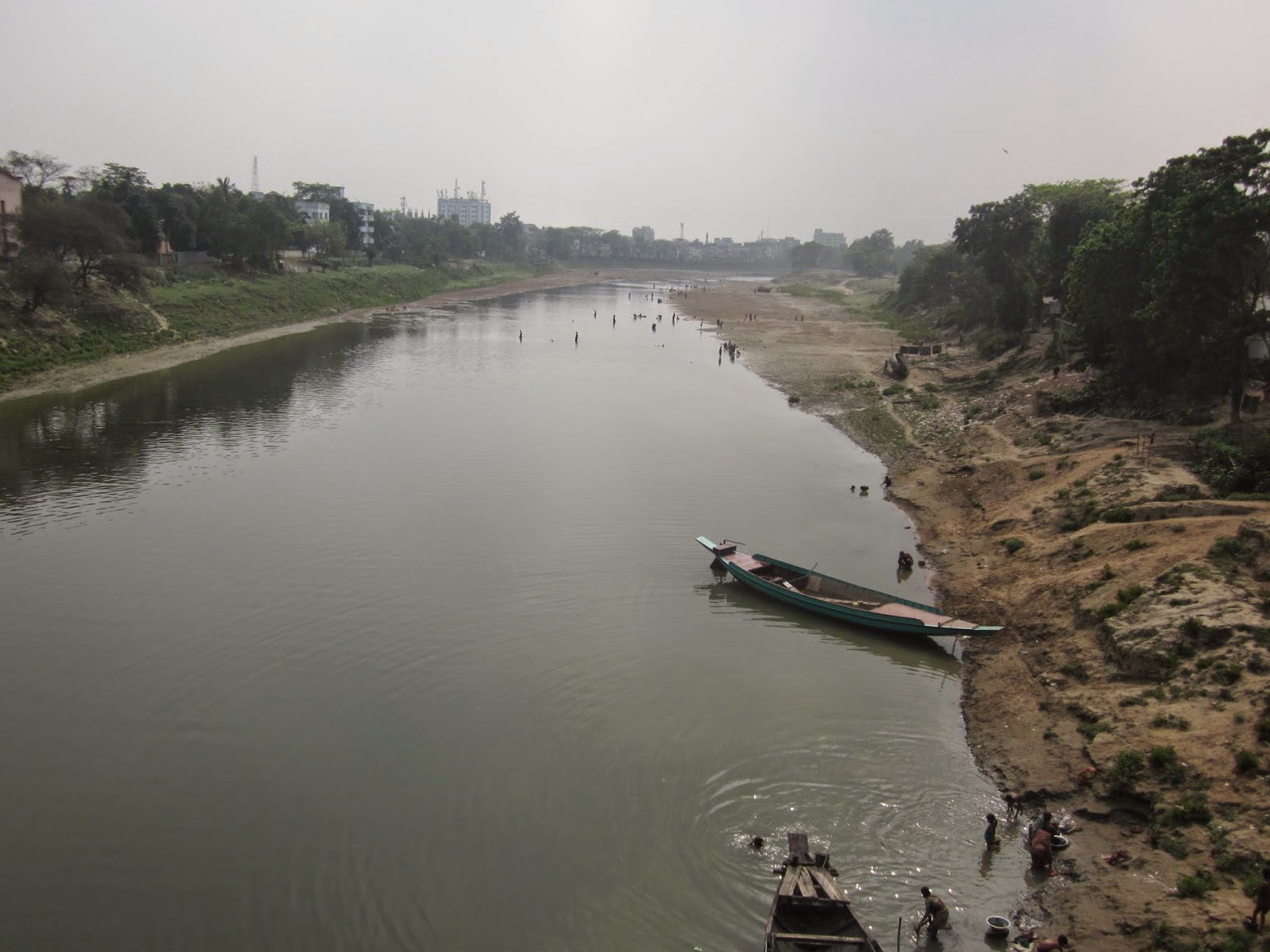
The Manu River, Moulvibazar town.
Md Salam Box with his son Noyon


Beside the Manu River weir is a tea shack called the Brother-Sister Variety Store. It’s the business of Md Salam Box, 51, from Matakarpon village. He’s somebody who believes in hard work. “In our family there are seven,” he says, “and I am the chairman. If I tell my family, ‘Today you will eat rice’ and they don’t eat it, who is at fault?”

From his sense of responsibility he wanted his children to study. But a few years ago circumstances changed. “My intestine busted,” he says, “It had a six by two inch hole in it, and after I became sick I couldn’t work like before. I opened this tea shop.” His thirteen-year-old son Noyon was unable to continue studying and took a job as a brickfield labourer.

“My son works very hard,” he says, “but these days so many young men like to stay in their houses and eat. Nor do they wish to study. These days the kids want a Honda to go to college, but if you give them an English newspaper they can’t read it.”

“Thirty years ago, I was very afraid of my father. It’s not like that now. There was no zom-zom then,” says Box, referring to noise and bustle.

He also fondly remembers yesteryear’s food. “There were many pineapple gardens. We had coconuts, palm syrup, mangoes, jam, jackfruit... There was room to grow vegetables everywhere – now it’s all buildings. The river was full of fish.”

Now Moulvibazar is all buildings. It's all zom-zom bustle.


“I miss bhubis and nashpati pears,” he says, referring to local fruits, the former called langsat or lanzones in English. “I miss latiall and kasalath rice.” These are traditional Sylhet-region rice species. Latiall is recalled as small grained with a nice aroma, while kasalath is an aus variety.

Yet he also considers that more development could have been achieved. “In other countries, how happy they are!” says Box. “Everything is already digital there.”

As we speak, Box’s dust-covered son Noyon appears, on a break from the nearby brickfield. He asks for a cold drink and before he leaves – he’s been taught responsibility – pays.

Meanwhile, back at Fousia Cane House, Torofder also attests to changed values. “People used to keep promises,” he says, “People didn’t lie. Even a murderer would say sorry back then.”


It was when he was twenty that Torofder finally got his first shoes, a parental gift that cost one taka – the same price as a large hilsa fish. “They were tyre-belt, wooden chappals,” he remembers, “I really liked them. At first it was strange to wear shoes but I got used to it. It was luxury and I felt like a king!” 


The Manu riverbank.
The Manu river from the weir.

The Manu River weir, Moulvibazar.

The weir sluice gates.

Behind the weir.


This article is published in Star Magazine, here: Those Were the Days


The Manu River.


Thursday, 14 August 2014

Manu

The advantage of the Manu station ticket counter is it's very unlikely you'll have to queue.

I

The trucks are loaded and overloaded these days, heaped high, rice grain, cement sacks, bananas or livestock. It’s a lily. It’s a lotus painted pink on the yellow cabin door – or a serene mosque in ghostly green with attendant crescent moon. There’s an eagle landed on a branch. There’s a magpie robin. Every truck is a canvas.

Non-specific flowers trail along the metal panels above the wheels. There’s the driver. There’s the attendant shouting out things. Every truck is an optimist ready to tempt its fate and ours. These are spiritual, personalised, grumpy machines. There are deadlines. There’s no time to lose. In the diesel stench they rumble, shoot like bullets along the highway kicking up dust and nerves all across the country.

Those trucks carry more than goods of course. They’ve loaded up that history and carted it away. Who will think of Manu now?

The Manu station timetable.


II

Shanti Lal Robidas, Manu platform.
There’s lethargy to the heat by the Manu River in rural Moulvibazar. The shiny singular line of railway tracks from Sreemangal to the south reaches Manu station on a long curve through fields, with a little box bridge over a culvert up the line. Beside the larger bridge in red-brown iron that crosses the Manu grand trees line the rustic platform. The trees are the best hope for conversation.

It’s not that the Manu platform is entirely empty. The stationmaster has gone home for lunch but Shanti Lal Robidas, 60 plus, is there. He doesn’t much wish to speak though. He’s brought his shoe shining kit from home – over the tracks among the collection of tin shed stores they call Manu Bazar. He’s waiting for any passing shoes that might need polishing or cobbling. It’s an effort that seems futile. The Mail, the Jalalabad and the local Kushiara... three trains per day deign to stop. Perhaps his is more a psychological business, something to get him out of the house. It’s a ritual.

Robidas lacks that engaging effervescence it’s so easy to take for granted. He’s really not a conversationalist – shy and reluctant. It stands out. He’s not Bengali for sure. “Five to six years ago all the trains stopped here,” he says, coaxed out of him, “Business was good.”

It's not certain he knows where his family come from.
Perhaps his heritage came via the tea plantations. Those workers’ families were lured and tricked from all over India by the British – many are no longer sure where their roots lie. They brought cultures and now half-forgotten languages; from his demeanour one can sense that anachronistic binding sense of caste, most often out of place in Bangladesh. It seems as if he doesn’t wish to speak because he’s ‘only’ a cobbler and cobblers can’t have anything useful to say. Perhaps that’s not it – nothing is sure. If he said a little more we’d know. But it feels oh so rural India.

Later, two of his friends arrive. They’ve noticed the sight of strangers on the platform. Cautiously Robidas confesses he’s been the Manu platform cobbler since the East Pakistan days but otherwise his friends take over, verbally encroaching to speak for him.

“Manu was more developed than Kulaura Junction,” one says, “All sorts of goods passed through – rice grain, timber, fish.”

“There’s no excitement like there once was – no business, no people,” says the other.

There's talk of a flood maybe fifteen years ago when the rail line was closed for seven days. Sometimes passengers slept and ate at the station.

The guy in the orange shirt was very keen to be in the photos.
Suddenly there’s the long bellow of a horn. A train is approaching from the Sreemangal side, acknowledging Manu station with the sound as if sending a little “hello, hi” to a friend from a bygone era. Or perhaps it’s a greeting for the cobbler? For the few on the platform there’s some interest in it: the strangeness of change!

I watch the train close in; the others watch me watching. But there’s no slowing down for Manu, no pairs of shoes to comfortably alight to be polished or cobbled. With a rush of wind; with passengers sticking heads out train windows, waving, watching rural Bangladesh rush by; with platform tree branches momentarily waving back; with kids train surfing on the roof... change is as suddenly gone – over the river, across the bridge, into the future. That change is bound for the bustling bazaar of Kulaura Junction and the modernised skyline of Sylhet City – express.

Stillness easily returns to Manu. Stillness has made itself comfortable there.

Express train passing by Manu station.

III

Manu was once a busy, commercial station.
In Kulaura there’s talk of a Manu River lined with godowns. Especially it was a port for fish and chingri shrimp sent by rail from Chandpur, Chittagong and Noakhali. Those goods got down at Manu to board barges on their way to market. In its heyday Manu was a commercial station with three rail lines, five station buildings and twelve staff working eight-hour shifts such that always a minimum of three were on duty.

Upstream is India, the Tripuran town of Kailashahar and beyond, oddly enough, another little train station called Manu. Indian Manu is on the Lumding – Agartala rail line opened in 2008.

Downstream is Moulvibazar town. But while these days there are river barrages on both sides, not to mention the border, in all likelihood it’s primarily the trucks that did the damage. With the ease of highway transport they packed up that history and carted it away.

Manu platform and the Manu River.

IV

Md Badal Rana, stationmaster.
In the evening Manu is deserted. Only stationmaster Md Badal Rana, 35, sits in his office, several ledgers in front of him. There are six columns he needs to complete each day with the amount of whatever meagre takings he’s collected. There’s no need for signalling work.

“I’m alone,” he says, “The station is only here for the bridge. The river is here. I have twenty-four hour duty.” His manner is gregarious, clearly pleased for the company. It’s the sort of thing to take for granted – there’s no doubt he’s Bengali.

“The trains, including the expresses, are many,” he says, “but the line is only one. Often trains have to wait at Sreemangal or Kulaura Junction. Today the 6 a.m. train came at 11 a.m. and the 11 a.m. train came at 2 p.m.” It’s his personal phone he uses to find out where a train is when passengers come. “The worst thing is when people have to wait a long time.”

“It’s a poor area,” he says, “People work as rickshaw drivers and such. They don’t buy tickets much; and the Kushiara comes first – it’s a local service where you buy the ticket onboard.” It costs ten taka to travel 24 kilometres, 12 taka for 31 km and 15 taka for 41 km.*

The tracks towards Kulaura Junction.
Rana likes the locals. “Hindu or Muslim, they are good, simple people. We have nice adda, chatting, together. Everybody knows me. I’m invited to all the pujas and weddings. They all have my mobile number and I spend too much money returning calls to sell tickets. Sometimes I sell long-distance tickets to Chandpur or Dhaka.”

It took Rana some adjustment to get used to his Manu posting, which he took up in 2011. “There is no food system here. No rice. And I don’t like coming at night. After 10 p.m. there aren’t people around but if a train is arriving at 1 or 2 a.m. I am here. What will I do if people come?” At the least, with the help of a local councillor he managed to have the tube well fixed. It was broken for thirty years but now he has drinking water.

He points to the broken ceiling above us. “What if a woman was sitting there and it falls?”


*US$1=80 Bangladeshi taka.

Manu station, Moulvibazar District, Bangladesh.

Manu was once a station of 5 buildings and 12 staff.


The station. Manu. Moulvibazar.


This article is published in Star Magazine, here: Manu


Stillness makes itself comfortable in Manu.


The trucks have carted away the history.