Showing posts with label Sylhet. Show all posts

Thursday, 4 December 2014

A Poet's Aside


The entangled branches of Tangail's tamal tree.
(Photos courtesy of Mohammed Shafiqul Islam).


Hurry! Hurry! Delay is waste, to tarry, distraction: so says the modern world. It’s probably why intercity buses stop only once, at some kind of wannabe-grand roadside eatery with a fluorescent name along the lines of “Food Village” or “Leisure Spot.” The conductor says we’ll be stopping for twenty minutes. It means half an hour.

Lord Krishna's tamal tree. Can you hear his flute song?


But the village flute doesn’t run like an intercity bus. For one thing, everybody knows a flute song never need cram extra passengers in. For another, flute songs don’t travel at death-defying speed. No – the meandering, the tugging of the soul along detours and improvised paths is what any flute song is about.

…which is why, though time is of the essence and we should be hurtling non-stop towards Dinajpur by now, it can happen that the flute leads us momentarily elsewhere, to a different kind of leisure spot. 

Like the flute, this place was favoured by Lord Krishna. It’s to be found in Tangail.

A journey by flute meanders, tugs the soul.
Moreover, well, let me be clear… It’s not a physical journey that I write of this time – I’ve never been there. It’s a journey heard about, a place that might be hoping to be known. Who am I to refuse the wishes of such a place? And instead of leisure – we are, after all, talking of Lord Krishna, we might say pleasure.

The hearing of the place came about when Shahjalal University of Science and Technology English lecturer and poet Mohammad Shafiqul Islam contacted me recently. Our conversation worked its way towards villages as conversations often do with me. The Tangail native was keen to speak of a village three kilometres east of Ghatail Upazila’s Sagardighi – the village called Gupta Brindaban in reference to Lord Krishna’s childhood home. Our poet wanted to tell about an old tamal tree.

The tamal tree collects the threads of people's prayers.
The last time he reached there, he says, with friends he sat beneath that tree and took comfort from its shade. It offered coolness and peace on a day of particularly scorching heat. “We were showered with the grace of life,” is how our poet described it.

Sridan, Sudan, Basudam, Subal, Madhumangal, Subahu, Arjun, Gandharba, Daam, Stokkrishna, Mahabal and Mahabahu: when Lord Krishna reached the place many moons earlier he brought with him twelve friends, according to our poet – others say there were sixteen. He came for leela, for secret pleasure.

It’s believed Krishna used to sit in the tree and play his flute. To its melody Radha would be entranced, Krishna absorbed in the duality of music and love. At other times his friends would be with him and Lord Krishna would take pleasure of a more platonic kind. Either way, Krishna is said to have stayed by that tamal tree for a long time.

As his forefathers did, Sree Prafulla Chandra Baishnaba cares for the tree.
 
“Sree Prafulla Chandra Baishnaba welcomed us with a smiling face when we arrived,” says our poet. Like his father and forefathers before him, he has taken on the duty of looking after the tree. There’s a temple nearby, the Bigraha Mandir, where people every day offer puja.

Krishna devotees fasten threads around the tamal tree’s branches, believing their ailments can be cured and wishes fulfilled by God’s grace. Muslims and Christians are also known to revere that place. 

Hundreds of years: the root of the tamal tree.
“The tree,” says our poet, “now hundreds of years old with its skin dried up, may seem weak with the weight of age but from the tranquillity of shade it grants devotees – with the nurturing of secret wishes and the drawing of feelings of sacredness from hearts, it surely measures great strength.” As Krishna once played his flute people now spend long hours absorbed in meditation.

“Their faces seem to glow with heavenly colours,” says our poet. “They begin to feel light, both physically and mentally as God is sure to grant life to their hopes.”

The tree itself is said to have died many years ago – but people did not stop their worship when it was lifeless – and then, after twelve years its branches mysteriously donned once more the decoration of new green leaves.

“Sree Prafulla showed us other aspects of the tree that are unusual,” says our poet. “It has an opening in the root and trees should not survive in a condition like that. And the shade it provides is extraordinary.” 

Through the twisted, turning years of this world...

Two branches of the tree are unusually entangled around one leafless, small branch – it is believed that was the branch upon which flute playing Lord Krishna sat.

In Chaitra month on occasion of Madhukrishna Troyodoshi a festival is held. Thousands of people congregate – of many faiths and from as far as India.

But of course one can’t anticipate taking comfort from the shade of a tamal tree forever. The devotees take their spiritual fill from the Radha-Krishna pleasure grove and eventually leave. Poets must understand too, of course, that once a poem is done there’s a need to move on. Even Lord Krishna, though he may have stayed for many days knew he had more to do elsewhere. 

Krishna the flautist, with Radha, at the nearby temple.
 
Our poet with his wife.
“As we left,” says our poet, “We carried with us a distinct celestial feeling of solemnity and sanctity.”

And so, like the devotees, like our poet and Lord Krishna, we are also bound to move forward. The village flute cannot give pause to the song for long. 

And so, like the intercity bus the mind with body must re-embark… One stop is sufficient, surely, for the trip to Dinajpur. Don’t worry it’ll only take twenty minutes, which really means half an hour. Don’t be late in getting, once more, on board.


With thanks to Mohammad Shafiqul Islam for sharing his experience.

The tamal tree from the south.


Friday, 31 October 2014

In the Garden


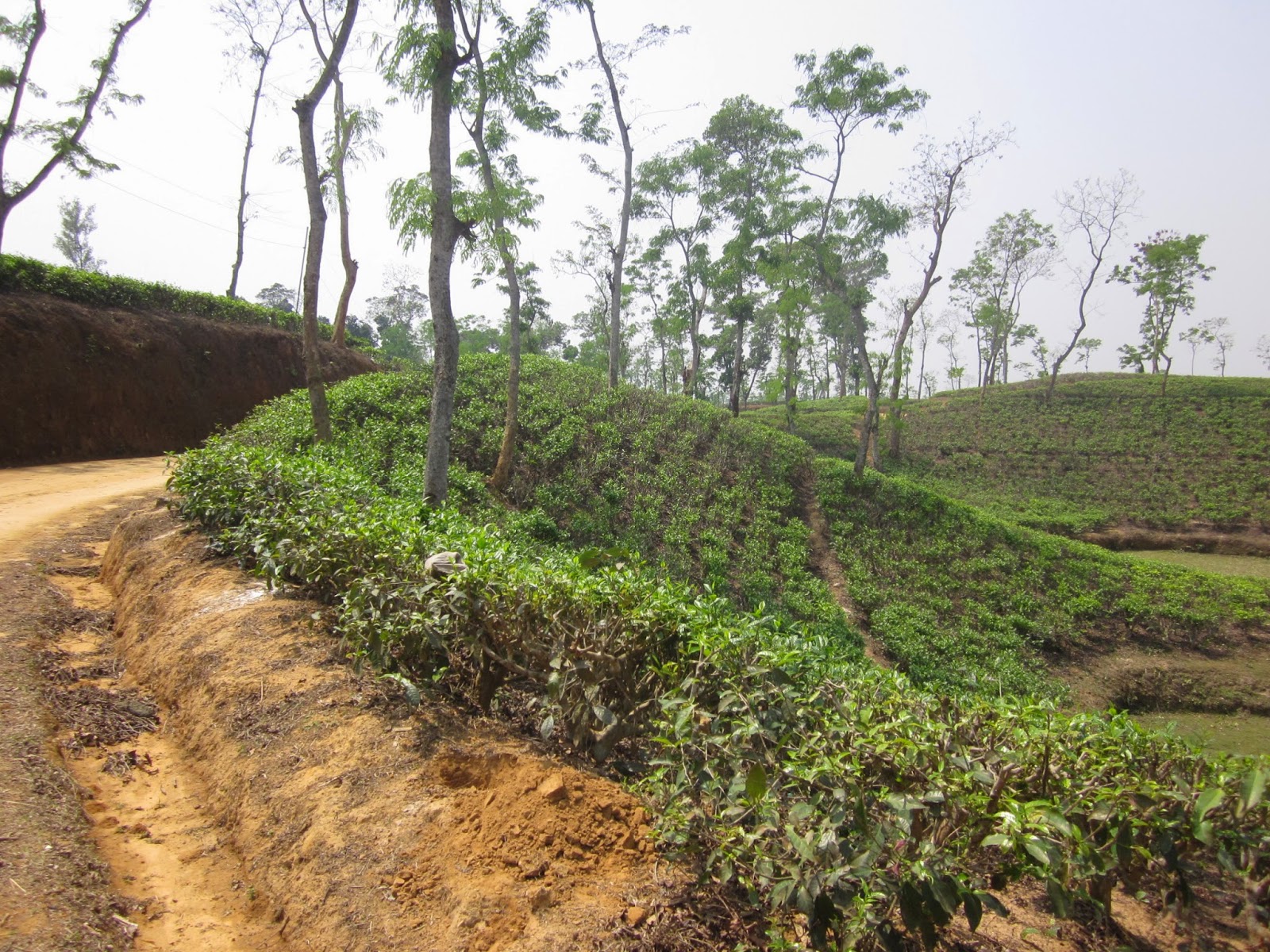
Chatlapore Tea Garden in Moulvibazar District.


Sun and light: the dirt road leading into Moulvibazar District’s Chatlapore hillock country feels forgotten. At the final village bazaar the rickshaw pulls to a stop. It’ll be on foot from there. There’s a sentry post and a boundary. It’s in the nature of gardens to be distinct from the wider world. They’re supposed to be nature rationalised and improved.

Houses are different in the garden.


The houses of usual Bangladesh can venture no further in, because usual Bangladesh has ended. Ahead are old structures of a new kind: workers’ cottages in rendered brick, washed in white, pastel blue or green, with brick chimneys distantly reminiscent of an old English village and more directly of colonial India. Only the tin roofs are the same.

An old landscape of a new kind arrives too: neatly trimmed tea bushes cover most ground, recounting at some feet higher the undulating lay of the land, in parallel. “When I was young the tea trees were younger,” says Sagar Das 50, a native of the estate who with his wife was long ago allocated one of those cottages. “Now I am old and the tea trees are also older.”

The small hills of Chatlapore.


Since the dawn of time gardens have been planted, pruned and tended as a space for relaxation, of beauty and contemplation. Gardens are usually a place to escape ourselves – but for its inhabitants the tea garden defines. Instead of being away from daily life the tea garden is daily life. It’s the only life. In place of a border to block out a shabbier world the tea garden boundary hems a world in. Das was born in Chatlapore.

When he was a baby his mother used to take him to sleep in a basket in the narrow aisles between the tea bushes or at the roadside under a tree. Jackals occasionally took children then. But a baby could hardly be left at home while wife plucked and husband toiled in the garden.

In Chatlapore tea garden, Moulvibazar.


As a boy there were games – one with two sticks, a longer one as bat and the shorter as ball. They played jambura football too, kicking the large grapefruit – called a pomelo or shaddock in English, about any patch of open ground. “As kids we ran naked,” says Das. “We didn’t know much.”

At 12 years old his unadulterated childhood reached its conclusion. With only one year of schooling completed, Das started to work. His first job was cleaning the nursery where tea saplings are readied. After one month he was shifted to drain digging. His starting salary was 37 taka per week, which he gave to his parents.

Tea garden housing for the workers.
On his first day he expressed shock. “What has my father done?” he asked aloud, “Will I come into the jungle to work?” The other workers laughed. Like theirs, his life in the garden was predetermined. He belonged to it.

Of course he’d learn the morning conversations: “Ma gave me rice,” “Ma gave me flat bread.” Minute details shared, even if tongue-in-cheek, was about all there was for variety and diversion – on the way to work, during the 9 am to 2 pm workday – every day except Sunday, or after work over a cup of preferred salt tea. Sugar is expensive in the garden.

These days Das works with a sickle, pruning. As is usual for a worker his current salary is a paltry 69 taka per day. He participates in leaf plucking during monsoon when the volume can’t be met by the women alone.

Rajkumari Das never went to school. She started working when she was 12.


Rajkumari Das, 40.


His wife Rajkumari Das, 40, is originally from Khajadura Tea Estate. She also started working at age twelve. “The tea garden was exciting,” she says of those first days, with an initial month devoted to fertilizer before she began helping her mother to pluck. “But I am still plucking!” she says.

Like the men, during work hours with two to three hundred other women she got used to sharing life’s little details. They talk about their families and homes, food and children. They swap recipes for chutney or favoured dishes, and occasionally chase away foxes.

Sometimes discussions are lively, sometimes serious or sad. And it all happens in that chutney language they call Chilo-Milo – a mixture of languages from all the groups the British seduced and brought from across India to work the plantations. For the word ‘come’, some say asa while others say awa, awather, awatho, awohi or chelo... there are yet more ways than those...

In the garden they speak a blended language called Chilo-Milo.


In the garden is a new culture and language of an old kind – or rather a mixture of many.

The language Mr and Mrs Das speak at home they call Deshwari, which may refer to the name of a village populated by Hindi and Santal speakers in India’s Jharkhand state. Their Deshwari may be a localised version of Hindi – it’s uncertain. Like many thereabouts they know little of their ancestry. Useless things from beyond the garden boundary, anything that doesn’t help the plants grow like identity, would seem to have a propensity to dissolve in salt tea – and in the garden sugar is expensive.

The first tea workers were brought in from across India.
Rajkumari, who never went to school, heard from her parents that her great grandfather came from some Indian elsewhere. Like many neighbours she’s heard that those first workers were coaxed into the garden with promises of finding trees that produced money just by touching or shaking them. More than that, she doesn’t know.

Over a century has gone since their forefathers arrived and a quiet sense of resignation appears to have settled over the Das home. They have their modest housing and at least the promise of adequate health care. There’s little point in questioning their below-meagre salaries which shape that quality blend of employment and servitude that is also their lives.

Tea workers taking a break from weeding, extra work undertaken before the plucking season peak.


There’s only to accept the multi-generational dislocation from original culture and ancestral identity. The British wanted tea. The garden came to be. In their family, all hope of genuine change belongs wholly to the next generation.

Identity tends to dissolve in the salt tea of the garden.


The house allocated to Mr and Mrs Das is, by coincidence, opposite one of the garden’s primary schools. “I used to see other children going in there,” says the father of four, “so I sent mine.”

Besides, Sagar Das remembers his own bewilderment at being sent to work in the ‘jungle’. He remembers his words about his father on his first work day. “My children,” he says with quiet pride, “will never say such a thing about me!”

Sagar Das aims for a future for his children beyond the garden.
Nowadays their eldest daughter works as a teacher for BRAC; the other two daughters and one son study from college to class 8. “I want my children to have a good life; I hope they will be able to take care of themselves,” says Das. “Only Bhagawan knows how it will happen exactly – but as long as they are okay. What more could I wish for?”

He seems to be aiming for his children to live beyond the boundary. Through education his goal appears to be nature rationalised and improved. For his children, Sagar Das wants the radical reality of a genuine garden – and perhaps even tea with sugar.

Allocated workers' housing.
But there’s a problem: the plantation system is designed for replication, not for change. It doesn’t have much time for the whims of one Mr. Das. Tea garden workers can only stay in their homes as long as at least one family member works in the plantation. So if all his children establish themselves beyond the hem and the rules of the only life he and his wife have known, where will they stay when they get old?


The British wanted tea. The gardens came to be. Evening arrives at Chatlapore.


This article is published in Star Magazine, here: In The Garden


The tea garden hems life in.


Thursday, 21 August 2014

Those Were the Days

Busy Moulvibazar has all the hallmarks of a Bangladeshi regional centre.
The shrine of Hazrat Shah Mustafa.


There’s no shortage of vibrancy to Moulvibazar town. The bazaar area is a kaleidoscope of dusty, coloured political banners and business signs. Electric wires entangle the streetscape and hundreds of notices once important to someone have papered over the best part of every electricity pole. It’s that usual dollop of localised chaos that signifies a district hub.

It’s not easy to imagine: this is the town named for a resident Islamic preacher, a maulavi descended from Hazrat Shah Mustafa, a companion of the famous sufi saint of Sylhet, Hazrat Shah Jalal. Hazrat Shah Mustafa’s shrine is in Moulvibazar.

Shoppers and passersby crowd footpaths and in the hotel restaurants there’s barely a vacant table. As has become the regional centre hallmark across Bangladesh there’s been that invasion of whirring electric buggies with their synthetic lollipop sirens. No, aside from the buggies, Moulvibazar’s commercial centre feels like a few square blocks of suburban Dhaka.

Hazrat Shah Mustafa's shrine, Moulvibazar.
Abdur Rouf Torufder, 75


Yet just a few rickshaw-minutes from the small-time traffic jams of the centre, still very much in town, Abdur Rouf Torofder, 75, has found a moment’s peace. He’s sitting in a rather happening cane rocking chair at his shop, Fouzia Cane House, waiting for customers and brushing off flies. Torofder remembers an altogether simpler Moulvibazar.

“There was the hospital, the high school where I studied and the police station,” he says, “Those were the three brick buildings. There was nothing... open land with dirt roads. There were horse carts and ox carts and we used to walk barefoot – only outsiders wore shoes. There were hardly any shops that sold them. A tin shed building in Moulvibazar was luxurious when I was young.”

From a time when perhaps only two hundred people lived in the town, Torofder remembers the twice weekly market days, the only relatively busy days. “Hawkers sold peanuts and mori puffed rice snacks – much tastier than you can find now. Half a kilogram of peanuts cost fifty paisa. We could enjoy bakery biscuits but there was no ice cream.”

“The town has become very big since,” he says.

The high school was one of three brick buildings in the town, decades ago.


On her way home to her daughter’s house in one of the side streets at the start of the Sreemangal Road, Fatema Begum, 70, likewise remembers the food. Born in Sylhet, she arrived in Moulvibazar some forty-five years ago to stay with her daughter who currently works as a maid. There, she discovered wonderfully fresh milk and curd. “People used to eat really well,” she says, “Now everything is expensive.”

The paradox is that like the other districts of Sylhet Division, Moulvibazar has benefited from large scale migration over many decades, principally to the United Kingdom – the Londoni phenomenon. Foreign remittances brought greater prosperity to many. “There was lots of open land, ponds...” Begum says, “Rich people were few – but now they are available. Now, too many people are fraudulent. They used to be very kind.” And kindness is an attribute she demonstrates by stopping to chat – we are lucky. “I’ve had two strokes, you know,” she says.

Before she continues her walk home she pauses – she’s had another thought. “In 1971 I saw the Pakistani army catching brothers and sisters. I saw everything.”

Vegetable seller Faruk Miah, 60.

Meanwhile at the market in front of the court house, father of three Faruk Miah, 60, originally from Chamorkuna village, is selling vegetables – he started as a retailer when he was thirteen. “My father died when I was seven,” he says, “I was alone. I stayed on government khas land and eventually started business. At first I sold betel nut – and for the last thirty-five years, vegetables.”

The Moulvibazar court house complex.
He remembers a damp Moulvibazar of open fields. “Taro plants grew wild in the town. At that time vegetables were seasonal – now they run year-round. Moulvibazar used to supply rice to other districts but now we import. All the vegetables were local too.”

Faruk still trades in local vegetables but remarks that the town has since been “attacked” by wholesalers and it’s become harder for the local sellers. “It used to be good – and the court market is still better than other places,” he says, “But now I have no peace.”

“Before people didn’t have anything,” Faruk recalls, “They used to sell their house land for hand-to-mouth crisis. In 1980, 30 decimals of land cost about 200 taka. Now one decimal is five to seven lakhs taka. Yet in those days people didn’t bargain.”

The courthouse hill, Moulvibazar town.
He remembers the floods before the barrage was constructed on the Manu River. In 1984 the whole town was under water except the small hill where the court is situated.

“I was a member of a theatre group,” he says, “and we used to sing songs all night – then in the morning we’d cultivate land, with everyone joining in.” It’s hardly surprising he has no time for modern entertainment. “Now it’s all cinema-ninema,” he says, “It’s all circus... not like before.”

“You know, the country was poor then,” he comments, “Many went to your country to make money.” He’d surely be right if I was born in the United Kingdom.

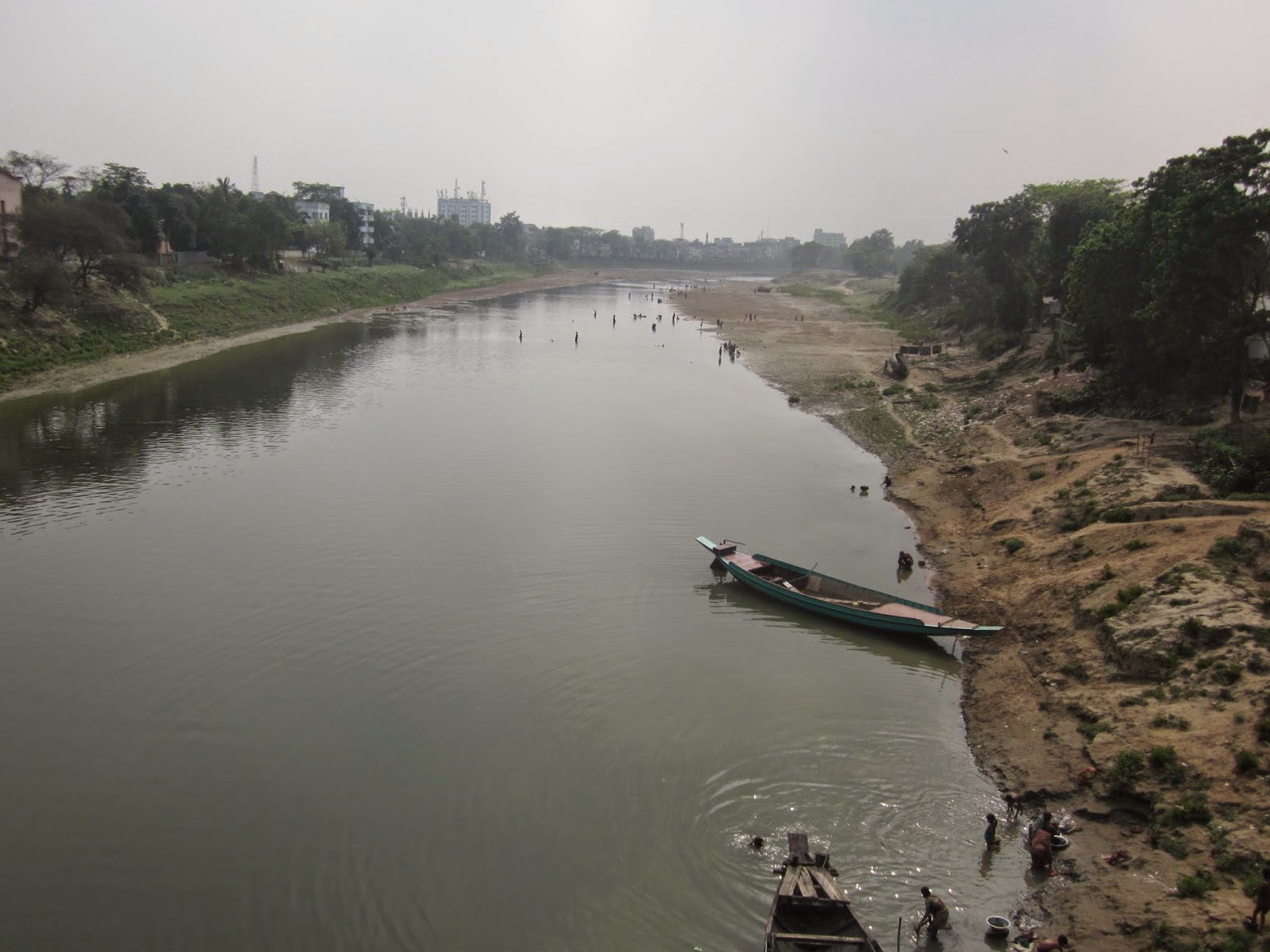
The Manu River, Moulvibazar town.
Md Salam Box with his son Noyon


Beside the Manu River weir is a tea shack called the Brother-Sister Variety Store. It’s the business of Md Salam Box, 51, from Matakarpon village. He’s somebody who believes in hard work. “In our family there are seven,” he says, “and I am the chairman. If I tell my family, ‘Today you will eat rice’ and they don’t eat it, who is at fault?”

From his sense of responsibility he wanted his children to study. But a few years ago circumstances changed. “My intestine busted,” he says, “It had a six by two inch hole in it, and after I became sick I couldn’t work like before. I opened this tea shop.” His thirteen-year-old son Noyon was unable to continue studying and took a job as a brickfield labourer.

“My son works very hard,” he says, “but these days so many young men like to stay in their houses and eat. Nor do they wish to study. These days the kids want a Honda to go to college, but if you give them an English newspaper they can’t read it.”

“Thirty years ago, I was very afraid of my father. It’s not like that now. There was no zom-zom then,” says Box, referring to noise and bustle.

He also fondly remembers yesteryear’s food. “There were many pineapple gardens. We had coconuts, palm syrup, mangoes, jam, jackfruit... There was room to grow vegetables everywhere – now it’s all buildings. The river was full of fish.”

Now Moulvibazar is all buildings. It's all zom-zom bustle.


“I miss bhubis and nashpati pears,” he says, referring to local fruits, the former called langsat or lanzones in English. “I miss latiall and kasalath rice.” These are traditional Sylhet-region rice species. Latiall is recalled as small grained with a nice aroma, while kasalath is an aus variety.

Yet he also considers that more development could have been achieved. “In other countries, how happy they are!” says Box. “Everything is already digital there.”

As we speak, Box’s dust-covered son Noyon appears, on a break from the nearby brickfield. He asks for a cold drink and before he leaves – he’s been taught responsibility – pays.

Meanwhile, back at Fousia Cane House, Torofder also attests to changed values. “People used to keep promises,” he says, “People didn’t lie. Even a murderer would say sorry back then.”


It was when he was twenty that Torofder finally got his first shoes, a parental gift that cost one taka – the same price as a large hilsa fish. “They were tyre-belt, wooden chappals,” he remembers, “I really liked them. At first it was strange to wear shoes but I got used to it. It was luxury and I felt like a king!” 


The Manu riverbank.
The Manu river from the weir.

The Manu River weir, Moulvibazar.

The weir sluice gates.

Behind the weir.


This article is published in Star Magazine, here: Those Were the Days


The Manu River.