Showing posts with label artisan. Show all posts

Thursday, 15 January 2015

A Conversation in Clay


The coals of the hookah will never run cold. The ox cart will never arrive. She is clay.

With hand to hip she’s kneeling: a repose that brings comfort to the carriage of the ox cart. Puffing on a hookah pipe as ladies like to do, she’s a connoisseur of culture.

Both smoking and ox cart travelling must offer ground for contemplation – all the more so in a frozen moment such as hers. The hookah’s coals can never run out of heat. The ox cart will never arrive. She cannot age for she is made of clay. She is but an intricate decoration: part of a brick in Dinajpur’s Kantaji Temple.

“There would’ve been a guild of artisans, probably fifty or more people,” says Dr Niru Shamsunnahar, Deputy Keeper at the Department of History and Classical Arts. “They would’ve had a master craftsman as leader, who by tradition specialised in architecture, painting and sculpture – all three.” Researcher and historian, she has studied terracotta for over a decade.

“The guild would roam, offering services at palaces and the houses of wealthy landlords. They even had blueprints from which a patron could choose.”

A long racing boat in the temple detail.


Being an artisan was a multigenerational profession within a family. Artisans were held in high esteem in Bengal – but while the names of some from the earlier Pala Dynasty have been preserved, the names of the artisans responsible for Kantaji are unknown.

Kantaji was built at Kantanagar not far from the bank of the River Dhepa by Dinajpur’s rulers, with construction commissioned by Maharaja Prannath in 1704 and completed during the reign of his adopted successor Maharaja Ramnath some decades later. The late medieval Hindu temple built in navaratna style originally featured nine spires, destroyed in the earthquake of 1897.

They've hunted some unknown scaly beast from the forest.

Needless to say the visitor to Kantaji will be struck by the staggering intricacy of the terracotta plaque embellishments on every wall. Needless to say they will leave with a sense of awe and wonder.

“There are other examples of terracotta work in Bangladesh,” says Dr Shamsunnahar, “but Kantaji is best preserved.” Terracotta design was a hallmark of ancient Bengal with many further examples in Paschimbanga, but not the rest of India. “There is not much rock in Bengal. Clay is pliable and soft. It was a natural choice.”

Kantaji Temple, Dinajpur.

From studying fourteenth century texts Dr Shamsunnahar was able to understand the complicated processes employed by artisans to give strength and religious energy to their constructions. River clay would be mixed with tree sap from bat, tetul and bael – banyan, tamarind and wood apple trees – among others. Silver, gold, turmeric and milk were added. As well as religious favour such recipes brought better protection from humidity and salinity.

“Most images would have been produced and reproduced using wooden casts called die, according to the blueprint plan” she explains, “with hand work reserved for important pieces such as images of gods, goddesses and royalty.”
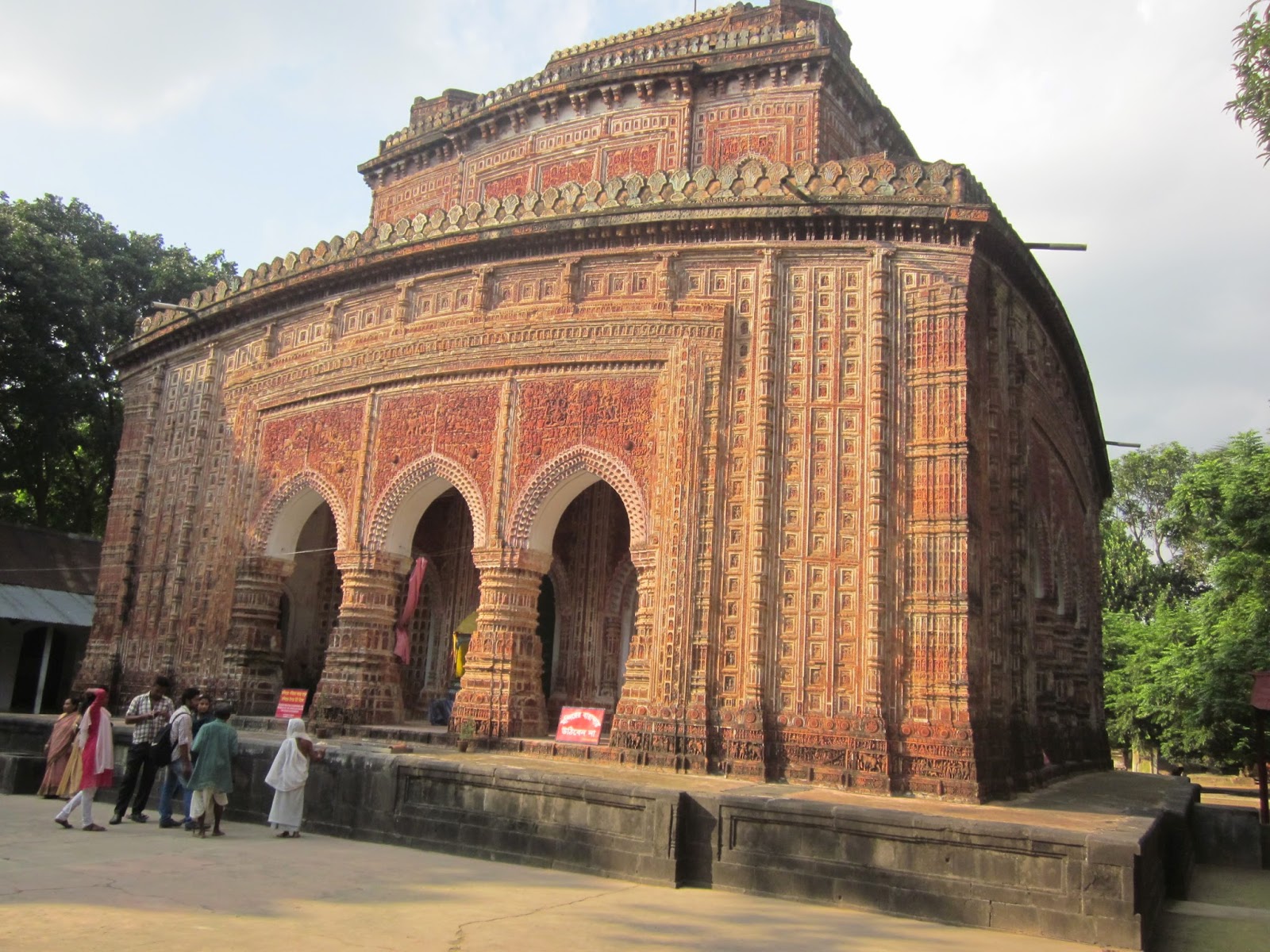
Kantaji Temple was built in the early eighteenth century.
At Kantaji the upper portions of the walls illustrate the Hindu epics, the Mahabharat and the Ramayana, while the lower sections feature daily life scenes. Especially if a patron was liberal, artisans were permitted to include a large degree of their own creativeness in depicting such scenes, what becomes a social story, a conversation in clay.

There’s a rich merchant resting on a takia pillow in a sedan chair. There’s a hunting dog. There’s a large, thin nouka boat illustrating the sport of racing and smaller nouka dinghies used more simply to cross a river. There’s a decorated horse, an elephant with a fancy saddle and a large unknown beast that’s come out of the forest during a hunt. And there’s that lady in the ox cart, still reclining, still smoking…

Is that a camel in Bengal?
“These images are inspired by the thinking and feeling of the artisans,” says Dr Shamsunnahar, “by what they saw and knew around them.”

The ox powering the cart is robust, healthy and decorated by a row of bells or trinkets around its body. It’s an ox of affluence unlike the thin and bony ox of a farmer today. His head is aloft. He’s all pride.

Three attendants, meanwhile, are positioned behind the driver on the ox’s back, a fourth on the back of the cart behind her. She is no ordinary citizen.

Perhaps a wealthy merchant rides in a sedan chair.


“In an earlier era they were called nagar-nati,” says Dr Shamsunnahar, which might be translated as courtesan or lady of the court. Such women were born into ordinary families, but at an early age their beauty and cultural talents were noted, and the girl would be taken from her father’s home to the royal court.

There they would be trained in the arts and educated. Nagar-natis would sing and dance, recite poetry and tell jokes. They were expected to be brilliant, accomplished, informed, wise and witty. And – choosing their own partners – they were expected to be expert in the art of love-making too. They were not allowed to marry. Later in life a nagar-nati might become tutor to the younger generation.

“Such women often grew wealthy and powerful due to their proximity to the rulers,” says Dr Shamsunnahar, “They had influence.”

Although at a later time the status of such women was increasingly overshadowed with associations of prostitution and immorality, originally they were considered as bastions of high culture entrusted with the pinnacle achievements of civilisation.

The terracotta carvings cover every wall.
But what is it she is contemplating? Has she let her mind slip back to the day she left her family as a girl? Or is her mind set to the future, considering a latest political manoeuvre to notch up gratitude with the Maharaja or one of his minions?

Dr Shamsunnahar remembers from her own childhood how the farmer’s wives would smoke for leisure. I remember the big wooden wheels of the Bangladeshi village ox carts from a good decade ago – they were plain wood, not with decorated spokes like the wheels of the cart that carry Kantaji’s lady. But while our memories must of course pass and, with time, fade, those luxurious ox-cart wheels can never turn for they are made of clay.

Kantaji Temple offers the largest display of well-preserved terracotta work in Bangladesh.


This article is published in Star Magazine, here: A Conversation in Clay


The visitor will leave with wonder and awe.


Friday, 13 June 2014

The Banyan Tree, Kansaris and Raja Parasuram

A kansa cup under manufacture.

On the empty road from Jamalpur town to Islampur the wind is telling of liberation. In that open country the crop fields speak of struggle and overcoming. Three on a Honda: a little lawlessness, technically, but like everybody else we get by and make do. It’s an enduring landscape that inspires. Let Bangladesh tell its own story.

Of the banyan tree, the bat gach of Battala, there is all the complexity of the movement of the market that has grown up alongside root and branch. That tree could’ve embarked upon a lengthy, winding monologue – does it remember from its sapling youth when Jamalpur was called Singhjani? Can it recall the arrival of the sufi saint, Shah Jamal, reportedly a younger brother of Sylhet’s Shah Jalal, to spread the word of Islam and bequeath to the broader area a newer name? Such a history is at least spoken of.

There have been kansa artisans at work in Islampur for 1000 years.
Like in any small Bangladeshi community everybody seems to know everybody in Islampur and the banyan, centre stage in the middle of its self-created roundabout, sees all. The tree hears the disputes, gossip, discussions and confidences. It knows that tea comes with ceramic saucer and welcoming words for visitors. And it remembers a once thriving kansa or bell metal industry.

Of the legendary King Parasuram the banyan must also have heard. Although his capital at Bogra’s Mahasthangarh lies distant – across the Jamuna and all too distant when a king’s available transport would’ve been palanquin and boat rather than three-by-Honda; although in all likelihood he never reached Islampur the monarch is remembered there. It comes down to this: even a legendary royal has to eat.

Team work. It takes two to shape a plate.

Legend says that bell metal, that version of bronze used for making utensils in the subcontinent, first reached East Bengal from some Indian elsewhere – Assam, Odisha, Pashchimbanga – to serve at Parasuram’s court. In this current age of melamine and steel, of easy glass and ceramic, it’s a simple matter to forget that kansa cups and plates were once standard for any raja needing to make impressive devotional offerings at temples and wishing to dine in style.

A kansari shapes a musical cymbal.


From Mahasthangarh the kansa industry branched out like the banyan, so legend says, to a handful of other manufacturing centres: first to Dhaka’s Dhamrai, from there to Kagmari, Kalipur, Mogra and Charibari in Tangail, also to Chapainawabganj and to Islampur. The later British conquerors encouraged the trade; kansa still meant luxury to them.

It’s true that even a banyan mightn’t have endured since the time of Parasuram. Of Islampur’s kansa tradition, if the tree did not see the first of it, it knows at least the subsequent history. It saw – say, twenty-five years back – a thriving kansa industry employing up to 350 kansari artisans in Islampur. It heard the story of Jagat Chandra Kamakar, the local kansari whose kansa work is said to have taken first prize at a World Handicrafts Exhibition in Birmingham many years ago. Still now there are around twenty families with perhaps fifty kansaris in Islampur to carry on the ancient trade.

“For nearly one thousand years my family was in this industry,” says Ankon Karmakar, secretary of the Islampur Bell Metal Society and one of Islampur’s two principal kansa traders. “I know at least the name of Prashanna Kumar Karmakar, my ancestor from a hundred years back who did this work.”

Preparing a plate for refining.
Ankon explains the kansa recipe: about 25% tin and 75% copper. The tin ingots arrive from Malaysia and Indonesia, the copper from Malaysia and supplies are bought from the Mitford market in Old Dhaka – although mainly recycled metal is used these days.

“Kansa is healthy and hygienic,” he says, “No acid forms when it’s used and it’s attractive, nice designs are possible. But the work is laborious. It’s an inhuman job and production is low. My son will not be involved in this trade and within a decade it will be gone from Islampur, just as some years ago it disappeared from parts of Tangail.”

Indeed, up the road in Kansaripara, the labouring kansaris care little for the dining requirements of Parasuram. The workers, from both the Hindu and Muslim communities, barely have leisure time to visit the banyan tree.

Sharifuddin working on a plate.
“Many kansaris are leaving to go to Dhaka to drive rickshaws,” says Sharifuddin, 30, taking a break from beating metal. “We start at 6 a.m.,” he says, before describing the process by which mixed metal shavings are melted then poured onto a plate to cool into a metallic lump. With tools the items are then shaped, one kansari pulling a rope backwards and forwards to turn a wheel while another scrapes and pounds out a cup, plate, devotional pot, musical cymbal or other item.

“We mostly use recycled materials,” he says, “copper from the motor coils of irrigation pumps, old copper wires or old kansa wares.” The entrepreneurs provide the raw materials each morning and five labourers over ten hours can turn four kilograms of material into eight plates. At a profit of 150 taka per plate, the team can earn 1200 taka per day – 200 taka take home pay per day per kansari. “It’s not enough to live on anymore,” says Sharifuddin, “Shohijal left, Morgu Bhai left, many left...”

Kansari Md Lal Mia, 32, details the practice of adding one bhori – 11.664 grams – of silver to the mixture. “Without silver the plate is red and discoloured,” he says, “With silver you can see your face in it. It’s more glamorous.” Besides, a kansa plate without silver will react to milk to make it taste sour and the shine will fade faster. But silver costs money: without it a finished plate sells for around 2200 taka; with it the sale price is around 4500 taka.

Kansaris Sharifuddin,30, and Md. Lal Mia, 32.
Yet Ankon Karmakar maintains there is good demand for the product. The difficulties he lists for the industry’s future include a lack of capital to purchase modern equipment. A circle machine costs about one crore taka while a finishing machine is cheaper. In India the kansa manufacturers are using both, which reduces the metal required in each item by half and produces a lighter kansa ware. “If the government or an NGO does not offer assistance with logistics and loan facilities the industry has no future despite the demand. Without the equipment it’s time consuming and very hard work.”

Indeed, encouraged by the laboriousness of their trade, three years ago the kansaris of Kansaripara made a legend of their own: one night they all packed up and secretly ran away to Dhaka to ride rickshaws. After some days Islampur’s kansa entrepreneurs found them and, following a word to the rickshaw renters, persuaded them to return. “They wouldn’t rent rickshaws to us anymore,” recalls Sharifuddin.

A musical cymbal.
But 200 taka per day is not enough to run a family. Many of the kansaris have second jobs, riding rickshaws locally of an evening when they should be sleeping. In the days of their forefathers working as a kansari was beneficial but living costs have risen.

“So why do you do it?” the banyan tree might ask.

“Because our ancestors did,” is the kansaris’ answer – and they did, so legend says, from some time around the reign of Parasuram.


A plate with silver in it brings Lal Mia's face to its reflection


It's hard to make ends meet as a kansari.


The workshops of Kansaripara. Within ten years' time they may be no more!


Lively Islampur market with the banyan tree in the background.


This article published in Star Magazine, here: The Banyan, Kansaris and Raja Parasuram


Metal shavings and tools.


Thursday, 6 March 2014

A Carpenter's Journey

Carpenter Gobindra Chandra Halder can't sit or walk unaided, but he pursues his livelihood with enthusiasm.

It begins with an idea. There’s planning to be done: a sketch in pencil completes the start. It requires concentration. There’s never been a journey of substance when it’s been relentlessly easy to plot the best course. There are always obstacles. Always.

Some travellers rely on maps. Others chart their distances with compass or strategy; or alternatively follow an intuition-based path. Gobindra Chandra Halder, 55, has found in flowers, birds, trees and people the key to his way forward. He has enlisted into his service the curves, repetition and symmetry of regal design. For his is the journey of a carpenter – a carpenter with more than thirty years of experience.

 Gobindra  has made a name for himself as a carpenter.
“The throat is four fingers,” Gobindra says, explaining how he measures each body part to give his carved figures proportional accuracy. Everything is measured.

The sawing and sanding are his setting out. It’s after that he proceeds further, commencing the painstaking carving phase that will bring to each design its life, its third dimension. He inches onward, slowly, slowly – towards the destination of the finished piece. “With delicate work,” he says, “there is no time limit.”

From his two-room, mud floor home-and-studio in College Road of Rajapur in Jhalokati he’s made his name in handmade furniture manufacture. The medium he found for his each successive journey is wood and Gobindra is a respected artisan in it.

Things are never that easy. There’s never been a journey of substance that’s been free of challenges. Sometimes such roadblocks are relatively minor and easy to negotiate; at other times difficulties of the seemingly insurmountable type appear – enough to tempt any weary traveller into hanging up his hiking boots for good. It’s in the nature of a journey: problems can arise at any time, well into a long ago established voyage or, as in Gobindra’s case, right from the start. He had little choice but to face his situation. There was nothing for it but to persevere.

“He was good at school,” says his brother, high school teacher Kitish Chandra Halder, “but fate did not reward him.”

There came a night when Gobindra was about ten years old, when he dreamt that robbers were looting their household. Driven by fear the sleeping child climbed out of the window and fell from the first floor.

At work in his garden.
At first it seemed as though he had overcome his injuries – that his nightmare would be recorded as no more than an amusing anecdote among various childhood mishaps. But from age fifteen Gobindra started to lose power in his legs. The movement in his neck, back, arms and legs started to decrease: the delayed result of a possible spinal cord trauma he had sustained.

His family took him to Dhaka. But after visiting many hospitals not only were the doctors unable to offer much more than the hope his injury would right itself over time, they were unable even to name his affliction.

His parents took him to the pond for swimming, which a doctor had suggested. They even tried treatment by a local healer, a kabiraj. All that was forty years ago.

“Our family has suffered for a lifetime from concern over his injuries,” says Kitish Halder.

Gobindra proved courageous. In pain and with difficulty he completed his SSC examinations. But after that he found it impossible to continue his studies. Nor when the time arrived was he able to marry.

There’s been a gradual deterioration. Our carpenter requires a walking stick to move about. He cannot turn his head. He cannot bend. Mostly he lives in pain. He dines at either his sister’s or his brother’s house as he cannot cook a meal. But Gobindra has never stopped trying – his furniture is evidence of his determination.

From a young age he had demonstrated a talent for carpentry. It allowed him to develop his small business and manage a meagre livelihood, in the company of flowers, birds, trees and people, in the medium of wood. He can earn around 5,000 taka per month, but his work gives much more than that: a sense of purpose.

“I never had lessons in carpentry,” Gobindra says, proud of his achievements, “The designs come quite naturally as I start to draw.”

Gobindra with a bed head he has made.
He makes all kinds of furniture including sofas, showcases, wardrobes, beds, alna clothes racks and chairs. But for his condition it would be no problem to work in building construction as well, he says.

“Big items like almirahs and larger beds are difficult for me now,” he says.

Each piece takes time to complete. Gobindra is unable to sit in a chair and needs to take regular rest, lying down for greater hours than he is able to work. Nonetheless his customers are usually pleased with the results. “They often pay more than the agreed amount when they see a piece completed.”

He should really go to Dhaka. Due to the difficulties in finding suitable transport and more so the cost, it’s unlikely that he will. But it would be interesting to know what forty years of progress in medicine could do for him. He might find there are treatment options now. His affliction might at the very least find its name.

But this is not his complaint. “People don’t order the most intricate items anymore. They are too expensive.” He wishes there were more flowers, birds, trees and people for him to measure and bring to life.

Yet, when asked what sort of design he enjoys most, he says “It’s like football. The best enjoyment is not for the players but for those who are watching.”

And all around Rajapur people are watching. Many houses in the area feature his work. In each sofa, showcase, wardrobe and bed is an arduous journey of his, most often seen in an everyday and taken-for-granted way – a journey hoping to reach the twin destinations of functionality and beauty. Yet it’s never been easy for our carpenter who cannot bend.


Carpenter Gobindra Chandra Halder in his two room, mud floor studio and home.