Showing posts with label ancient. Show all posts

Thursday, 15 January 2015

A Conversation in Clay


The coals of the hookah will never run cold. The ox cart will never arrive. She is clay.

With hand to hip she’s kneeling: a repose that brings comfort to the carriage of the ox cart. Puffing on a hookah pipe as ladies like to do, she’s a connoisseur of culture.

Both smoking and ox cart travelling must offer ground for contemplation – all the more so in a frozen moment such as hers. The hookah’s coals can never run out of heat. The ox cart will never arrive. She cannot age for she is made of clay. She is but an intricate decoration: part of a brick in Dinajpur’s Kantaji Temple.

“There would’ve been a guild of artisans, probably fifty or more people,” says Dr Niru Shamsunnahar, Deputy Keeper at the Department of History and Classical Arts. “They would’ve had a master craftsman as leader, who by tradition specialised in architecture, painting and sculpture – all three.” Researcher and historian, she has studied terracotta for over a decade.

“The guild would roam, offering services at palaces and the houses of wealthy landlords. They even had blueprints from which a patron could choose.”

A long racing boat in the temple detail.


Being an artisan was a multigenerational profession within a family. Artisans were held in high esteem in Bengal – but while the names of some from the earlier Pala Dynasty have been preserved, the names of the artisans responsible for Kantaji are unknown.

Kantaji was built at Kantanagar not far from the bank of the River Dhepa by Dinajpur’s rulers, with construction commissioned by Maharaja Prannath in 1704 and completed during the reign of his adopted successor Maharaja Ramnath some decades later. The late medieval Hindu temple built in navaratna style originally featured nine spires, destroyed in the earthquake of 1897.

They've hunted some unknown scaly beast from the forest.

Needless to say the visitor to Kantaji will be struck by the staggering intricacy of the terracotta plaque embellishments on every wall. Needless to say they will leave with a sense of awe and wonder.

“There are other examples of terracotta work in Bangladesh,” says Dr Shamsunnahar, “but Kantaji is best preserved.” Terracotta design was a hallmark of ancient Bengal with many further examples in Paschimbanga, but not the rest of India. “There is not much rock in Bengal. Clay is pliable and soft. It was a natural choice.”

Kantaji Temple, Dinajpur.

From studying fourteenth century texts Dr Shamsunnahar was able to understand the complicated processes employed by artisans to give strength and religious energy to their constructions. River clay would be mixed with tree sap from bat, tetul and bael – banyan, tamarind and wood apple trees – among others. Silver, gold, turmeric and milk were added. As well as religious favour such recipes brought better protection from humidity and salinity.

“Most images would have been produced and reproduced using wooden casts called die, according to the blueprint plan” she explains, “with hand work reserved for important pieces such as images of gods, goddesses and royalty.”
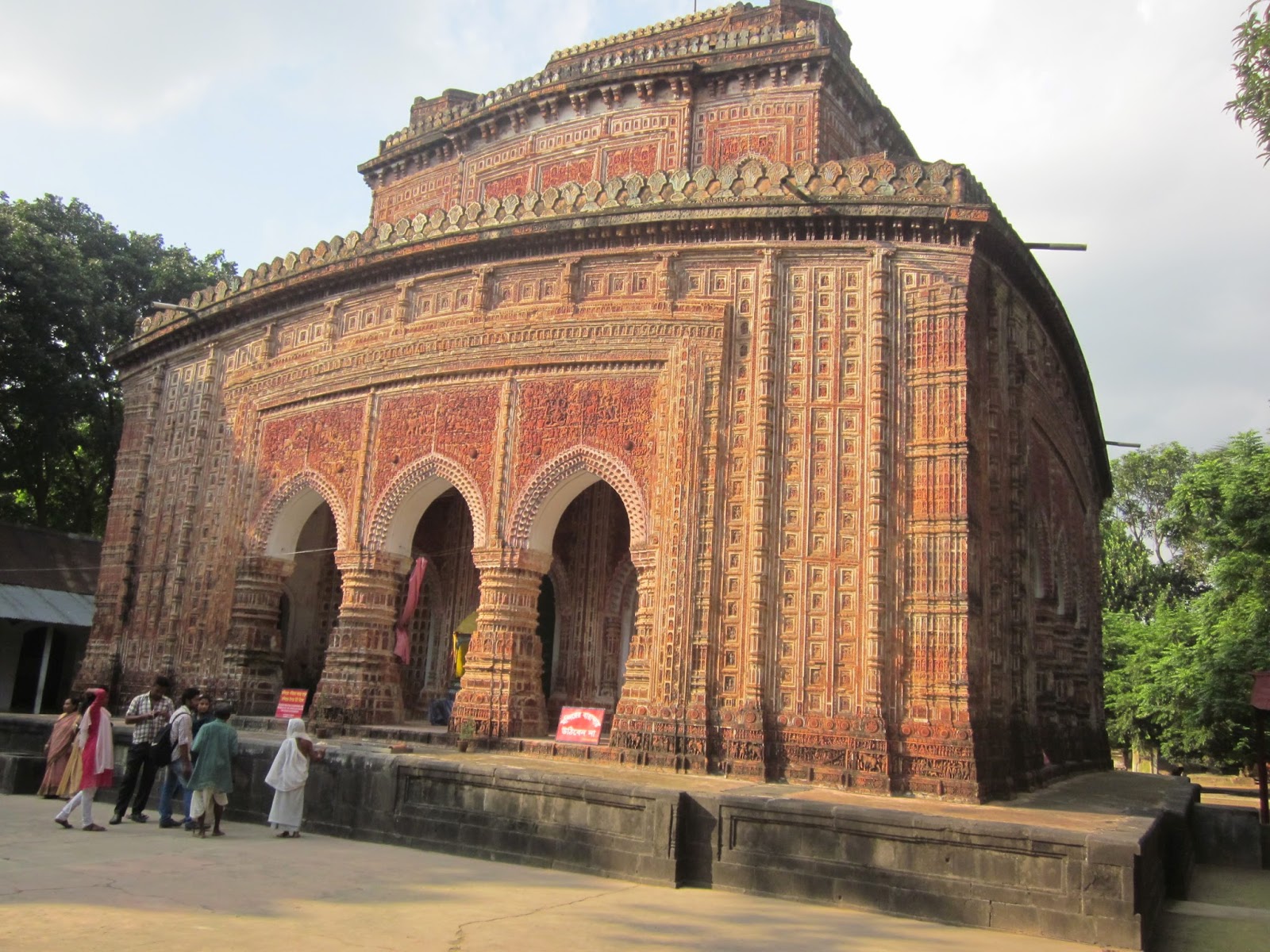
Kantaji Temple was built in the early eighteenth century.
At Kantaji the upper portions of the walls illustrate the Hindu epics, the Mahabharat and the Ramayana, while the lower sections feature daily life scenes. Especially if a patron was liberal, artisans were permitted to include a large degree of their own creativeness in depicting such scenes, what becomes a social story, a conversation in clay.

There’s a rich merchant resting on a takia pillow in a sedan chair. There’s a hunting dog. There’s a large, thin nouka boat illustrating the sport of racing and smaller nouka dinghies used more simply to cross a river. There’s a decorated horse, an elephant with a fancy saddle and a large unknown beast that’s come out of the forest during a hunt. And there’s that lady in the ox cart, still reclining, still smoking…

Is that a camel in Bengal?
“These images are inspired by the thinking and feeling of the artisans,” says Dr Shamsunnahar, “by what they saw and knew around them.”

The ox powering the cart is robust, healthy and decorated by a row of bells or trinkets around its body. It’s an ox of affluence unlike the thin and bony ox of a farmer today. His head is aloft. He’s all pride.

Three attendants, meanwhile, are positioned behind the driver on the ox’s back, a fourth on the back of the cart behind her. She is no ordinary citizen.

Perhaps a wealthy merchant rides in a sedan chair.


“In an earlier era they were called nagar-nati,” says Dr Shamsunnahar, which might be translated as courtesan or lady of the court. Such women were born into ordinary families, but at an early age their beauty and cultural talents were noted, and the girl would be taken from her father’s home to the royal court.

There they would be trained in the arts and educated. Nagar-natis would sing and dance, recite poetry and tell jokes. They were expected to be brilliant, accomplished, informed, wise and witty. And – choosing their own partners – they were expected to be expert in the art of love-making too. They were not allowed to marry. Later in life a nagar-nati might become tutor to the younger generation.

“Such women often grew wealthy and powerful due to their proximity to the rulers,” says Dr Shamsunnahar, “They had influence.”

Although at a later time the status of such women was increasingly overshadowed with associations of prostitution and immorality, originally they were considered as bastions of high culture entrusted with the pinnacle achievements of civilisation.

The terracotta carvings cover every wall.
But what is it she is contemplating? Has she let her mind slip back to the day she left her family as a girl? Or is her mind set to the future, considering a latest political manoeuvre to notch up gratitude with the Maharaja or one of his minions?

Dr Shamsunnahar remembers from her own childhood how the farmer’s wives would smoke for leisure. I remember the big wooden wheels of the Bangladeshi village ox carts from a good decade ago – they were plain wood, not with decorated spokes like the wheels of the cart that carry Kantaji’s lady. But while our memories must of course pass and, with time, fade, those luxurious ox-cart wheels can never turn for they are made of clay.

Kantaji Temple offers the largest display of well-preserved terracotta work in Bangladesh.


This article is published in Star Magazine, here: A Conversation in Clay


The visitor will leave with wonder and awe.


Thursday, 28 November 2013

The Living Stone of Middle Shilua

The stone's growth maybe centred on its unusual folds and creases pushing outwards.

In making sense of the physical world there is, surely, an over-reliance on the eyes. Ears too can play a role; hearing is not less of a primary sense than sight. Besides, sometimes if we pay sufficient heed to the things we hear our lives are simply more enjoyable. I’m thinking of those wonderful words, “I did not see it but I heard…”

Middle Shilua in Pathan Nagar Union of Chhagalnaiya Upazila in Feni District is in many respects a nondescript village. It features the typical pond-and-paddy landscape; there are small stores along the main road for groceries, tea and gossip; it can surprise nobody that adhan’s melody rings forth five times a day from the village mosque. All is as it should be in Middle Shilua, except for the presence of a large, conspicuous stone.

Seven elephants could not lift the stone, I heard.
Under normal circumstances even a stone, no matter what its size, might not be more than a triviality. But the Village Flute was drawn to Middle Shilua because it heard a remarkable thing: that the stone in Middle Shilua is one that grows.

Twenty-eight-year-old Shekawat Hossein lives in the village. His house pond, beside a smaller side road, borders the small yard enclosed by a low brick wall in which the stone is situated. It’s easy to find him for a chat.

“I did not see it but I heard,” says Shekawat, “that people once tried to lift that stone with the help of seven elephants but it would not budge.” While he has not personally observed the stone growing, he remarks that it is not easy to take notice of such a thing when one sees the rock on a daily basis. It’s certainly true that those with children or houseplants might be the last to register the incremental growth of offspring or plant.

Shekawat is heard to say that it is those who leave Middle Shilua and return after a number of years who can best attest to the stone’s enlargement, which may involve the rock’s unusual folds and creases gradually pushing outwards.

A stone that lives and grows has understandably been a village talking point for many generations. Indeed, over the years the stone has successfully established for itself a tin roof shelter and a donation tin with a sign of dubious origin that instructs every visitor to leave money before departing the area. The stone has even influenced the village’s name – in Feni’s brand of Bangla, shil means stone.

Gazi Habibullah heard it is a miracle stone.
“I heard it is a miracle stone,” says elderly shopkeeper Gazi Habibullah. “I heard it holds the power for helping others and that beneath the stone lie the riches of seven kings.” The problem is, he continues, that nobody can lift the stone to retrieve the wealth – not even those seven elephants. It is only the rightful owner of the riches that will be able to lift the stone, he heard, an owner who will be born of no mortal father.

Undoubtedly the Middle Shilua stone is a curious one. There are many places where stones belong: on mountaintops, along desert ridges, in the asteroid belt beyond Mars and even under the ocean. But like most of Bangladesh the land about Middle Shilua is the creation of great rivers that have refined and deposited particle of sand and earth to make the alluvial soils. It really isn’t a proper place for a large stone, whether or not of the living kind.

From his Dada, his uncle, Habibullah heard that the rock came at first, quite mysteriously, out of the mud in the very spot where it sits today. He heard that from its first appearance the rock gradually grew – and with his hands Habibullah demonstrates how protruding areas that were once the size of a tennis ball are now grapefruit size.

I heard meanwhile, from Habibullah, that the current tin-roof shelter is the second of its kind – it needed to be rebuilt when the stone grew too large for the first. Even today the stone protrudes beyond the roofline – could this be evidence of growth?

Habibullah recalls the stone’s yard was first demarcated during the British period, and from the generation before his he heard there was once a sign on which was written “If anyone destroys this stone’s character or site they will be held accountable in accordance with the law.”

Shekawat’s father, Mohiuddin Chowdhury Milon, says that during the British and Pakistani periods many upper level government servants including the Subdivision Officer would visit the stone. He was heard to say that as a child these official visitors used to encourage him to study and give a few rupees in ad hoc pocket money.

The stone sits in its own walled yard, under a shelter.
Mohiuddin heard the stone was constructed by the Mogh and from when he was a child until not so long ago he observed that many Hindus made puja worship there. Alternatively, it is to be heard there was once a Buddha statue in front of the stone because the Buddhists of Tripura believed the site sacred.

Village account says there is the outline of a human foot with five toes to be seen on one side of the stone while the footprint of an elephant adorns another. These features are not straightforward to see but are easy enough to be heard of.

So it was that, armed with curiosity and a few photographs, I made my way at a later date to another place where rocks might belong – the Bangladesh National Museum in Dhaka. There, I heard from Dr. Niru Shamsunnahar, expert in the history of terracotta in Bangladesh and helpful Deputy Keeper of the Public Education Department that it might be worthwhile to consult the Bangladesh District Gazetteer for Noakhali, of which Feni was a part in 1977 when the book was written, for further information about the stone.

Similarly I heard from Afroza Khan Mita, the Assistant Director of the Department of Archaeology, that the Shilua site was a protected archaeological site in Bangladesh and that more information could be found in A.K.M. Zakaria’s 1984 book Bangladesher Pratnasampad, Bangladesh’s Artefacts.

In these two books it states that at Middle Shilua there is a broken protima, a religious image that is thought to have been colossal in size and is extremely old, dating from the second century BCE. On the pedestal were once inscribed some writings in an obscure language and underneath the stone may be the ruins of a temple, which might only be verified upon excavation.

The stone may be a broken 'protima'.
Interestingly, in neither book did it mention that the Shilua stone was growing. Nor was it specified that the stone wasn’t growing. In neither book did it mention the seven elephants or positively negate the possibility of finding seven kings’ wealth underneath. Perhaps the researchers for those books hadn’t heard these things – maybe they never spoke to Habibullah’s Dada.

In the Gazetteer there was, however, a photograph of the rock from the early 1970s and it was certainly of interest to see that in light of the photos I took in recent days.

And yet it might be a mistake to base an understanding of the rock of Middle Shilua on an over-reliance on the eyes. No, being neither villager nor archaeologist I hesitate to state definitively how the two photographs compared in terms of the rock’s size – or comment on whether or not it is a living stone – not least because sometimes life is simply more enjoyable if we pay sufficient heed to the things we’ve heard.

Shekawat Hossein says it's not easy to notice the stone growing when you see it every day.


The stone of Middle Shilua. Has it outgrown its shelter?


This article is published in Star Magazine, here: The Living Stone of Middle Shilua