 |
| The coals of the hookah will never run cold. The ox cart will never arrive. She is clay. |
With
hand to hip she’s kneeling: a repose that brings comfort to the carriage of the
ox cart. Puffing on a hookah pipe as ladies like to do, she’s a connoisseur of
culture.
Both
smoking and ox cart travelling must offer ground for contemplation – all the
more so in a frozen moment such as hers. The hookah’s coals can never run out
of heat. The ox cart will never arrive. She cannot age for she is made of clay.
She is but an intricate decoration: part of a brick in Dinajpur’s Kantaji
Temple.
“There
would’ve been a guild of artisans, probably fifty or more people,” says Dr Niru
Shamsunnahar, Deputy Keeper at the Department of History and Classical Arts.
“They would’ve had a master craftsman as leader, who by tradition specialised
in architecture, painting and sculpture – all three.” Researcher and historian,
she has studied terracotta for over a decade.
“The
guild would roam, offering services at palaces and the houses of wealthy
landlords. They even had blueprints from which a patron could choose.”
 |
| A long racing boat in the temple detail. |
Being
an artisan was a multigenerational profession within a family. Artisans were
held in high esteem in Bengal – but while the names of some from the earlier
Pala Dynasty have been preserved, the names of the artisans responsible for
Kantaji are unknown.
Kantaji
was built at Kantanagar not far from the bank of the River Dhepa by Dinajpur’s
rulers, with construction commissioned by Maharaja Prannath in 1704 and
completed during the reign of his adopted successor Maharaja Ramnath some
decades later. The late medieval Hindu temple built in navaratna style originally featured nine spires, destroyed in the
earthquake of 1897.
 |
| They've hunted some unknown scaly beast from the forest. |
Needless
to say the visitor to Kantaji will be struck by the staggering intricacy of the
terracotta plaque embellishments on every wall. Needless to say they will leave
with a sense of awe and wonder.
“There
are other examples of terracotta work in Bangladesh,” says Dr Shamsunnahar,
“but Kantaji is best preserved.” Terracotta design was a hallmark of ancient
Bengal with many further examples in Paschimbanga, but not the rest of India.
“There is not much rock in Bengal. Clay is pliable and soft. It was a natural
choice.”
 |
| Kantaji Temple, Dinajpur. |
From
studying fourteenth century texts Dr Shamsunnahar was able to understand the complicated
processes employed by artisans to give strength and religious energy to their
constructions. River clay would be mixed with tree sap from bat, tetul
and bael – banyan, tamarind and
wood apple trees – among others. Silver, gold, turmeric and milk were added. As
well as religious favour such recipes brought better protection from humidity
and salinity.
“Most
images would have been produced and reproduced using wooden casts called die,
according to the blueprint plan” she explains, “with hand work reserved for
important pieces such as images of gods, goddesses and royalty.”
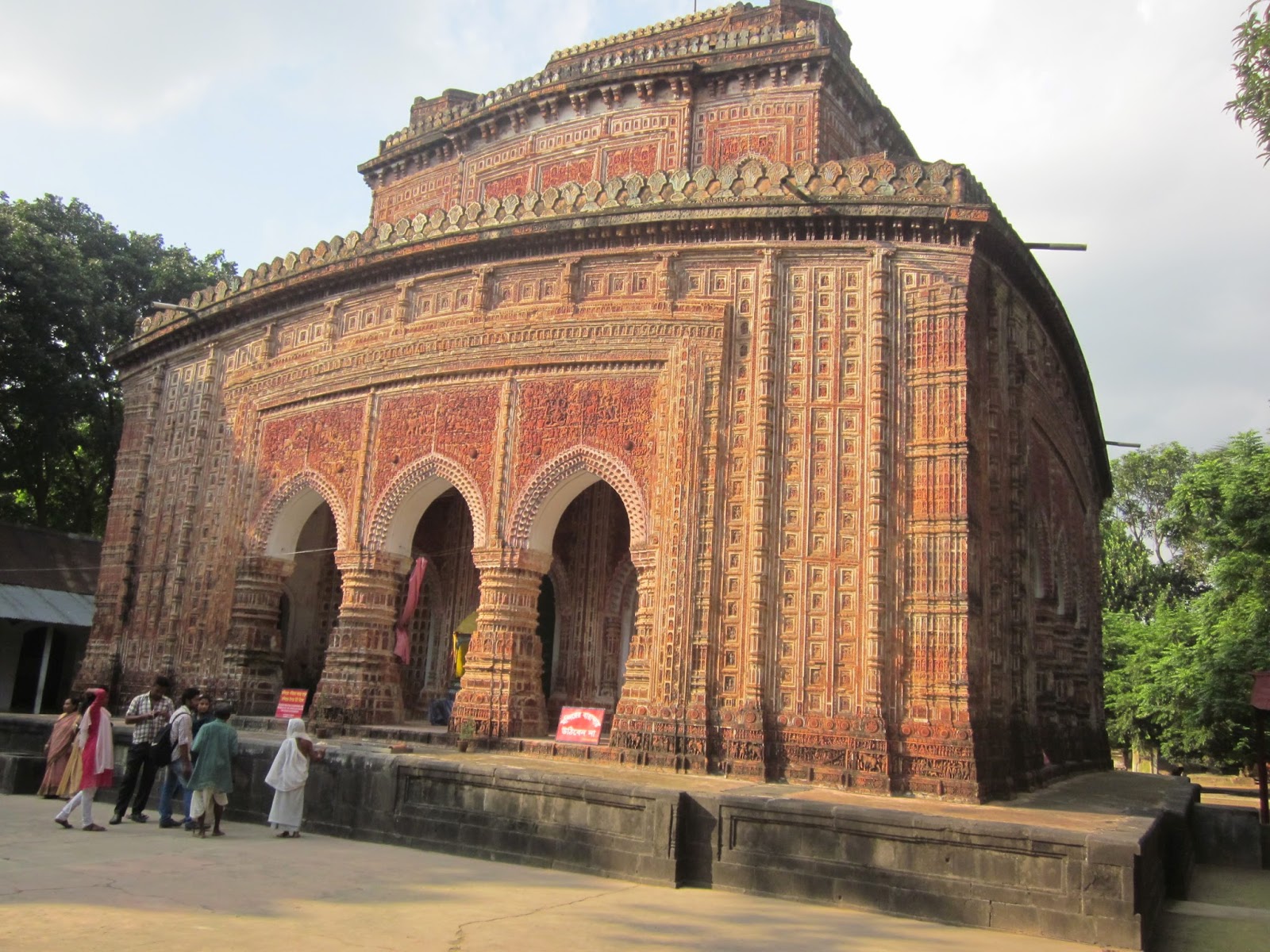 |
| Kantaji Temple was built in the early eighteenth century. |
At
Kantaji the upper portions of the walls illustrate the Hindu epics, the
Mahabharat and the Ramayana, while the lower sections feature daily life
scenes. Especially if a patron was liberal, artisans were permitted to include
a large degree of their own creativeness in depicting such scenes, what becomes
a social story, a conversation in clay.
There’s
a rich merchant resting on a takia pillow in a sedan chair. There’s a hunting
dog. There’s a large, thin nouka boat
illustrating the sport of racing and smaller nouka dinghies used more simply to cross a river. There’s a
decorated horse, an elephant with a fancy saddle and a large unknown beast
that’s come out of the forest during a hunt. And there’s that lady in the ox
cart, still reclining, still smoking…
 |
| Is that a camel in Bengal? |
“These
images are inspired by the thinking and feeling of the artisans,” says Dr Shamsunnahar,
“by what they saw and knew around them.”
The
ox powering the cart is robust, healthy and decorated by a row of bells or
trinkets around its body. It’s an ox of affluence unlike the thin and bony ox
of a farmer today. His head is aloft. He’s all pride.
Three
attendants, meanwhile, are positioned behind the driver on the ox’s back, a fourth
on the back of the cart behind her. She is no ordinary citizen.
 |
| Perhaps a wealthy merchant rides in a sedan chair. |
“In
an earlier era they were called nagar-nati,”
says Dr Shamsunnahar, which might be translated as courtesan or lady of the
court. Such women were born into ordinary families, but at an early age their
beauty and cultural talents were noted, and the girl would be taken from her
father’s home to the royal court.
There
they would be trained in the arts and educated. Nagar-natis would sing and
dance, recite poetry and tell jokes. They were expected to be brilliant,
accomplished, informed, wise and witty. And – choosing their own partners –
they were expected to be expert in the art of love-making too. They were not
allowed to marry. Later in life a nagar-nati might become tutor to the younger
generation.
“Such
women often grew wealthy and powerful due to their proximity to the rulers,”
says Dr Shamsunnahar, “They had influence.”
Although
at a later time the status of such women was increasingly overshadowed with
associations of prostitution and immorality, originally they were considered as
bastions of high culture entrusted with the pinnacle achievements of
civilisation.
 |
| The terracotta carvings cover every wall. |
But
what is it she is contemplating? Has she let her mind slip back to the day she
left her family as a girl? Or is her mind set to the future, considering a
latest political manoeuvre to notch up gratitude with the Maharaja or one of
his minions?
Dr
Shamsunnahar remembers from her own childhood how the farmer’s wives would
smoke for leisure. I remember the big wooden wheels of the Bangladeshi village
ox carts from a good decade ago – they were plain wood, not with decorated
spokes like the wheels of the cart that carry Kantaji’s lady. But while our
memories must of course pass and, with time, fade, those luxurious ox-cart
wheels can never turn for they are made of clay.
 |
| Kantaji Temple offers the largest display of well-preserved terracotta work in Bangladesh. |
This article is published in Star Magazine, here: A Conversation in Clay
 |
| The visitor will leave with wonder and awe. |


