Showing posts with label student. Show all posts

Friday, 17 April 2015

Our Moheshkhali

The future Moheshkhali, as imagined by Tanzina, Jahanara and Shaheda of Ghotibanga Govt. Primary School.
The British-era cemetery with primary school behind.


In the dry spring months Moheshkhali Island’s Ghotibanga Bazar takes on the appearance of a desert outpost, like a film set from a western genre movie – think John Wayne. It mightn’t have the tumbleweed but the dusty, sandy strip of tin shops adjacent to a windswept British-era cemetery is vaguely reminiscent of Hollywood’s American Wild West. You wouldn’t think the coast is nearby.

Overlooking the scene like a clichéd movie director instructing from his director’s chair is Ghotibanga Government Primary School, housed in a cyclone shelter. Surely nobody can introduce Moheshkhali to the newcomer as well as the island’s students can.


The year 8 students took to the task of drawing Moheshkhali with relish.

The school of one thousand students, nine teachers and two assistant teachers is in the process of making local history – it’s the island’s first primary school to adopt the government initiative of teaching up to class eight.

“The students are very eager to learn,” says English teacher Md Shohidullah. “They are productive, have lots of potential and too much curiosity.”

Armed with crayons and felt-tip pens I hope to ask the 48 class-eight students to draw their island: as it was, as it is and as it will be.

Tajmahal and Tahamina, both 13, have each included their house on either side of a tidal channel.
There's no lack of sharing skills in Ghotibanga


Art is included in the syllabus from class six but at remote Ghotibanga there’s no permanent art teacher so the students hardly ever draw. Nonetheless they prove more than willing to take up the challenge.

Students Tajmahal and Tahamina, both 13, at the nearest bench, set to work depicting contemporary Moheshkhali. Onto paper they outline the figures of banana and banyan trees, and a jubjar bush.

With southern Moheshkhali criss-crossed by tidal watercourses there’s a small river added and on each side of it they’re colouring a house for each of them, with the addition of a small nouka boat with which they might ferry the channel to visit each other.

I admire how easily they work together on the one picture. But to some degree Ghotibanga’s students are accustomed to making do.

Just as there are hardly enough pens and crayons to go around, according to Class 8 teacher Md. Jahedul Islam, 26, who has taught there for the last two years, the school suffers a shortage of low and high benches for students to sit at and the classrooms need new blackboards.

“We need ceiling fans too,” adds one student. It’s not difficult to imagine how true that must be when summer arrives.


Inside the classroom.
Pleased with artistic results.


I ask the girls what’s the best thing in Moheshkhali. “The betel leaf,” Tajmahal answers. Although sweet Moheshkhali betel leaf is famous to the degree that it’s the subject of songs, I’m surprised. “How do you know?” I ask. “Do you chew paan?”

“Our mothers and aunts chew it,” says Tahmina. “We live here, so we know.”

Meanwhile the boys are clustered around a bench to the right, beside the window. Md Sharif, 15, seems to naturally assume the position of group captain, confidently sketching a design in lead pencil, with colour added later. The boys are working on Moheshkhali’s past.

With the ubiquitous salt fields, bean vines and a nouka boat, the scenes of yesteryear are remarkably similar to the current day. There’s a farmer tilling soil, a hay bail and a cow. Perhaps the only feature that is really nearing its end is the foot-powered rice crusher, once familiar to villages across the country.

There are only 12 boys to 36 girls in class 8. 
“I like the shutki [dried fish] best,” Sharif says of his island, “We send it everywhere. It’s really tasty.”

Curious, I ask their teacher Islam why there are only twelve boys in the class, to thirty-six girls. “Many boys drop out after class 5 or 6,” he says, “Their families need them to work.” Sometimes this reality arises from poverty, but Moheshkhali is an island with a business focus – salt, fish and betel leaf. Education doesn’t always get its deserved priority.


The boys work together with Md. Sharif (2nd row, right) taking the lead.


Like many Bangladeshi primary schools, this one doubles as cyclone shelter.


In the classroom’s back corner, Sagorika, Ruposhi, Samira and Lovely, all 14 years old, are working on a drawing of the island’s icon: Adinath Temple. Their artwork features the nearby jetty, built by the Nepalese government for the temple that country also honours, the mangrove forests and a tiger – there may once have been a tiger kept on the temple grounds. There’s even a priest to attend the temple with the signature singular strands of hair coming from the top of his otherwise bald head.
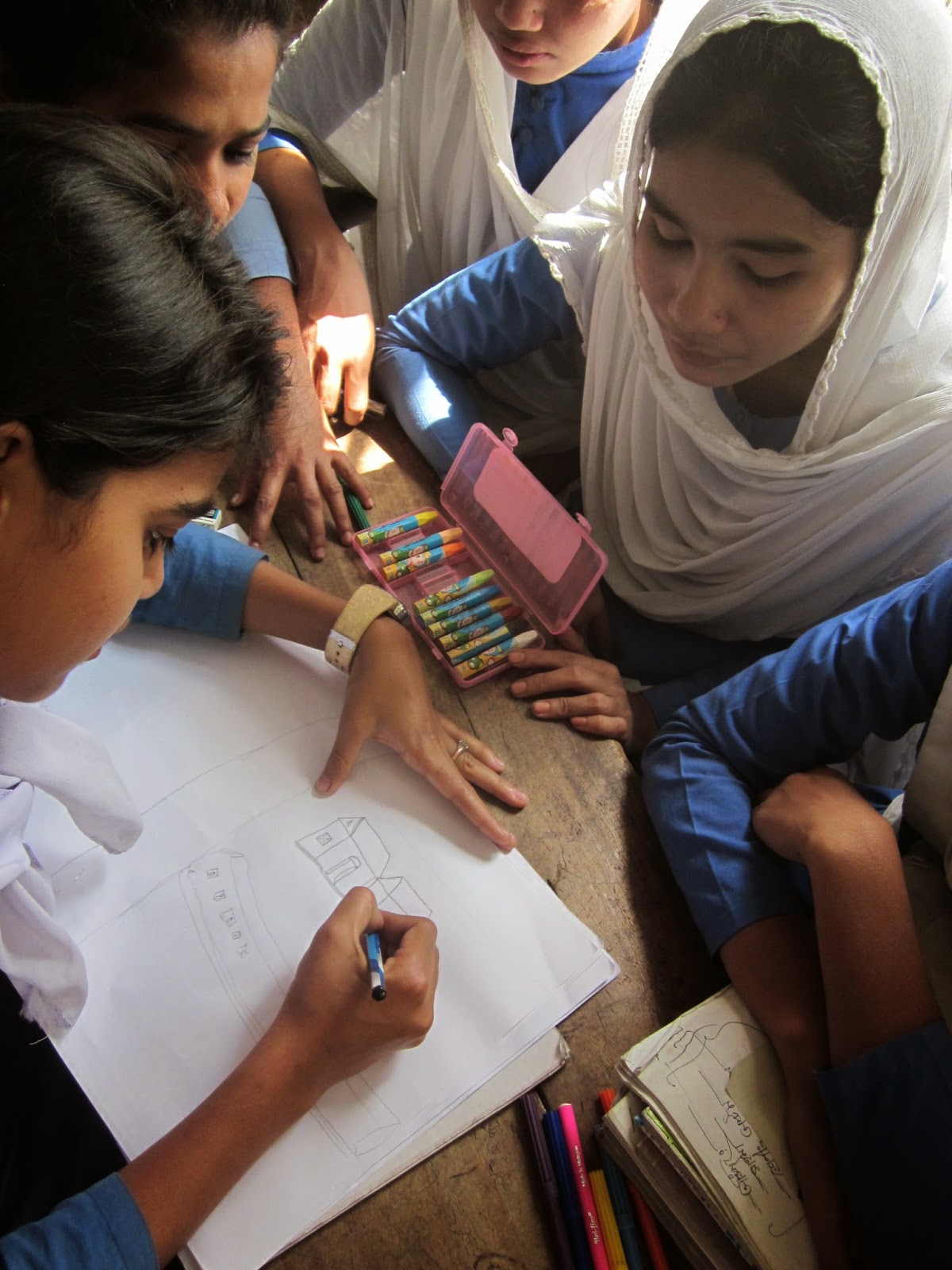


The novelty of drawing.


“It’s a beautiful area,” the girls tell me. “We were there the day before yesterday – and we saw you there!”

Nearby, Tanzina, Jahanara and Shaheda have been working on Moheshkhali’s future, demonstrating no lack of imagination. On one side of the page they’ve put a village – not much change – but on the other is a large town with a train service – something of an imagined Moheshkhali City.

The train seems far-fetched, I guess, but if the enthusiasm and dedication the Ghotibanga students have given to the task at hand are any indication, the possibilities for Moheshkhali’s future are bright.


Life as it used to be: Ghotibanga's class 8 boys illustrate.


Eucalyptus trees in the school yard.


This article is published in The Daily Star, here: Discovering Moheshkhali through Students' Art

Thursday, 18 December 2014

Something Happened


Class 5 student Mosammad Dilara Khatun doesn't like to remember what happened last May.


Dilara, trying to explain what happened.


If you ask my judgement the adults spoke sincerely. However, it was when the children spoke, when terror overtook their faces and they were on the verge of tears… 

I wouldn’t have believed it… But in Dharmapur of Dinajpur’s Biral Upazila, surely enough, something happened…

To find any scrap of Bangladeshi countryside that’s unpleasing to the eye would be difficult. Dharmapur is particularly charming. The road winds alongside a brook, passing in and out of stands of sal – the archipelagic edges of the Dharmapur Forest that nudges the Indian border.

Being in the tea shop game, entrepreneur Shyama Barman can scarcely miss any goings on in Dharmapur. Her stall should win an award for its minimalist architecture. The mud stove is matched by neat, mud benches – a rarity nowadays; a strategically stretched cloth covers the sun’s glare and the open walls invite any breeze. Meanwhile the laidback lattice along one side serves to define the cosy space. It’s uncommon to find a tea stall as beautiful.

“Of course I was scared,” she says, remembering last May, “but the shop stayed open.”

It's unusual to find a tea stall as beautiful as Shyama Barman's.


The day is bright. Farmer Mohammed Anwar is, for the moment, Shyama’s customer – and her tea is equally award-worthy. “They went to school as usual,” he says, “Then suddenly they felt delirious. It was like that for about a month. It’s never happened before.”

Dharmapur Government Primary is not a hundred yards from Shyama’s stylish village enterprise. It’s an ordinary two-storey building – particularly clean and decorated with painted illustrations of English and Bangla letters, of fish and jackfruit, of portraits of Tagore and other inspirational folk. It has four teachers for the 300 students studying in classes one to five.

In front of the main gate is a small temple. It’s empty now. The gate is locked. Since May only the side gate is used.

“There are big trees in the forest,” offers Anwar as he finishes his tea. “People hardly go to the deepest places.” He speculates that the bhoot in question, the supernatural spirit believed to have haunted the school, may have lived in an old tree, as bhoots are often thought to do.

“Or it was living in the temple,” suggests Shyama.

Dharmapur Government Primary is clean and brightly painted. It's not at all spooky.
Principal Madhab Chandra Barman, 42.

In the school’s office, it’s teacher Mosammad Akhija Sultana who greets us. “The students used to relieve themselves at the side of the temple,” she soon explains. “We think something happened.”

The principal, who arrives shortly, is Madhab Chandra Barman, a youthful 42-year-old eager to share his experience. “It was early morning when it started,” he says, “There was a World Vision programme before school. I was at home getting ready when I got a message to come quickly. Within two minutes I was here.”

He found 11-year-old class 5 student Mosammad Dilara Khatun in a state. She was complaining someone was beating her on the cheeks. She said she’d seen an old man in white dhoti walking towards her, and after he sat beside her he started the beating. “She was in the classroom,” says principal Madhab, “Nobody was beating her.”

Like his father and grandfather, Toroni Barman dabbles in exorcisms.

Dilara was inconsolable. Not knowing what to do Madhab called 81-year-old Toroni Barman. In Dharmapur it’s dhoti-wearing Toroni who, like his father and grandfather before him, is known to specialise in exorcisms. “I’ve treated many,” Toroni says, “but never at a school.”

With a sprinkling of panipora holy water, with the smoke of incense and mantra recitation, Dilara’s state returned to normal, at least temporarily.

“The next day,” says the principal, “Rebekah was affected. Then Masuma. Then Rita. Then Lija. Then Firoz.” Over several days, eight class 5 students displayed the same symptoms. “They all saw the man in dhoti,” says the principal. “As he left them another saw his approach.”

Dharmapur Government Primary, Biral, Dinajpur.

Each day Toroni exorcised. Each day one student’s symptoms dissipated. Only Dilara would suffer, sporadically, throughout.

“Firoz is very strong,” the principal thinks to add. “When he was affected he was beating himself. He was shouting, ‘Somebody is beating me!’ Ten to twelve students with the teachers couldn’t control him.”

Sree Aapon Chandra Barman, 12, faced the bhoot last. His symptoms were different.

Then the principal lowers his voice – it’s as if he’s unsure whether to say the next part, for fear of its meeting disbelief. “It’s strange but when the girls were saying they were being beaten, afterwards we could see finger imprints on their cheeks.”

The principal called the Education Department. “There’s no such thing as a bhoot,” his seniors said. They sought to arrange a counsellor but the problem wouldn’t wait.

A bhoot is a creature of the air, says Toroni Barman.
“A bhoot is a creature of the air,” says Toroni. “It’s difficult to understand where they’ll go, where they move. There was a bhoot roaming here.”

On the last day of the anomalies it was Sree Aapon Chandra Barman who was affected – but his symptoms were different. In the first-floor classroom, quite suddenly he raised his hands behind his head in the shape of a cobra’s hood. He started swaying, snake-like.

Toroni was called. “What do you want?” he demanded of Aapon.

“The children are relieving themselves on me,” twelve-year-old Aapon replied. “It has to stop!” With these words Aapon ran to the balcony and, in front of all, he jumped!


Uninjured, Aapon ran across the yard to the main gate, to the temple outside – and beside it he fell down, losing consciousness.

This time Toroni exorcised not only Aapon but the entire school grounds. The front gate was locked. Nobody passed the temple anymore. Everything, finally, returned to normal.

Rumana Aktar Lija was one of the students who met the bhoot.
“The bhoot isn’t here now,” says Toroni. “It went somewhere – it’s difficult to say where. But I doubt it’ll return.”

As word spread most students had stopped attending school. “The area was in panic,” says Madhab. “Parents worried what might happen to their children. I had to go house to house to convince each family – it wasn’t easy – that the situation was normal again.”

Dilara, Lija, Aapon. I shouldn’t have asked, I shouldn’t have asked! One by one, as they recount what they can, fear takes hold. “I saw a man in dhoti…” says Lija. “He caught me and took me to the temple,” says Aapon, who doesn’t remember jumping. “He was slapping my cheeks,” says Dilara.

Mosammad Dilara Khatun with her father Mohammad Dulal.


Unlike the others, the bhoot also attacked Dilara at home. “We’ve always lived here,” says farmer Mohammad Dulal, her father. “We’ve never had a problem so when she first said there was an old man in the room I got angry. I didn’t believe her. But after some time… I saw her fear. It was real. She really was seeing something…”