Showing posts with label shutki. Show all posts

Friday, 17 April 2015

Our Moheshkhali

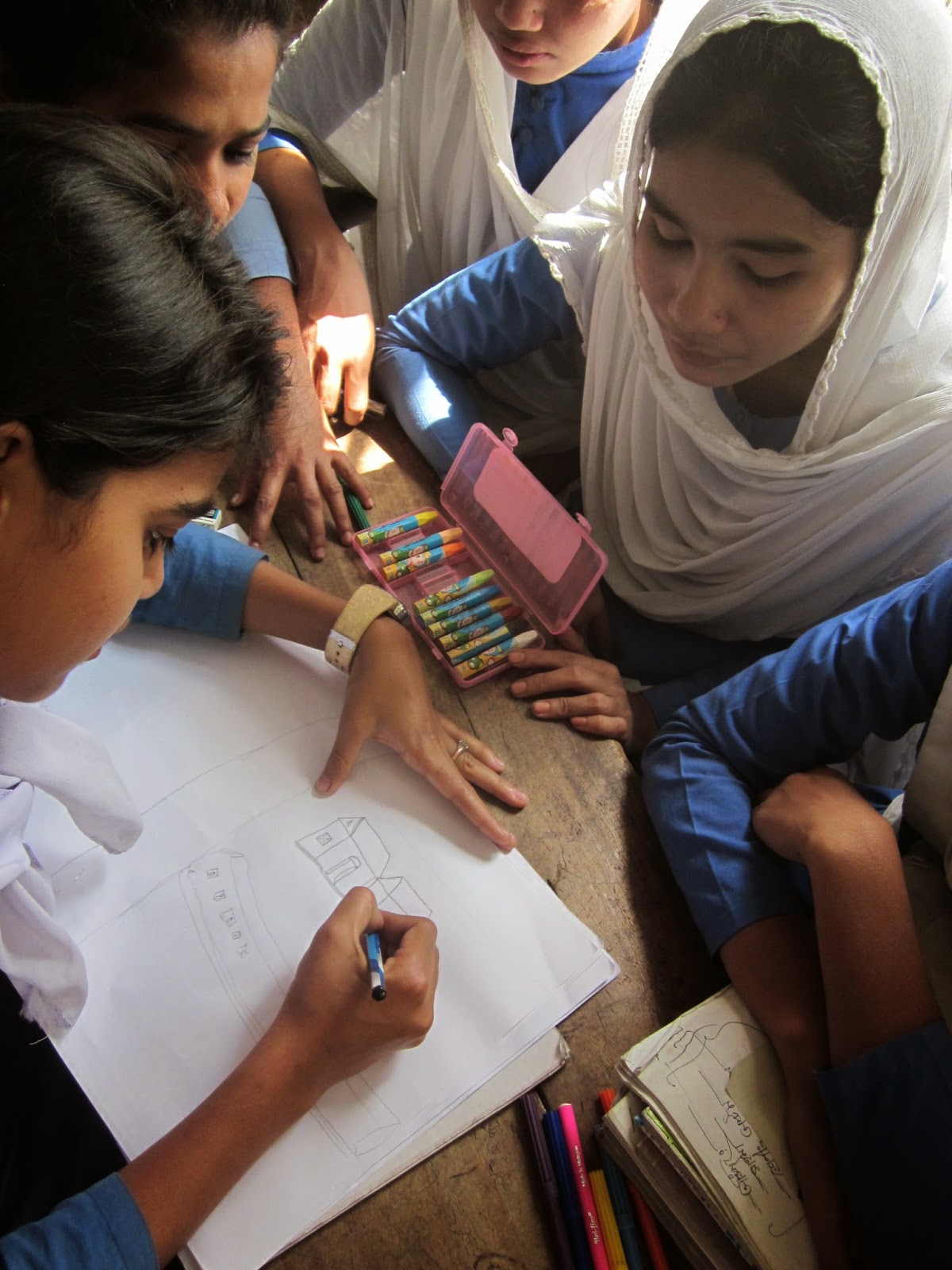
The future Moheshkhali, as imagined by Tanzina, Jahanara and Shaheda of Ghotibanga Govt. Primary School.
The British-era cemetery with primary school behind.


In the dry spring months Moheshkhali Island’s Ghotibanga Bazar takes on the appearance of a desert outpost, like a film set from a western genre movie – think John Wayne. It mightn’t have the tumbleweed but the dusty, sandy strip of tin shops adjacent to a windswept British-era cemetery is vaguely reminiscent of Hollywood’s American Wild West. You wouldn’t think the coast is nearby.

Overlooking the scene like a clichéd movie director instructing from his director’s chair is Ghotibanga Government Primary School, housed in a cyclone shelter. Surely nobody can introduce Moheshkhali to the newcomer as well as the island’s students can.


The year 8 students took to the task of drawing Moheshkhali with relish.

The school of one thousand students, nine teachers and two assistant teachers is in the process of making local history – it’s the island’s first primary school to adopt the government initiative of teaching up to class eight.

“The students are very eager to learn,” says English teacher Md Shohidullah. “They are productive, have lots of potential and too much curiosity.”

Armed with crayons and felt-tip pens I hope to ask the 48 class-eight students to draw their island: as it was, as it is and as it will be.

Tajmahal and Tahamina, both 13, have each included their house on either side of a tidal channel.
There's no lack of sharing skills in Ghotibanga


Art is included in the syllabus from class six but at remote Ghotibanga there’s no permanent art teacher so the students hardly ever draw. Nonetheless they prove more than willing to take up the challenge.

Students Tajmahal and Tahamina, both 13, at the nearest bench, set to work depicting contemporary Moheshkhali. Onto paper they outline the figures of banana and banyan trees, and a jubjar bush.

With southern Moheshkhali criss-crossed by tidal watercourses there’s a small river added and on each side of it they’re colouring a house for each of them, with the addition of a small nouka boat with which they might ferry the channel to visit each other.

I admire how easily they work together on the one picture. But to some degree Ghotibanga’s students are accustomed to making do.

Just as there are hardly enough pens and crayons to go around, according to Class 8 teacher Md. Jahedul Islam, 26, who has taught there for the last two years, the school suffers a shortage of low and high benches for students to sit at and the classrooms need new blackboards.

“We need ceiling fans too,” adds one student. It’s not difficult to imagine how true that must be when summer arrives.


Inside the classroom.
Pleased with artistic results.


I ask the girls what’s the best thing in Moheshkhali. “The betel leaf,” Tajmahal answers. Although sweet Moheshkhali betel leaf is famous to the degree that it’s the subject of songs, I’m surprised. “How do you know?” I ask. “Do you chew paan?”

“Our mothers and aunts chew it,” says Tahmina. “We live here, so we know.”

Meanwhile the boys are clustered around a bench to the right, beside the window. Md Sharif, 15, seems to naturally assume the position of group captain, confidently sketching a design in lead pencil, with colour added later. The boys are working on Moheshkhali’s past.

With the ubiquitous salt fields, bean vines and a nouka boat, the scenes of yesteryear are remarkably similar to the current day. There’s a farmer tilling soil, a hay bail and a cow. Perhaps the only feature that is really nearing its end is the foot-powered rice crusher, once familiar to villages across the country.

There are only 12 boys to 36 girls in class 8. 
“I like the shutki [dried fish] best,” Sharif says of his island, “We send it everywhere. It’s really tasty.”

Curious, I ask their teacher Islam why there are only twelve boys in the class, to thirty-six girls. “Many boys drop out after class 5 or 6,” he says, “Their families need them to work.” Sometimes this reality arises from poverty, but Moheshkhali is an island with a business focus – salt, fish and betel leaf. Education doesn’t always get its deserved priority.


The boys work together with Md. Sharif (2nd row, right) taking the lead.


Like many Bangladeshi primary schools, this one doubles as cyclone shelter.


In the classroom’s back corner, Sagorika, Ruposhi, Samira and Lovely, all 14 years old, are working on a drawing of the island’s icon: Adinath Temple. Their artwork features the nearby jetty, built by the Nepalese government for the temple that country also honours, the mangrove forests and a tiger – there may once have been a tiger kept on the temple grounds. There’s even a priest to attend the temple with the signature singular strands of hair coming from the top of his otherwise bald head.


The novelty of drawing.


“It’s a beautiful area,” the girls tell me. “We were there the day before yesterday – and we saw you there!”

Nearby, Tanzina, Jahanara and Shaheda have been working on Moheshkhali’s future, demonstrating no lack of imagination. On one side of the page they’ve put a village – not much change – but on the other is a large town with a train service – something of an imagined Moheshkhali City.

The train seems far-fetched, I guess, but if the enthusiasm and dedication the Ghotibanga students have given to the task at hand are any indication, the possibilities for Moheshkhali’s future are bright.


Life as it used to be: Ghotibanga's class 8 boys illustrate.


Eucalyptus trees in the school yard.


This article is published in The Daily Star, here: Discovering Moheshkhali through Students' Art

Thursday, 26 December 2013

Shutkani Torkari à la Kurigram


The shutkani torkari ready to eat!

How to make shutkani torkari etc. in 12 easy steps:-

Opening note: the following process would’ve been much simpler had I’d met my friend’s younger brother stationed at Ulipur fire station at first, as described last week. But that was on the second arrival in Ulipur in the space of days, while discovering shutkani torkari, a Kurigram District specialty, was a task of the first. I didn’t know any Ulipur locals then. Anyway, let’s get started...

The locals at the Al Shad Hotel, College Road, Ulipur will prove enthusiastic accomplices in the quest to discover the local cuisine

Ingredients
250 grams fresh puti fish
3 onions
2 cloves of garlic
15 – 20 small chillies
25 grams jute leaves
2 pinches salt
2 teaspoons turmeric
half a glass of water
cooking oil
2 brothers and 1 sister-in-law
1 village kitchen
a generous serving of Ulipur hospitality

Method
Step 1: For the best result in experiencing shutkani torkari you’ll first need a bou, amma or apa – a wife, mother or older sister from Kurigram District, preferably from a village, who will be expert in cooking. Local dishes are not served in restaurants and homemade food is best. Political correctness aside, it remains a general truth that the ladies of a household are the culinary master chefs.

However, finding one of these relatives at short notice isn’t easy – and in the case of a bou the endeavour will be complicated and have lifelong consequences. But don’t despair – a suitable substitute is to find a generous bhabi or elder sister-in-law. It is well-known that a Bangladeshi bhabi is a close relation akin to a friend and that bhabis by habit take care of their choto bhais or little brothers, especially when it comes to food.

The good news is that bhabis are easier to find. Bangladesh is full of bhabis – all you need to do is to first locate a kindly bhai or brother.

Step 2: A recommended starting point for locating a bhai in Ulipur is the Al Shad Hotel on College Road. With the hotel managers and patrons it will be easy to quickly establish cordial relations and enquiries regarding a desire to sample the local cuisine will be received with enthusiasm and lively discussion.

If possible, try to raise the subject when Health Assistant Md. Shohidur Rahman has stopped by for a bite to eat. It is likely he will kindly volunteer the cooking skills of his own bhabi in Bisnubhallabhe village of Dhamsreni Union, some ten kilometres from the town.

It might be that he is able to call ahead to ask if it is okay, at which point his bhabi, Umma Habiba Mitu, will likely agree. Any offer to buy the ingredients before setting out on his Honda will be firmly refused – everything is available at the house, you will be told. In such a case, one may be on the way to the beautiful village by Shohidur Bhai’s motorcycle within minutes.

Health Assistant Shohidur Rahman in primary discussion


Step 3: Shohidur Bhai will likely stop to show the fishing nets in the waterlogged land beside ricefields at the entrance to the village where the pint-sized puti fish are caught. In the meantime, Bhabi will have started, unasked, to sort the various ingredients onto plates, chopping and washing the onions, garlic and chillies in preparation – so it looks like a TV cooking show set before your arrival. She will have the clay oven fired.

Bhabi will have neatly arranged all the ingredients in advance, so the kitchen looks like a TV cooking show set
Step 4: There will be introductions with Shohidur’s older brother Md. Mizanur Rahman Bipul and of course, with Bhabi. In due course you will be shown to the kitchen.


Step 5: Next, take the dried jute leaves and mix in water, slightly crushing them in the process. While doing this, Shohidur will explain how the jute leaves are harvested when the plants are young, no taller than his nephew. It is the new leaves which are chosen – a process which does not destroy the jute plant. It continues to grow, to provide the golden fibre. The harvested jute leaves are subsequently dried in the sun for 2 – 3 days. Put the washed jute leaves into a pan, adding the fresh puti fish.

Bhabi will periodically stir the torkari while it cooks for 15-20 minutes


Step 6: Add the onions, garlic and chillies followed by salt, turmeric, water and oil. Lightly mix by hand, and please note that one can be actively involved in this process. All the work need not be left up to Bhabi.

The torkari simmering on Bhabi's stove. 

Step 7: Place on village stove to cook for fifteen to twenty minutes. While Bhabi lightly turns the torkari as it cooks, Bipul Bhai will bring the conversation to a boil concerning that other Kurigram delicacy, shidal – a dish made from shutki, which is dried, emaciated and shrivelled fish and kochu pata, or aram leaves.

The process for making shidal is first to dry the puti fish for seven days in the sun – the usual shutki method. Then the shutki is mixed into balls with kochu and returned to sun-dry for another 15 – 20 days. The brownish, uninviting, disc-shaped and very smelly shidal ball is then ready for use. It’s a strange kind of treasure.

Bipul Bhai will explain that when visitors from Ulipur town reach the villages they often desperately seek out shidal; while visitors from Dhaka tend to react with surprise and curiosity, asking “What on Earth are you eating?”

The smelly shidal ball waiting to be cooked. No outsider would think to put that in their mouths.


Step 8: While this is going on, Shohidur Bhai will be visiting the neighbours. He has already decided that any experience of Kurigram cuisine cannot be complete without at least seeing a shidal ball – as good as the shutkani torkari promises to be. As they had none in the house, the obliging neighbours will have agreed to provide one – and Bhabi meanwhile will metamorphose this plan into actually cooking the shidal, to make more precisely a shidal bhorta – a mashed shidal dish.

Step 9: By this time the steaming shutkani torkari will be served, usually with rice. It has a strong flavour, with a spinach-like consistency but slight bitterness to it – with just a hint of puti fish. Shutkani torkari leaves a lasting taste in the mouth which makes one want more. Even for a novice who’s not particularly fond of fish – shutkani torkari à la Bhabi is delicious.

Brothers Mizanur and Shohidur Rahman.

Step 10: Meanwhile the shidal disc will have arrived. Its odour is worse than a three-day old shirt and certainly no non-local would ever consider putting that in their mouths. Yet, the Kurigramers know better – that when cooked it will have a spicy, fulsome flavour.

Somehow before the eating of the shutkani torkari is completed, Bhabi will have miraculously fried the shidal with onions and chilli before it is mashed into a bhorta with mortar and pestle. It’s spicier than the torkari, saltier with a stronger, unique flavour that, while tasty at first, must be as coffee – a flavour type which only brings increased enjoyment with accustom. It’s not difficult to understand why Ulipur townspeople feverishly seek it out. Next time I will too.

Another dish associated with Kurigram District is pelka, a seasonal soup traditionally available at winter’s end made from jute leaves and soda, or with shozna leaves in other seasons. But word from the Al Shad crowd is that pelka has resigned itself to history and is rarely enjoyed in Ulipur nowadays.

The shidal concoction ready to be mashed into a bhorta.

Step 11: Returning to town, Shohidur Bhai will stop beside a four-hundred-year-old village mazar, an Islamic shrine which sits not fifty metres from a likewise old Hindu temple, now within the roots of a huge tree. He wishes to demonstrate something of which he is proud: in Dhamsreni Union as in Ulipur, people of different faiths live in harmony.

Step 12: Upon reaching College Road, you’ll find half the street talking about the project: to sample Ulipur cuisine. The experience will need to be discussed at length with the crowd at the Al Shad over a cup or three of tea.

Shidal bhorta à la Kurigram, à la Bhabi.


This article is published in Star Magazine, here: Shutkani Torkari a la Kurigram