Showing posts with label adventure. Show all posts

Monday, 4 November 2013

Village Flute Behind the Scenes: Monpura


Photos from Monpura:


With the adda circle, the conversationalists, in the Ibrahim Store, Badher Bazaar, Monpura.


With Salman Hossein Saju to my left, adda in full swing at the Ibrahim Store.


Taking a dip at the College Pond is a good remedy for the heat of the day.


Notes:

Directly after Durga Puja this year, only a day or two later, came the Muslim holiday of Eid al-Adha. In Bangladesh most people like to retire to the village home for Eid. The city of Dhaka is half empty of people during these days. With Monpura just one hour by ship from the village that became my home over the last 18 years, on the island of Hatiya, it was a great opportunity to spend the holiday in the village rather than back in Dhaka.

After four days it was already so that while walking in the main bazaar of Hazirhat random people would greet me. Perhaps they were customers of the Ibrahim Store or had seen me at one of the Durga Puja pandals? The barbers at one of the barber shops were relatives of a good friend of mine from Hatiya and there were one or two other Hatiyala connections there.

All transport around the island was by motorcycle since there is no public bus, and it was easily arranged at the Ibrahim Store. Thus I arrived at the ghat at 5:30 a.m. to meet the ship to Hatiya. At the ghat were no less than three greetings from Monpurans who must've been meeting other friends or relatives, and no less than three invitations to return and visit again!

Meanwhile, on reaching Hatiya I discovered my friend who was supposed to pick me up by Honda from the ghat had accidentally fallen asleep again and would be late. There was time for tea with Emran, from my village, who was picking up his sister-in-law and who I've known for most of twenty years. 

Then on heading into Tomoruddin Bazaar, where the ghat is, a Honda stops to offer a lift. I'm not sure who the rider and passenger are but they know me. So we head, three on one bike, to the main town of Ochkhali, and along the way the rider explains that he is the son of an Imam who used to work at the mosque at local Bota Market, not far from my village home. His father works at another mosque these days but that is how they know me.

All was as usual in Hatiya - meetings, greetings, the Bengali family and friends. 

Except that the villagers in Azizia Bazaar had decided I needed an office, a tin roof bazaar office that usually belongs to the Bazaar Committee there. Electricity in Hatiya only runs for a few hours of an evening, and only in the bazaar - so when the sun set I'd be 'off to work', at my office! The villagers used to keep the public out most of the time, so I could concentrate on writing - and then there were times for adda. Strangely, on one occasion a marriage contract was drawn up in front of me, and unexpectedly I was asked to be a witness to it. The bride and groom weren't there, only their fathers who both seemed to be decent people.

'How old is the bride?' I asked.

'Eighteen,' they said - but they know that is the correct answer. 'What kind of eighteen? Does eighteen mean eighteen?' They said it did.

'Well go easily with the new couple,' I said, not that I should be giving advice, 'No in-law problems, no dowry, and all will be well!' Unlike in most of Bangladesh in Hatiya dowries for Muslims are not common anyway, but can occur.

Thus I witnessed the agreement.

On Eid Day I didn't go to the mosque this year, though in the past I have, sitting quietly up the back. All the friends and neighbours are there, so it always seemed a shame I couldn't go simply due to my Christian background.

Meanwhile there were daily calls - just as we rehearsed but without climbing a tree for reception - from Monpura, from Saju, Bimal, Hasan and others. I definitely needed to go back to Monpura, Saju said, because when I visited his house, his mother was away in Bhola and she wanted to see what I looked like, observe how I was. Well, there's really no saying no to Saju's mother - at some point in the future I just need to find the time!

But there was a bit of administration to do in Dhaka... before setting out for a new district.


Photos from Hatiya:


In 'my office' at Azizia Bazaar in Hatiya.


Adda at the office: Rofiq, Salim and the gang.


Another moment of office adda: Soleiman, Nobir (boss), Ashraf and Situ are there.
In Azizia, everybody is 'wellcome' - so welcome that a double 'l' is needed to describe just how welcome they are!


After about the hottest day in Hatiya ever, this strange swirling cloud formation formed over the house. Tornadoes are not unheard of in Bangladesh, or even in Hatiya, and I don't know if this was the start of one but fortunately the spout didn't drop and nothing came of it.


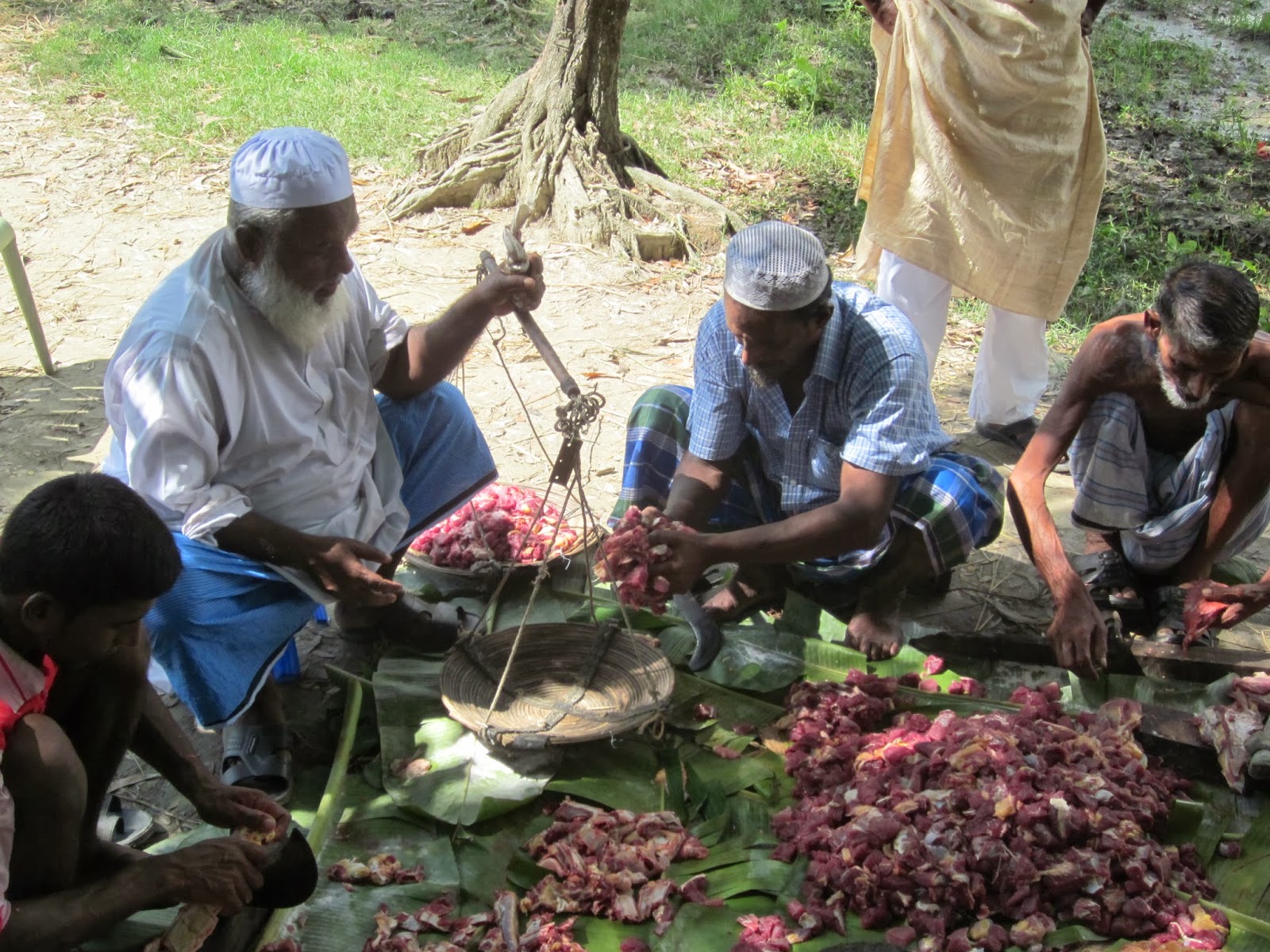
Khair Kaka (Uncle) holds the scales while our householders divide the beef . It's an Eid al-Adha tradition.


Amma - my Bengali adopted mother - with her youngest grandson, currently called Plabon. In Bangladesh there is a naming ceremony that takes place when the child eats its first rice - until then various names may be tried out!


Thursday, 24 October 2013

The Ibrahim Store

Government Dighee, Monpura.

“How will we stay in contact?” asked 29-year-old Salman Hossein Saju, who said he was a fish businessman – which sometimes means politics. He has 125 coconut palms and twice took me for refreshing green coconut water, for daber pani at his place.

Others preferred the “Will we ever see you again?” version. I’d known them for four days. I suggested we could stay in contact by phone but Saju needed a demonstration. He snatched somebody’s mobile from the tea shop table and gave it, before putting his phone to his ear to commence the skit by way of example of the real calls that would occur.

Think quickly! You’re in the company of islanders now.

“Hello,” he said into his phone.
“Hello,” I said into the one he’d given me.
“How are you?”
“I can’t hear you – network disturb.”
“Climb a tree,” he said. I did that.
“Can you hear me now?”

The crowd at the Ibrahim Store, a tea shop in Badher Bazaar on the small island of Monpura, Bhola District, in the Bay of Bengal, were delighted with the ad lib performance.

Keora forest in Hazirhat town.
There were a few trial runs – Feni, Kurigram, Jamalpur – I’ll tell you about those later; but in Monpura I really considered I’d begun a new journey, to the 64 corners of Bangladesh. Monpura was the first easy notes of this flute song.

It seemed as well to consider a Monpuran beginning. Any journey starts with small steps within sight of home. From Monpura one can see Hatiya, where lies the village that adopted me years ago. Monpura is the final stop before Hatiya on the Dhaka launch. I’ve passed by many times, taken tea at the ghat at dawn. I’ve always wanted to visit.

By motorcycle the island can be covered in two minutes, west to east. North to south it’s about 20 kilometres. Life is a struggle for most of the probably 120,000 islanders, farmers and fishermen – yet, as is small-island inevitable, everybody knows everybody and in Monpura goats are left roadside during the night. There’s no anticipation of thieves.

I’d arrived for Durga Puja, thinking it would add festivity to my setting out. There would be Ma Durga’s company in the first four days and it befits: ultimately all journeys start with mother.

Yet to be a truly Bangladeshi journey… well, starting out without completing tea doesn’t have much Bangladeshi sense to it – that’s what led to the Ibrahim Store.

The keora forests make Hazirhat unique.
After I sat, the crowd of ready-to-meet well-wishers gathered. They watched me jotting notes – taking to pen and paper because electricity only runs from 6 p.m. until after midnight. I heard one villager on his mobile telling the caller, who must’ve enquired of his whereabouts, “There’s a foreigner here. I’m watching him.” He said it so matter-of-factly, as obvious an activity as watching TV.

By tea shop account it’s rare to find a foreigner – apart from the Nigerian who’d arrived three months earlier for a football tournament, a bideshi might arrive every five years – and usually only stay for a day.

Observations were made I didn’t hold my pen properly – I never mastered that in childhood. Observations were made I had good health since I could drink several cups of tea without relieving myself. “When we drink two glasses of water,” said Saju, “we must leave at least one behind.”

There were many questions – do I speak Bangla? How old am I? What is my salary? Do I know Ricky Ponting?

Word spread of my Hatiyan history and it proved easy to relate to. After the 1970 cyclone – the most devastating to hit Monpura, the most devastating ever recorded worldwide – only those with the strength to cling to trees survived. There weren’t any cyclone shelters. “There were no women left,” said Mohammed Hasan, 34, sitting to my left. He’s a high school teacher: social science. “They brought new wives from Hatiya by boat.”

It’s another reason for Monpura to be a good start – the regions affected by the 1970 cyclone have a special relationship with the birth of Bangladesh. The failure of the Pakistani government to properly respond was an immediate factor that combined with longstanding issues to push the independence movement.  In a way, Bangladesh itself once took tea at the Ibrahim Store, on its journey. 


Keora tree roots in the mangrove forests of Hazirhat.

The Hatiyan wives in turn brought their language, which mingled with the Barisal-Bhola based Monpuran Bangla version. There was discussion – of the Hatiyan penchant for pronouncing ‘p’ as ‘h’ and light-hearted criticism of the unusual, Noakhali-style sentences that the wind blew into their heritage. Bujjenni? Do you follow?

Monpura was affected by the 1991 cyclone and Cyclone Sidr, but the sea didn’t rise like in 1970. Water is more dangerous than wind. In 1970 one woman was found floating at sea, unconscious, seven days later. She survived.

I asked how many Monpurans go to shelters these days. Hasan suggested about 40%. People don’t readily leave their homes in times of peril.

As we chatted there was a signal 3 in place for the Bay; but Cyclone Phailin chose to take the introduction of Odisha. In Monpura it brought a welcome breeze.

I discovered another commonality with Hatiya: most betel leaf and nut is ship-delivered from the gardens of Bhola. The man opposite helpfully suggested it wasn’t wise to drink tea soon after chewing betel since the limestone paste, the chun used on betel, when it mixes with the tea’s sugar, forms stones in the stomach.

I was curious about Monpura’s main town, Hazirhat, which might be the most attractive hardly-a-town I’ve seen in Bangladesh. Hazirhat features large tanks and, more uniquely, stands of keora mangrove forest in the middle of town. At night the forest stretches are pitch black; in the daytime buffaloes wallow – before and after is the settlement.

Badher Bazaar used to be a small islet, Hasan said. People used to cross by boat to Hazirhat. In 1978 then Barisal District Commissioner Nasir Uddin Khan commenced work to close the river. The result is really praiseworthy. It’s in the name – Badher Bazaar means Dam Market.

An old man contributed his story of giving Pakistani soldiers, in 1971, fruit mixed with unbearably hot spices; and there was a strange tale of a Bengali called Kissinger who went to Australia and took two litres of ‘milk’ from a bullock.

There was discussion of marriage: in Monpura almost all are married by age 16. “We are lucky if we live to be 50,” said one villager, forlornly, “so we have to start early.” “But the government says it’s better if we marry at 20,” said another.

Hasan said Monpura’s dogs are descended from a large variety introduced by the Portuguese in the sixteenth century – though the dogs looked no larger than usual. I have doubts Monpura can match the 3,000 years of distant Sandwip; more likely it is a younger landmass like the 150-year-old nearby Hatiya.

“The Portuguese found such abundance – fish, milk, rice – they were astonished,” Hasan said. From it came the name Monpura – because their mon or heart was touched.

Yet the mon in Monpura isn’t difficult to find. It’s everywhere, even in the Ibrahim Store. Philosophy, humour, history and wit – I’m contemplating a new theory – controversial – that the best adda or chatting in Bangladesh is on the islands.

But Durga Puja is not in the Ibrahim Store. Even a journey that starts with tea must inevitably progress to the first step…


Monpura, Bhola, Bangladesh.


This article published in Star Magazine, here: The Ibrahim Store