Showing posts with label change. Show all posts

Thursday, 8 January 2015

Work and Prayer


There are about 100 Oraon families in Borobila Village.


In the comfortable, spacious afternoon in the courtyard of Badol Minji’s house in Borobila village of Dinajpur’s Ghoraghat they’ve hastily arranged a table and chairs. Silver-haired Minji is a respected ex-local-member and renowned ex-president of the local indigenous association. Borobila is an Oraon village of one hundred families. Easily he takes his place near the table head. His daughter floats about showcasing the latest henna design to adorn her youthful hands.

Badol Minji with his daughter.
Minji’s presence carries natural dignity but it doesn’t radiate far. Nearby his wife Dulali Khalko is too animated to sit. She’s engaged in narrating the story of two brothers, her storytelling seeming to feed upon itself like a merrily boiling kettle. Her facial expressions tread the boards, spanning the spectrum of seriousness as she tries to recall each detail to ensure its safe delivery to its exact belonging-place in the sacred story. It’s mesmerising.

Beware: afternoons like the one at Badol Minji’s house carry risk. Bright and welcoming, they’re all too easy to get lost in.

According to the 1991 national census there were 11,296 Oraons scattered across Bangladesh’s northern districts. In Ghoraghat today there are up to 500.

Daram-Karam they call the story about the one brother who prayed while the other spent his days working. Life was good: the working brother’s toil produced more than enough food. With the other brother’s prayer the food was wholesome.

There are around 500 Oraons in Dinjapur's Ghoraghat.
But there came one day, Khalko narrates – the kettle sings – when the working brother noticed his brother performing puja around a branch of sacred kadam tree that he’d pushed into the ground. It must’ve been like any other day except that on that day it seemed the easier option. The working brother suddenly angered.

“I’m working the whole day in the field!” he complained, Khalko says, “You’re only doing puja!” With rage he took the kadam branch and threw it into the nearby river.


Dulali Khalko narrates the sacred story of two brothers.

While there is suggestion the Oraon are the Kurukh people whose origins lie along the Konkan Coast of Maharashtra and Goa – famed wanderers whose geographic distribution was enhanced with the railway expansion during the British era, such origins are far from certain. In Borobila they say the Oraon language has two main forms: Kurukh which is rarely spoken in Bangladesh, and Saddari, which is common. 

From the day he discarded the kadam branch the working brother faced difficulties, says Khalko. In his food he found insects and worms. He soon understood his error and left to search for the branch in the river, hoping to set things right.

Badol Minji’s house of mud brick is unusually two-storey and rather grand for the village. It’d be easy to see in it the traditional dormitory-style housing of the Oraons, which used to allow boys and girls daily contact, ideal for finding a life a partner. But the houses of the past were low in height. Later they became taller. The mud of Minji’s house may be traditional. The tin is new.

Badol Minji's house.
By custom guests at Oraon houses were served rice and date-palm-juice wine of the pachai or rarer mahua variety, in small bowl-like cups made from leaves. In Borobila the brew comes in glasses. There wasn’t any available at Badol Minji’s but the neighbours were obliging. It’s unquestionably delicious.

Gradually the house takes on a less traditional aspect. It starts to look like the modest manor of a small-scale forgotten vineyard in a remote French village. A crackly Edith Piaf record and a few bread sticks: that afternoon at Badol Minji’s surely would’ve engulfed us.

Dulali Khalko never noticed the change. Her facial expressions continued to stir into the afternoon even greater brightness. The kettle-boil narration has lost no steam.

The working brother walked far in search of the branch. Becoming thirsty he stopped on the riverbank to take a drink; but in his cupped hands he saw inside not water but insects.

He found a kul tree. He knew the fruit would be a little sour, but at least they had liquid to refresh him. “Maybe the water inside will help,” he thought, Khalko narrates. But inside the fruit he found only insects.

“And after many struggles,” says Khalko – finally the straw in the clay stove seems to be running low – “he found the branch. He started to perform puja and water became water, food became wholesome.”

Her face relaxes. The afternoon grows more potent.

In the courtyard of Badol Minji's house.
In the courtyard of Badol Minji’s house we learn that the Oraon religion long ago mixed with Hinduism. But Dal puja or Karam festival – at the time of Saraswati puja and very similar to the Hindu Bhadu festival – is the calendar’s highlight, when a kadam branch is planted in the ground, when they sing and dance to drums and sacrifice chickens. 

We learn too that about half the Bangladeshi Oraon already converted to Christianity. We hear concerns in Borobila about the promise of a Christian INGO to establish a school there – the lure of education is tempting; but in Borobila as yet there are no Christians.

Badol Minji is expressing regrets that the Oraon often face discrimination in dealing with broader Bangladeshi society. “If society met with us,” he says, “what’s the problem? We are often neglected but as far as I know Oraons are no less brilliant than others.”

And then he flips the coin. “Our problem is our people are shy. They do not like to meet with Muslims but it would promote harmony.”

Decoration inside an Oraon home.
Meanwhile the French afternoon, incongruous with the talk of problems, seems as if it might stretch on to Spain, and who could wish that it wouldn’t?

They’re talking about Christianity again: they could still wear bangles and the chandan after marriage wouldn’t be a problem, the Father says.

“One thing,” says Badol Minji, “We are still united. A thief in the village is really rare. It’s peaceful here.”

It’s true that it’s not easy to consider life’s challenges on an afternoon at Badol Minji’s house. There’s only us. There’s only now. No disquieting memories to faze us. No regrets: just a very Bangladeshi afternoon that might just reach to Spain if we let it.


With research from “Life and Land of Adibashis” by Abul Barkat, Mozammel Hoque, Sadeka Halim and Asmar Osman, Pathak Shamabesh, 2009.


At the time of puja in Borobila.


This article is published in Star Magazine, here: Work and Prayer


The Oraons of Borobila.


Thursday, 21 August 2014

Those Were the Days

Busy Moulvibazar has all the hallmarks of a Bangladeshi regional centre.
The shrine of Hazrat Shah Mustafa.


There’s no shortage of vibrancy to Moulvibazar town. The bazaar area is a kaleidoscope of dusty, coloured political banners and business signs. Electric wires entangle the streetscape and hundreds of notices once important to someone have papered over the best part of every electricity pole. It’s that usual dollop of localised chaos that signifies a district hub.

It’s not easy to imagine: this is the town named for a resident Islamic preacher, a maulavi descended from Hazrat Shah Mustafa, a companion of the famous sufi saint of Sylhet, Hazrat Shah Jalal. Hazrat Shah Mustafa’s shrine is in Moulvibazar.

Shoppers and passersby crowd footpaths and in the hotel restaurants there’s barely a vacant table. As has become the regional centre hallmark across Bangladesh there’s been that invasion of whirring electric buggies with their synthetic lollipop sirens. No, aside from the buggies, Moulvibazar’s commercial centre feels like a few square blocks of suburban Dhaka.

Hazrat Shah Mustafa's shrine, Moulvibazar.
Abdur Rouf Torufder, 75


Yet just a few rickshaw-minutes from the small-time traffic jams of the centre, still very much in town, Abdur Rouf Torofder, 75, has found a moment’s peace. He’s sitting in a rather happening cane rocking chair at his shop, Fouzia Cane House, waiting for customers and brushing off flies. Torofder remembers an altogether simpler Moulvibazar.

“There was the hospital, the high school where I studied and the police station,” he says, “Those were the three brick buildings. There was nothing... open land with dirt roads. There were horse carts and ox carts and we used to walk barefoot – only outsiders wore shoes. There were hardly any shops that sold them. A tin shed building in Moulvibazar was luxurious when I was young.”

From a time when perhaps only two hundred people lived in the town, Torofder remembers the twice weekly market days, the only relatively busy days. “Hawkers sold peanuts and mori puffed rice snacks – much tastier than you can find now. Half a kilogram of peanuts cost fifty paisa. We could enjoy bakery biscuits but there was no ice cream.”

“The town has become very big since,” he says.

The high school was one of three brick buildings in the town, decades ago.


On her way home to her daughter’s house in one of the side streets at the start of the Sreemangal Road, Fatema Begum, 70, likewise remembers the food. Born in Sylhet, she arrived in Moulvibazar some forty-five years ago to stay with her daughter who currently works as a maid. There, she discovered wonderfully fresh milk and curd. “People used to eat really well,” she says, “Now everything is expensive.”

The paradox is that like the other districts of Sylhet Division, Moulvibazar has benefited from large scale migration over many decades, principally to the United Kingdom – the Londoni phenomenon. Foreign remittances brought greater prosperity to many. “There was lots of open land, ponds...” Begum says, “Rich people were few – but now they are available. Now, too many people are fraudulent. They used to be very kind.” And kindness is an attribute she demonstrates by stopping to chat – we are lucky. “I’ve had two strokes, you know,” she says.

Before she continues her walk home she pauses – she’s had another thought. “In 1971 I saw the Pakistani army catching brothers and sisters. I saw everything.”

Vegetable seller Faruk Miah, 60.

Meanwhile at the market in front of the court house, father of three Faruk Miah, 60, originally from Chamorkuna village, is selling vegetables – he started as a retailer when he was thirteen. “My father died when I was seven,” he says, “I was alone. I stayed on government khas land and eventually started business. At first I sold betel nut – and for the last thirty-five years, vegetables.”

The Moulvibazar court house complex.
He remembers a damp Moulvibazar of open fields. “Taro plants grew wild in the town. At that time vegetables were seasonal – now they run year-round. Moulvibazar used to supply rice to other districts but now we import. All the vegetables were local too.”

Faruk still trades in local vegetables but remarks that the town has since been “attacked” by wholesalers and it’s become harder for the local sellers. “It used to be good – and the court market is still better than other places,” he says, “But now I have no peace.”

“Before people didn’t have anything,” Faruk recalls, “They used to sell their house land for hand-to-mouth crisis. In 1980, 30 decimals of land cost about 200 taka. Now one decimal is five to seven lakhs taka. Yet in those days people didn’t bargain.”

The courthouse hill, Moulvibazar town.
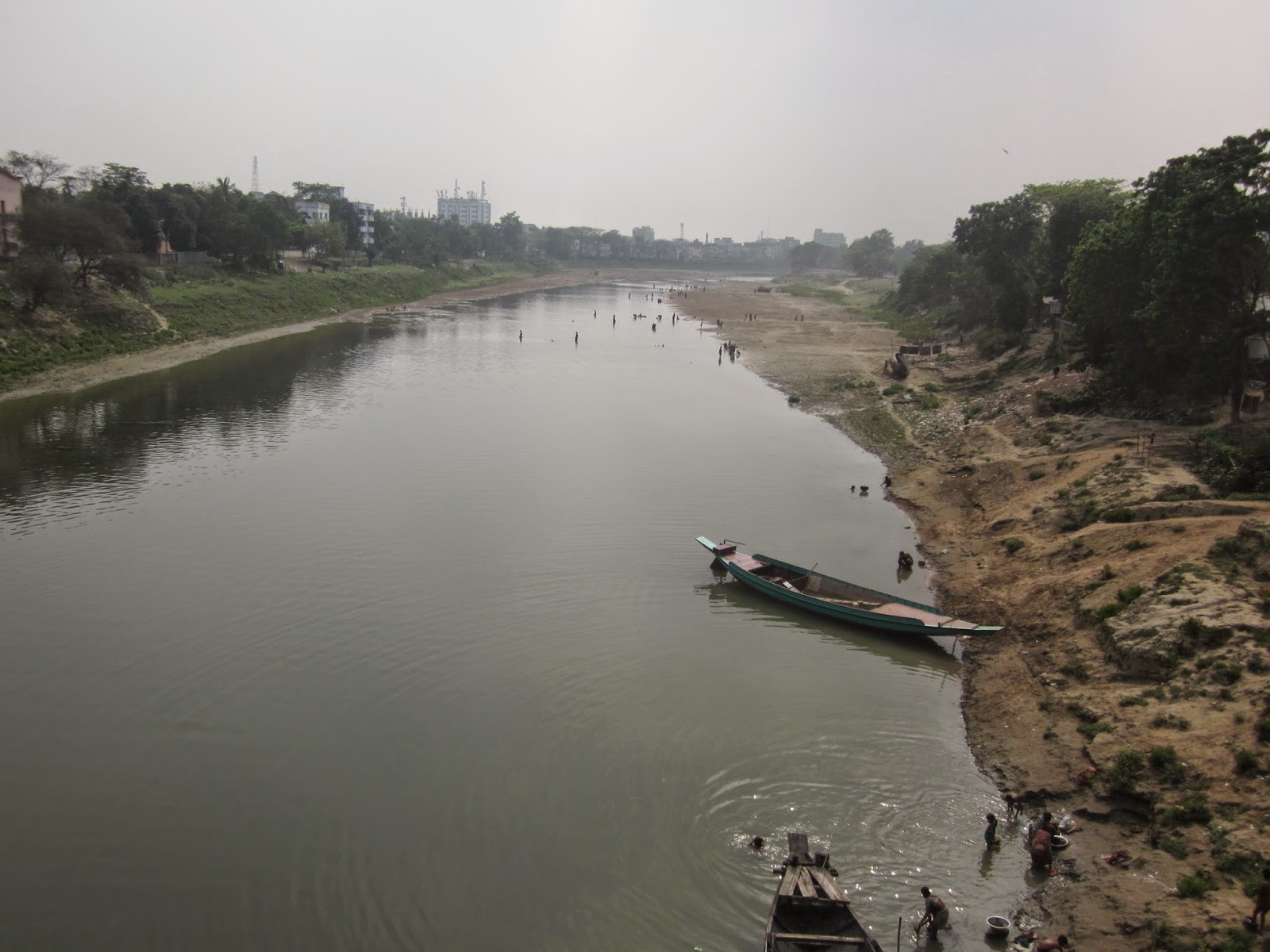
He remembers the floods before the barrage was constructed on the Manu River. In 1984 the whole town was under water except the small hill where the court is situated.

“I was a member of a theatre group,” he says, “and we used to sing songs all night – then in the morning we’d cultivate land, with everyone joining in.” It’s hardly surprising he has no time for modern entertainment. “Now it’s all cinema-ninema,” he says, “It’s all circus... not like before.”

“You know, the country was poor then,” he comments, “Many went to your country to make money.” He’d surely be right if I was born in the United Kingdom.

The Manu River, Moulvibazar town.
Md Salam Box with his son Noyon


Beside the Manu River weir is a tea shack called the Brother-Sister Variety Store. It’s the business of Md Salam Box, 51, from Matakarpon village. He’s somebody who believes in hard work. “In our family there are seven,” he says, “and I am the chairman. If I tell my family, ‘Today you will eat rice’ and they don’t eat it, who is at fault?”

From his sense of responsibility he wanted his children to study. But a few years ago circumstances changed. “My intestine busted,” he says, “It had a six by two inch hole in it, and after I became sick I couldn’t work like before. I opened this tea shop.” His thirteen-year-old son Noyon was unable to continue studying and took a job as a brickfield labourer.

“My son works very hard,” he says, “but these days so many young men like to stay in their houses and eat. Nor do they wish to study. These days the kids want a Honda to go to college, but if you give them an English newspaper they can’t read it.”

“Thirty years ago, I was very afraid of my father. It’s not like that now. There was no zom-zom then,” says Box, referring to noise and bustle.

He also fondly remembers yesteryear’s food. “There were many pineapple gardens. We had coconuts, palm syrup, mangoes, jam, jackfruit... There was room to grow vegetables everywhere – now it’s all buildings. The river was full of fish.”

Now Moulvibazar is all buildings. It's all zom-zom bustle.


“I miss bhubis and nashpati pears,” he says, referring to local fruits, the former called langsat or lanzones in English. “I miss latiall and kasalath rice.” These are traditional Sylhet-region rice species. Latiall is recalled as small grained with a nice aroma, while kasalath is an aus variety.

Yet he also considers that more development could have been achieved. “In other countries, how happy they are!” says Box. “Everything is already digital there.”

As we speak, Box’s dust-covered son Noyon appears, on a break from the nearby brickfield. He asks for a cold drink and before he leaves – he’s been taught responsibility – pays.

Meanwhile, back at Fousia Cane House, Torofder also attests to changed values. “People used to keep promises,” he says, “People didn’t lie. Even a murderer would say sorry back then.”


It was when he was twenty that Torofder finally got his first shoes, a parental gift that cost one taka – the same price as a large hilsa fish. “They were tyre-belt, wooden chappals,” he remembers, “I really liked them. At first it was strange to wear shoes but I got used to it. It was luxury and I felt like a king!” 


The Manu riverbank.
The Manu river from the weir.

The Manu River weir, Moulvibazar.

The weir sluice gates.

Behind the weir.


This article is published in Star Magazine, here: Those Were the Days


The Manu River.